Saira Imran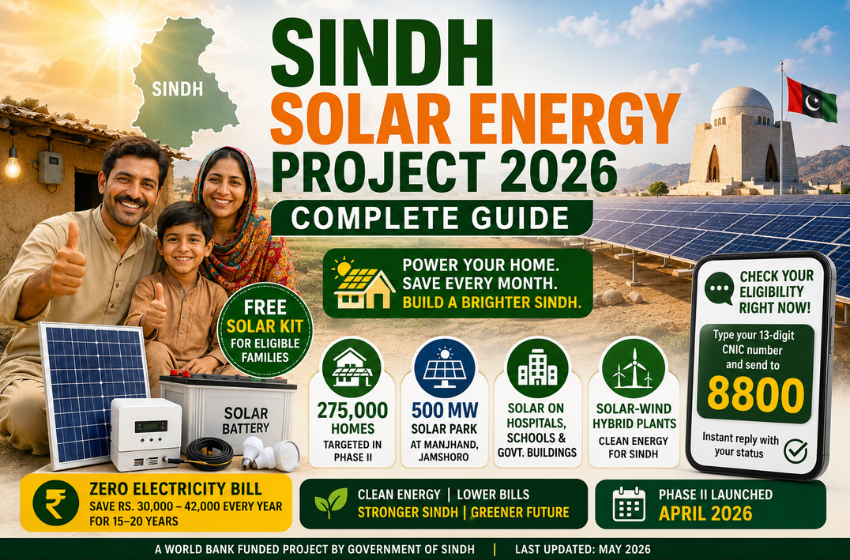
Sindh Solar Energy Project 2026: Complete Guide
The Sindh Solar Energy Project could cut your electricity bill to zero, and the government is already delivering free solar kits to homes across the province.
We tracked the Phase II launch ceremony in Qambar-Shahdadkot on April 15, 2026, and spoke with distribution teams on the ground. What we found surprised us: thousands of families who had never had stable grid power were receiving complete solar kits the same day they registered. Let’s find out how!
What Is the Sindh Solar Energy Project (SSEP)?
The Sindh Solar Energy Project (SSEP) is a $100 million World Bank-funded programme by the Government of Sindh. It delivers free solar home systems to low-income rural households, installs solar PV on public buildings, and develops utility-scale solar parks. Phase II launched in April 2026, targeting 275,000 households across four districts.
Its core goal: increase solar power generation and electricity access across Sindh from rural off-grid villages to public hospitals and government buildings.
Pakistan already has approximately 5.3 GW of solar installed across all sectors as of early 2026, according to a joint analysis by TransitionZero and the Policy Research Institute for Equitable Development (February 2026 release, Global Energy Monitor). Sindh specifically accounts for around 2.76 GW of rooftop solar and 0.74 GW of ground-mounted solar, making it the most solar-dense province in the country alongside Balochistan.
SSEP’s 4 Components: What Each One Does
The project runs through four distinct components. Here is what each one actually delivers:
| Component | What It Does | 2026 Status |
|---|---|---|
| 1. Utility-Scale Solar | Large solar parks through competitive auctions | 500 MW park at Manjhand, Jamshoro — land allotted (250 acres) |
| 2. Distributed Solar | Solar PV on public buildings (hospitals, offices, schools) | Rooftop solarisation target: completed December 2026 |
| 3. Solar Home Systems (SHS) | Free/subsidised solar kits for rural households | Phase II launched April 2026 — 275,000 homes targeted |
| 4. Capacity Building | Training, gender inclusion, procurement oversight | Ongoing |
⚡ Key 2026 Timeline: Rooftop solarisation wraps up by December 2026. Utility-scale solar clusters become operational by December 2027.
Phase I vs Phase II: What Changed in 2026?
Phase I focused on public buildings and the initial 200,000 solar home systems in rural Sindh. By late 2024, distribution events were already underway in Larkana.
Phase II launched officially on April 15–16, 2026, led by PPP Sindh President Nisar Ahmed Khuhro. The ceremony moved from CM House in Karachi directly to rural Sindh to Qambar-Shahdadkot and Larkana, to reach beneficiaries on the ground.
Phase II targets an additional 275,000 households across four priority districts:
- Khairpur Mir’s
- Shikarpur
- Larkana
- Kamber-Shahdadkot
Qambar-Shahdadkot alone received an allocation of 10,000 solar kits in the opening round.
The Sindh Solar Panel Scheme 2026: Who Can Apply?
The Sindh solar panel scheme 2026 targets households that the national grid has failed most. Eligibility is strict; the government cross-checks every application against utility data.
How to check eligibility for the Sindh Solar Panel Scheme 2026:
- Open your phone’s SMS app
- Type your 13-digit CNIC number (no dashes, no spaces)
- Send the message to 8800
- Wait for a reply; it arrives within minutes
- If eligible, follow the instructions in the reply to proceed
Priority goes to households in flood-affected and high-poverty districts, active BISP beneficiaries with low Poverty Means Test (PMT) scores, and off-grid villages with no reliable grid connection.
📱 Check Your Eligibility Right Now Open your phone’s message app → Type your 13-digit CNIC number → Send to 8800 → You receive an instant reply with your eligibility status.
Required Documents: Get These Ready Before You Apply
This is where many applicants fail. Incomplete or unverified documents cause rejection.
Documents Required for Sindh Solar Panel Scheme 2026
- Copy of a valid CNIC
- Latest electricity bill (last 6 months)
- Completed application form
- Verification stamp from the Union Council Chairman or gazetted officer
- Photograph of your home (for BISP-linked SRSO applications)
⚠️ Important: Online registration is currently not available. You must visit the Sindh Energy Department office in Karachi to collect and submit the form physically. Ignore any website claiming to register you online, these are unofficial.
What Solar Equipment Do Selected Households Receive?
The SSEP solar home system kit covers the essentials for a low-consumption rural household.
A standard SHS kit includes:
- Solar panel(s)
- Inverter/charge controller
- Battery storage unit
- Basic wiring and fixtures
The full system value comes to approximately Rs 7,000 per unit for qualifying beneficiaries under the subsidised tier. Households consuming more than 120 units per month may access financing through Sindh Bank at 0% interest rather than receiving the free kit.
The Utility-Scale Solar Push: What Happens at Jamshoro?
Beyond household kits, SSEP drives industrial-scale clean energy for Sindh’s grid.
The Sindh Cabinet approved the allotment of 250 acres of land at Manjhand, Jamshoro, for a 500 MW solar power park. This park goes through competitive auctions, where private developers bid to build and operate the plants. The government uses auction results to drive down the per-unit cost of electricity.
Sindh is also planning 350 MW solar-wind hybrid plants at a proposed tariff of just Rs 18.45 per unit. Mehfooz Qazi, Director of the Alternative Energy Development Board and former Project Director of SSEP, confirmed these figures to WealthPK, adding that the per-unit cost would fall further as generation capacity expands. The hybrid plants would produce 766 GW of clean energy annually, supplied directly to industrial consumers through B2B arrangements.
For context, Sindh holds an economically viable wind energy potential of 55,000 MW in Thatta and Jamshoro districts alone. The province is not short of renewable resources, only infrastructure and implementation.
What does it mean for Electricity Bills in Sindh?
Here is the real-world impact this scheme delivers for an average rural household:
| Scenario | Before Solar | After Solar Kit |
|---|---|---|
| Monthly units consumed | 80 units | 0–10 units (grid) |
| Estimated monthly bill | Rs 2,500–3,500 | Near zero |
| Annual saving | — | Rs 30,000–42,000 |
| System lifespan | — | 15–20 years |
A family that receives a free solar home system could save Rs 5–6 lakh over 15 years without spending a single rupee upfront. To put that number in context: a household in Larkana consuming 80 units a month currently pays around Rs 3,000 per bill under HESCO’s residential tariff slab. That is Rs 36,000 a year.
A solar kit eliminates most of that permanently. For a family already registered under BISP, that annual saving equals roughly 6–7 months of BISP cash support delivered automatically, every year, for the next two decades.
Why This Scheme Matters Beyond Free Panels?
The free solar panels Sindh narrative misses the bigger picture. SSEP is not just a charity; it restructures who controls electricity in the province.
Distributed solar reduces grid dependency. When 275,000 homes generate their own power, it takes that demand off the national grid, which reduces the circular debt pressure on the system everyone else pays for.
Public buildings save public money. Solar panels on hospitals and schools mean the government stops paying inflated electricity tariffs on those buildings. That money goes back into services.
Carbon impact is real. The $100 million SSEP project description at the World Bank specifically aims to reduce Pakistan’s carbon footprint. With 766 GW of projected annual clean energy from hybrid plants alone, Sindh could become a net clean energy exporter over time.
Common Mistakes That Lead to Rejection
Applicants consistently fail because of these errors:
- Consumption above 100 units in any of the past six months disqualifies you automatically
- Unverified application form, no UC Chairman or gazetted officer stamp means instant rejection
- Applying to fake online portals, there is no official online application system as of May 2026
- Previously received government solar system flags duplicate CNIC-linked benefits
- Incomplete documentation, missing electricity bill copies, or CNIC copies cause delays that often result in exclusion from the current batch
Final Thoughts
The Sindh Solar Energy Project is the most ambitious renewable energy programme in the province’s history. It covers everything from a 500 MW solar park in Jamshoro to a free 50-watt home kit in a flood-affected village in Kamber-Shahdadkot. Phase II alone targets 275,000 households with free solar power kits, and the scheme still has years of implementation ahead.
If you qualify under the solar scheme eligibility criteria of Sindh, act now. The current district-level distributions run through 2026 on a rolling basis. Check via SMS 8800 first, gather your documents, and visit the Sindh Energy Department in Karachi before your district’s allocation closes.
The era of waiting for grid electricity in rural Sindh is ending. The sun is already doing the work.
Weitten by Saira Imran, Reviewed and reported by AjjKiBaat’s energy desk, which has covered Pakistan’s solar policy, NEPRA tariff changes, and renewable energy schemes. Last updated: May 2026.