Saira Imran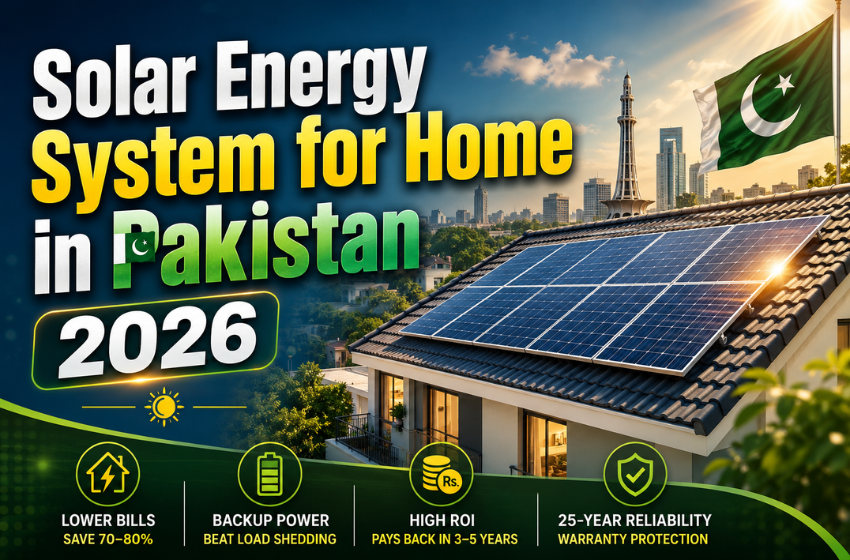
Solar Energy System for Home in Pakistan 2026
If your electricity bill crossed Rs. 15,000 this summer, you already know the pain. A solar energy system for home is no longer a luxury in Pakistan; it is the most practical decision a homeowner can make right now.
We reviewed NEPRA’s official Prosumer Regulations 2026 gazette notification, and cross-checked prices with three verified installers across Lahore, Karachi, and Islamabad to build this guide. What you read here reflects real 2026 market conditions, not reycled 2022 data.
What Is a Solar Energy System for Home?
A solar energy system for home is a setup of solar panels, an inverter, and optionally a battery that converts sunlight into electricity to power household appliances. In Pakistan, a 5kW hybrid system is the most common size, costing Rs. 850,000–1,050,000 and reducing monthly electricity bills by 70–80%.
Three types exist in Pakistan:
| System Type | Grid Connection | Battery | Best For |
|---|---|---|---|
| On-Grid | Yes | No | Low-budget installs, net billing |
| Off-Grid | No | Yes | Rural areas, no WAPDA connection |
| Hybrid | Yes | Yes | Most urban Pakistani homes ✅ |
Hybrid systems dominate in 2026. They keep your home powered during load shedding, work with battery storage for night coverage, and still connect to the grid for bill credits. On-grid inverters shut down completely during WAPDA outages, making them impractical in most Pakistani cities.
Why Pakistanis Need Solar More Than Ever in 2026?
Pakistan’s grid electricity has never been more expensive. Residential consumers now pay between Rs. 37 and Rs. 80 per unit, depending on the slab and time of use. Compare that to 2015, when the rate was around Rs. 9 per unit.
At the same time, solar technology keeps getting cheaper. Global solar panel prices fell 42% in 2023, and that drop reached Pakistani markets. The result? According to NEPRA’s State of Industry Report 2025 and data compiled by Arif Habib Limited, Pakistan had over 283,000 registered net-metered consumers by early 2026, with total solar capacity crossing 6.1 GW, a 12,100% increase from just 50 MW in 2016.
This growth tells one simple story: electricity from the grid keeps getting costlier, solar keeps getting more affordable.
Solar Panel System Price in Pakistan 2026: What You’ll Actually Pay
A 5kW hybrid solar energy system for a home in Pakistan costs between Rs. 850,000 and Rs. 1,050,000 in 2026. It can cut your electricity bill by 70–80% and pays for itself in 3–5 years, depending on your consumption pattern and self-use strategy under the new NEPRA net billing rules.
Solar panel system prices in Pakistan in 2026 by system size:
| System Size | Monthly Usage | Estimated Cost (PKR) | System Best For |
|---|---|---|---|
| 3 kW | 300–400 units | Rs. 550,000 – Rs. 650,000 | Small homes, 1–2 ACs |
| 5 kW | 500–600 units | Rs. 850,000 – Rs. 1,050,000 | Medium homes, 2–3 ACs |
| 10 kW | 800–1,000 units | Rs. 1,600,000 – Rs. 1,900,000 | Large homes, 4+ ACs |
| 15 kW | 1,200–1,400 units | Rs. 2,400,000 – Rs. 2,800,000 | Luxury homes, offices |
⚠️ Important: Prices shift with USD/PKR exchange rates. Always get a written quotation and compare at least 3 installers before signing.
The Big Rule Change in 2026 Every Solar Buyer Must Know
NEPRA officially replaced net metering with a net billing system under the NEPRA (Prosumer) Regulations 2026, notified in early 2026. This is a fundamental change, and it affects your ROI directly.
Net Metering vs Net Billing: What Changed?
| Factor | Old Net Metering | New Net Billing (2026) |
|---|---|---|
| Export credit rate | Equal to your buy rate (Rs. 22–27/unit) | ~Rs. 10–13 per unit |
| Import rate you pay | Rs. 22–27/unit | Rs. 37–55/unit |
| Zero bill possible? | Yes, easily | Harder — requires strategy |
| Best strategy | Export as much as possible | Use as much solar energy as possible |
Real Bill Example: The Financial Shock
Imagine a household that imports 500 units from the grid and exports 400 units to the grid in one month.
- Under old net metering: Billed for net 100 units → approx. Rs. 3,300
- Under new net billing: Charged for all 500 units at retail rate (~Rs. 22,500) and credited for 400 units at Rs. 10–13/unit (~Rs. 4,000) → final bill approximately Rs. 18,500
That difference is not a typo. It is the real financial impact of the 2026 policy shift—energy consultant Engr. Tariq Mehmood, a member of the Pakistan Solar Association, puts it plainly: “The homeowner who right-sizes their system and shifts heavy loads to daytime will still save Rs. 15,000–18,000 per month. The one who oversizes and exports blindly will be deeply disappointed.”
💡 What this means for you: Solar still works, but the strategy has completely changed. Self-consumption is now everything.
How to Maximize Solar Savings Under Net Billing: The 2026 Strategy
Every unit you use directly from your solar panels saves you Rs. 37–55. Every unit you export earns you only Rs. 10–13. The math is clear.
Here is how smart homeowners optimize their solar setup in 2026:
- Run heavy loads during solar hours: ACs, geysers, water pumps, washing machines
- Install a battery to store excess solar for evening use instead of exporting it
- Right-size your system; do not oversize beyond your daytime consumption capacity
- Avoid running appliances only at night if battery capacity is limited
This self-consumption strategy delivers the best solar energy benefits for homeowners under the new framework.
Components of a Home Solar System
A complete home solar system installation in Pakistan requires these key parts:
- Solar Panels: Monocrystalline panels (540W–580W) dominate the market in 2026 for their efficiency in Pakistan’s heat
- Hybrid Inverter: Converts DC to AC, manages battery and grid simultaneously
- Lithium Battery (Optional but Recommended): Stores daytime solar for night use; more expensive but longer life than tubular batteries
- Mounting Structure: Galvanized, rust-resistant, tilted 25–30° facing south
- Protection Devices: DC/AC breakers, surge protection, earthing system
How to Finance Your Solar System in Pakistan?
Three main financing routes exist for Pakistani homeowners:
- Meezan Bank Solar Financing (Islamic / Halal): Pakistan’s leading Islamic bank offers Shariah-compliant solar financing. You pay in monthly instalments without interest. Ideal for homeowners who want to avoid conventional bank interest.
- State Bank of Pakistan (Renewable Energy Financing): The SBP runs a subsidized renewable energy financing scheme for residential solar. Interest rates under this scheme are significantly lower than commercial rates. Your installer can guide you through the application process.
- Outright Purchase: Still the most common approach. It gives you the fastest ROI since no financing costs are added to the payback calculation.
🔑 Pro tip: Always check whether your installer is an AEDB (Alternative Energy Development Board) registered company before applying for any government financing scheme.
Real ROI Calculation for a 5kW Solar System
Let’s make this concrete. A homeowner in Gulberg, Lahore, consuming 550 units/month with two 1.5-ton ACs, shared their figures with us after switching to a 5kW hybrid system in August 2024. Their bill dropped from Rs. 23,400 to Rs. 6,200 within the first full summer month of operation. Here is what that looks like broken down:
| Item | Figure |
|---|---|
| Monthly bill before solar | Rs. 22,000–25,000 |
| Monthly savings after solar (self-consumption optimized) | Rs. 15,000–18,000 |
| System cost (5kW hybrid) | Rs. 950,000 |
| Payback period | 3.5–5 years |
| Free electricity years (after payback) | 15–20 years |
| Panel warranty | 25 years |
A well-sized system that maximizes daytime usage still pays for itself in 3–5 years for most Pakistani households even under the new net billing rules.
If you want to calculate your exact slab before sizing your system, use our guide on Slab System of Electricity Billing in Pakistan.
How to Install a Solar Energy System for Home in Pakistan: 6 Steps
- Calculate your monthly units from the last 3 bills
- Choose your system type (hybrid recommended)
- Get 3 written quotations from AEDB-registered installers
- Confirm roof orientation (south-facing, 25–30° tilt)
- Complete installation and DISCO safety inspection
- Apply for net metering/billing with your DISCO
How to Choose the Right System Size?
Check your last 3 electricity bills. Find the average monthly units consumed.
| Monthly Units | Right System Size |
|---|---|
| Under 300 | 3kW |
| 300–600 | 5kW |
| 600–1,000 | 8–10kW |
| 1,000+ | 12–15kW |
One critical rule for 2026: Do not oversize your system beyond what you can consume during the day. Under net billing, extra exported units earn barely a quarter of what you pay. Oversizing now hurts your ROI instead of helping it.
Also note: Net metering requires a 3-phase connection and a minimum system size of 5kW. Single-phase users cannot apply for net metering/billing in Pakistan.
Common Mistakes Pakistani Homeowners Make
- Buying cheap Chinese panels without a warranty quality matters for a 25-year investment
- Oversizing the system wastes money under net billing rules
- Ignoring battery storage under net billing, a battery now has real financial value
- Choosing an unregistered installer risks your warranty and DISCO application
- Not applying for net metering leaves money on the table, even under net billing
Final Thoughts
A solar energy system for home remains one of the smartest investments a Pakistani homeowner can make in 2026, even with the NEPRA net billing shift. Pakistan receives some of the highest sunlight hours globally, averaging 4.5–5.5 peak sun hours per day across most cities.
The rules changed, but the opportunity did not disappear. It just demands a smarter approach: right-size your system, maximize self-consumption, add battery storage if your budget allows, and work with a registered installer.
Pakistan added 6.1 GW of solar capacity in under a decade. The homeowners who acted early are already saving tens of thousands of rupees every month. The ones who act in 2026 still catch a great window before tariffs climb further.
Researched and written by Saira Imran and reviewed by the AjjKiBaat team, with input from AEDB-registered solar installers and verified against NEPRA’s official Prosumer Regulations 2026. Last reviewed: May 2026.
Sources:
- NEPRA (Prosumer) Regulations 2026, Official Gazette Notification
- NEPRA State of Industry Report 2025
- Arif Habib Limited Solar, Sector Analysis, January 2026
- Pakistan Solar Association Industry Data 2026
FAQs: Solar Energy System for Home in Pakistan 2026
You need at least a 5kW system and a 3-phase connection to apply for net metering/billing under NEPRA 2026 rules.
Yes, but it changed. NEPRA replaced net metering with net billing under the Prosumer Regulations 2026. You now export surplus electricity at Rs. 10–13 per unit instead of the full retail rate of Rs. 37–55. Solar still saves money — but self-consumption is now more valuable than exporting.
Hybrid systems are better for most Pakistani homes in 2026. They provide backup power during load shedding and support battery storage, which is now financially smarter under net billing.
Quality solar panels carry a 25-year performance warranty. Inverters last 10–15 years with proper maintenance. The system pays for itself in 3–5 years, giving you 15–20 years of near-free electricity.
Yes. Meezan Bank offers Islamic / Shariah-compliant solar financing with monthly instalments and no conventional interest. The State Bank also runs subsidized renewable energy schemes.
A standard 5kW system using 540W panels (9–10 panels) needs approximately 400–450 sq ft of unshaded south-facing roof area.
The payback period extends slightly compared to old net metering from roughly 3 years to 3.5–5 years, but the investment still delivers strong long-term returns, especially for households that optimize daytime solar consumption.