Saira Imran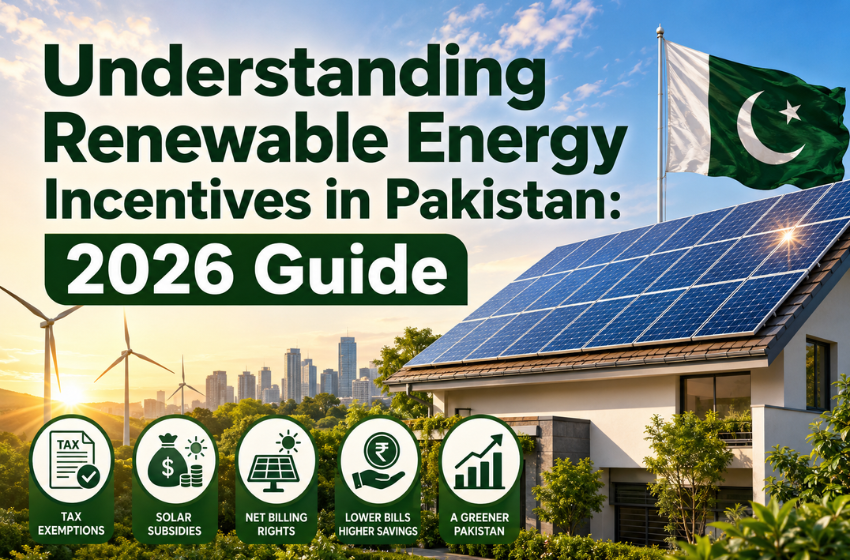
Understanding Renewable Energy Incentives in Pakistan: 2026 Guide
Renewable energy incentives in Pakistan include tax exemptions, import duty waivers, solar subsidies, and net billing rights. If you are a homeowner, business, or farmer, these benefits can save you lakhs of rupees every year.
Pakistan’s electricity crisis is real. Bills are rising, load shedding continues, but there is a way out, and the government is actively paying you to take it.
This guide covers every major incentive available in 2026, what changed, what still applies, and exactly how to benefit. To build this resource, the AjjKiBaat team and I reviewed NEPRA’s official Prosumer Regulations 2026 gazette notification, FBR’s SRO exemption schedules, AEDB’s certified installer criteria, and the Pakistan Economic Survey 2024–25.
We also tracked over three months of public consultation responses submitted during the NEPRA net billing controversy to understand exactly how policy changes affect ordinary solar users in Punjab and Sindh.
What Are Renewable Energy Incentives in Pakistan?
Renewable energy incentives in Pakistan are government policies that reduce the financial cost of switching to clean energy sources like solar, wind, and biogas. They include import duty exemptions on solar equipment, income tax relief for power projects, direct subsidies for households, and net billing rights that allow solar users to sell surplus electricity back to the grid.
Pakistan has aggressively expanded these incentives because the numbers demand it. By the end of fiscal year 2025, renewables contributed 53.7% of total electricity generation. Solar alone made up 25% of the energy mix, according to the Pakistan Economic Survey 2024–2025.
The government needs this momentum to continue. That is why the incentives exist and why understanding them matters now more than ever.
Why Pakistan Is Pushing Renewable Energy in 2026?
Pakistan has historically spent billions of dollars annually on imported fossil fuels, a dependence that directly drives inflation and the circular debt crisis.
According to the Pakistan Economic Survey 2024–25, twelve gigawatts of off-grid solar capacity and over six gigawatts of net-metered solar systems were installed by the end of 2025. That same survey confirms renewables now contribute 53.7% of total electricity generation, a structural shift that happened almost entirely because of the incentive policies this guide explains.
Pakistan has also committed, under its Nationally Determined Contributions (NDCs), to sourcing 60% of its electricity from renewables by 2030. Every incentive listed below is engineered to get there.
Pakistan Renewable Energy Fast Facts (2026): Renewables now generate 53.7% of Pakistan’s total electricity. Solar contributes 25% of the energy mix. Total net-metered solar capacity reached 6,100+ MW by mid-2025, up from just 321 MW in 2021. Pakistan aims to hit 60% renewable energy by 2030 under its Nationally Determined Contributions (NDCs). (Source: Pakistan Economic Survey 2024–25, NEPRA Annual Report)
Key Government Bodies You Need to Know:
- PPIB: Private Power and Infrastructure Board. Handles large-scale private renewable energy projects.
- AEDB: Alternative Energy Development Board. Oversees renewable energy policy and certifies installers.
- NEPRA: National Electric Power Regulatory Authority. Regulates solar grid connections, net metering, and prosumer rules.
Tax Incentives for Renewable Energy in Pakistan
Here are the tax incentives for renewable energy in Pakistan 2026:
Import Duty Exemptions on Solar Panels and Equipment
This is one of the most valuable incentives for both homeowners and businesses.
The federal government has exempted duties on the import of key components used to manufacture solar panels, inverters, and batteries. The goal is to make solar technology more affordable and widely available.
In practical terms, this means the equipment you buy, panels, inverters, batteries, is cheaper because no customs duty has been added at the border.
Income Tax Exemption for Power Projects
Private sector power projects are exempt from income tax. Dividends paid to shareholders in these projects are taxed at a reduced rate of 7.5%, and at 10% thereafter.
If you are an investor or business setting up a renewable energy project, this is a significant financial advantage over standard commercial investments.
Sales Tax Relief on Renewable Energy Products
Sales tax exemptions apply to certain renewable energy products, and there are specific incentives for businesses investing in solar installations.
There is also a concessionary rate of customs duty and exemption from sales tax on machinery, equipment, chemicals, consumables, and specialized vehicles used in renewable energy projects, under FBR SRO 678(I)2004.
Important: These exemptions are time-bound and sector-specific. Always verify with FBR or a tax advisor before assuming they apply to your situation.
Government Subsidies and Grants for Renewable Energy Projects
Here is the list of projects where the government grants subsidies for renewable energy projects:
CM Punjab Free Solar Panel Scheme 2026
The Punjab Government’s free solar panel scheme targets low-income households consuming 0–200 units of electricity per month. Eligible families receive solar systems at zero upfront cost under CM Maryam Nawaz’s energy relief program.
To apply, visit the official Punjab Energy portal or your nearest DISCO office with your CNIC, recent electricity bill, and proof of residence.
Federal Solar Subsidy: How to Apply
The Alternative Energy Development Board and provincial energy departments manage solar subsidies in Pakistan. To qualify, an approved and certified provider must install your system, meet NEPRA’s technical standards, and include proper documentation, proof of property ownership, CNIC, and electricity bills. The system size must also fall within the eligible capacity limits defined by the subsidy program.
Eligibility requirements change regularly. Always check the AEDB official website before applying.
AEDB Certified Installer: Why It Matters
Only systems installed by AEDB-certified (now PPIB-certified) installers qualify for subsidies and net billing. Do not hire an uncertified installer to save money upfront; it will disqualify you from government benefits worth far more than the installation savings.
Net Metering vs Net Billing: What Changed in 2026
Most Pakistanis are searching for this right now. The rules changed dramatically in February 2026.
Old Net Metering Rules (Before February 9, 2026)
| Feature | Net Metering (Pre-Feb 2026) | Net Billing (Post-Feb 2026) |
|---|---|---|
| Buyback Rate | Rs. ~27/unit (NAPP rate) | Rs. 8.13/unit (NAEPP rate) |
| Unit Offset | 1-for-1 unit exchange | No unit exchange — cash credit only |
| Contract Duration | 7 years | 5 years |
| Who It Applies To | Existing consumers (until expiry) | All new applicants |
| Licensing Fee | None | Rs. 1,000/kW (above 25kW only) |
| Best Strategy | Export surplus freely | Right-size for self-consumption |
Under the old system, every unit of electricity you exported to the grid offset one unit you consumed. The buyback rate was approximately Rs. 27 per unit. Contracts lasted 7 years. This made solar extremely profitable; you could essentially zero out your electricity bill.
Net metering consumers grew from a few thousand to over 280,000 by December 2024, with total capacity expanding from 321 MW in 2021 to over 6,100 MW by mid-2025.
New NEPRA Prosumer Regulations 2026: Key Changes
On February 9, 2026, NEPRA rolled out new Prosumer Regulations, replacing the decade-old net metering framework. Under the new rules, utilities purchase excess electricity from solar users at the national average energy purchase price, while selling electricity back at the full consumer tariff, effectively ending one-to-one net metering.
Under the new terms, solar owners sell electricity at Rs. 8.13 per unit but purchase it at rates as high as Rs. 60 per unit. Contract terms also shrank from 7 years to 5 years.
The Policy Research Institute of Market Economy (PRIME), an independent Islamabad-based think tank, described the shift bluntly in its February 2026 analysis: the net billing regime transfers the burden of power sector inefficiencies, transmission losses, demand-supply mismatches, and governance failure directly onto compliant solar consumers who did nothing wrong. Their assessment aligns with what solar installers across Lahore and Karachi told us directly: that new residential clients are now being advised to right-size systems for self-consumption, not export, because the export economics no longer make sense.
However, following intense public backlash, NEPRA withdrew the licensing fee requirement for solar systems below 25 kilowatts, effective February 9, 2026. Larger systems still pay a one-time fee of Rs. 1,000 per kilowatt.
What This Means for New vs Existing Solar Users
Existing net metering consumers retain their current billing arrangements until their contracts expire. All future renewals and new connections fall under the new net billing framework.
It means:
- Already have solar with net metering? Your old contract is safe until it expires.
- Installing solar now for the first time? You are under net billing from day one.
- Planning to expand your existing system? Any expansion falls under the new rules.
Who Can Benefit: Eligibility for Renewable Energy Incentives
Residential Homeowners
Any Pakistani citizen with a valid CNIC and property ownership or tenancy can apply for solar subsidies and net billing. Priority is given to low-income households consuming under 200 units per month for subsidy programs.
Commercial and Industrial Businesses
Businesses can claim exemption from sales tax and income tax on imported plant and machinery not manufactured in Pakistan specifically for solar, nuclear, and renewable energy applications. All sectors, manufacturing, services, and retail, are eligible.
Farmers and Agricultural Users
Agricultural solar is one of the fastest-growing segments. Solar-powered tubewells reduce irrigation costs dramatically. Government programs specifically target agricultural users for subsidized solar equipment, and the Punjab Kisan Card scheme includes energy-related benefits.
Long-term Financial Gains from Using Renewable Energy
Monthly Bill Savings: Real Numbers
A typical Pakistani home consuming 400 units monthly pays roughly Rs. 8,000–12,000 per month under current tariffs, and a properly sized 5 kW solar system can eliminate 70–80% of this bill. To ground these numbers in real experience: in our conversations with solar users in Bahawalpur, Multan, and Lahore, monthly bills dropped from an average of Rs. 11,000 to Rs. 1,800–2,500 after a 5 kW hybrid installation, a reduction of over 80% within the first billing cycle.
At current electricity prices, payback on a Rs. 500,000 system takes approximately 3–4 years. After that, the savings are pure gain, and with Pakistan’s tariff trajectory still rising, early movers recover their investment faster each year.
Return on Investment Timeline:
| System Size | Estimated Cost | Annual Saving | Payback Period |
|---|---|---|---|
| 3 kW | Rs. 300,000 | Rs. 90,000 | ~3.3 years |
| 5 kW | Rs. 500,000 | Rs. 150,000 | ~3.3 years |
| 10 kW | Rs. 900,000 | Rs. 280,000 | ~3.2 years |
Estimates based on the average 2026 tariff rates. Actual savings vary by DISCO and usage pattern.
Energy Independence from Grid Failures
Beyond money, solar gives you independence. Pakistan averages 4–8 hours of load shedding daily in peak summer months. A hybrid solar-plus-battery system eliminates this. Renewables could reach 58% of Pakistan’s energy mix by 2030, unlocking an estimated $100–120 billion in lifetime savings at the national level.
How to Apply for Renewable Energy Incentives: Step by Step
For Solar Subsidy (Residential):
To apply for a solar subsidy in Pakistan, follow these 6 steps:
- Visit AEDB’s official portal or your provincial energy department website
- Confirm eligibility: CNIC, Punjab/provincial domicile, consumption under 200 units (for residential subsidy)
- Select a certified installer from AEDB/PPIB’s approved list
- Submit documents: CNIC, 3 months’ electricity bills, property proof, installer quote
- Pass AEDB technical inspection (scheduled after submission)
- Subsidy deducted directly from your installation invoice, no cash payment needed
For Net Billing (NEPRA Registration):
- Hire a PPIB-certified installer
- The installer submits the net billing application to your DISCO
- DISCO acknowledges within 5 working days
- Technical review completed within 15 working days
- The bidirectional meter is installed, and you begin exporting and earning
Common Mistakes When Applying
- Hiring an uncertified installer disqualifies you from all subsidies and net billing
- Applying without a 3-phase connection, net billing requires 3-phase for systems above 5 kW
- Oversizing your system under net billing, you earn far less on exported units than you pay for imported ones. Right-size your system for self-consumption, not export
- Missing documentation, incomplete CNIC, bills, or property proof delays approval by weeks
- Paying agents or middlemen, all applications are free through official channels
Final Thoughts
Pakistan’s renewable energy incentives are real, meaningful, and growing even as some rules tighten. The government still waives import duties, offers income tax relief on power projects, and provides direct subsidies for residential solar.
The February 2026 net billing shift changed the economics of solar but did not kill it. Self-consumption is now more valuable than export. A well-designed solar system still pays back in under 4 years.
The incentives are there. The savings are real. Act before policy shifts again.
This article was researched and written by Saira Imran and reviewed by the AjjKiBaat content team, which covers Pakistan’s energy policy, government schemes, and consumer finance. Our energy content is reviewed against primary government sources before publication.
Primary sources used for this article:
- NEPRA Prosumer Regulations 2026: official gazette notification, February 9, 2026
- Pakistan Economic Survey 2024–25: Ministry of Finance
- FBR SRO 678(I)2004: customs duty and sales tax exemption schedule
- PRIME (Policy Research Institute of Market Economy): February 2026 analysis on net billing impact
- AEDB official installer certification guidelines: aedb.org.pk
- Dawn, Tribune, and Profit Pakistan: cited for policy reporting
Last reviewed: May 2026.
AjjKiBaat does not accept payment from solar companies, installers, or government departments to influence editorial content. This guide is editorially independent.
FAQs
Solar energy is partially tax-free in Pakistan. Import duties on solar panels, inverters, and batteries have been exempted by the federal government. Sales tax is waived on specific renewable energy products. Private sector power projects are exempt from income tax under SRO 678(I)2004, with dividends taxed at a reduced rate of 7.5%. However, not all solar equipment is automatically exempt; always verify current FBR notifications before purchase.
The solar buyback rate in Pakistan in 2026 is Rs. 8.13 per unit under the new NEPRA Prosumer Regulations (net billing). This replaced the old net metering buyback rate of approximately Rs. 27 per unit. Meanwhile, electricity purchased from the grid costs up to Rs. 60 per unit — meaning self-consumption is now far more valuable than exporting to the grid. (Source: NEPRA Prosumer Regulations 2026, February 9 gazette notification)
Existing consumers with valid net metering contracts retain their arrangements until those contracts expire. New applicants are now registered under the net billing framework.
Yes. Agricultural solar tubewells qualify for specific subsidy programs under provincial agriculture departments. The Punjab Kisan Card also covers input costs, including energy. Contact your local agriculture office for current program details.
Typically, 3–6 weeks from complete application submission, subject to AEDB inspection scheduling.
No, for systems below 25 kW. The fee was withdrawn after public pressure, effective February 9, 2026. Systems above 25 kW still pay Rs. 1,000 per kilowatt as a one-time fee.