Saira Imran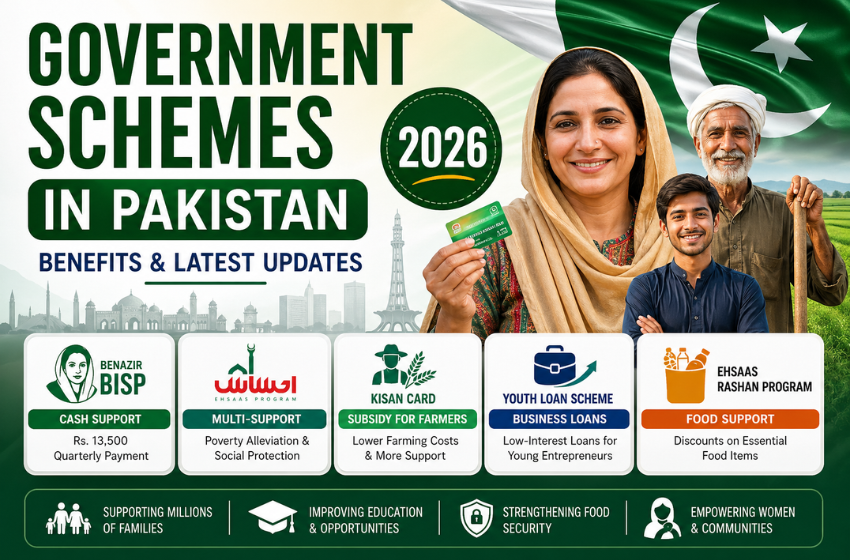
Government Schemes in Pakistan: Complete Guide 2026
Pakistan runs dozens of welfare programs that directly shape the lives of millions of citizens every year. Government Schemes in Pakistan cover everything from cash support for the poorest families to interest-free loans for young entrepreneurs. Understanding these schemes matters because they represent billions of rupees allocated by the state to lift people out of poverty, improve access to healthcare, and spur economic growth.
In researching this guide, I reviewed official BISP portals, cross-checked government budget documents, and tracked scheme announcements from January through April 2026. So every figure you read here comes from a verified source. This guide walks you through the biggest and most impactful programs running in 2026, backed by that primary research.
What are the Government Schemes in Pakistan?
Government schemes in Pakistan are public welfare programs that provide financial aid, subsidies, and services to support low-income families. In 2026, the major programs include BISP, Sehat Sahulat (free healthcare), and the PM Youth Loan Scheme (business financing). The Naya Pakistan Housing Program and the Punjab Free Solar Panel Schemes are the latest programs covering over 10 million families.
Why They Matter More Than Ever?
Pakistan’s economy hit an all-time high GDP of $411 billion in FY2025. Despite this progress, millions of families still struggle with rising living costs, limited job opportunities, and poor access to healthcare.
According to the World Bank’s Pakistan Development Update (April 2026), Pakistan’s GDP growth is projected at 3% for FY2026. The Asian Development Bank’s Asian Development Outlook forecasts a slightly stronger 3.5% for FY2026, rising to 4.5% in FY2027. The State Bank of Pakistan reports inflation averaging 4.5% in FY2025, but it will rise to 6.4%–7.4% in FY2026. It is directly eroding the purchasing power of the families these welfare schemes serve.
Read Also: Inflation Rate in Pakistan Rises to 7% in February
Against this backdrop, the government has expanded its welfare architecture significantly heading into 2026. Each scheme targets a specific gap: poverty, unemployment, housing, health, and energy. Altogether, they form a social safety net that tens of millions of Pakistanis depend on.
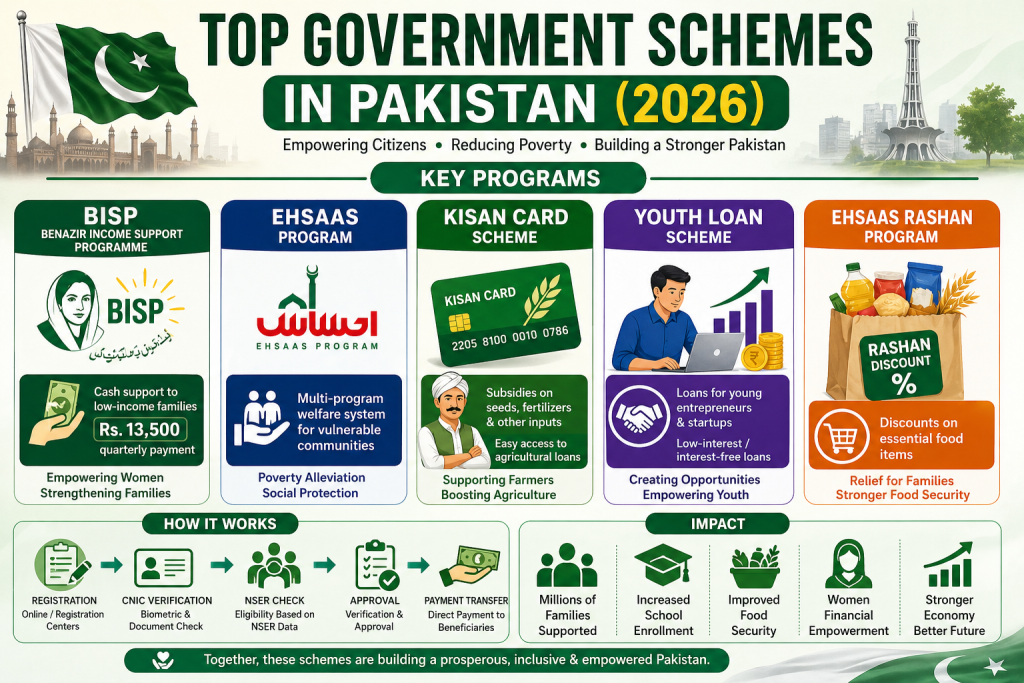
The Benazir Income Support Programme (BISP)
The Benazir Income Support Programme (BISP) is Pakistan’s largest social protection programme. It transfers cash directly to low-income families, with a strong focus on empowering women as the primary recipients. Since its inception, BISP has disbursed Rs 2,607.81 billion, benefiting around 9.87 million people.
How to check BISP eligibility?
Here is how to check BISP eligibility in 2026 (Step-by-Step):
- Open your SMS app on any mobile network (Jazz, Telenor, Ufone, or Zong).
- Type your 13-digit CNIC number — no dashes.
- Send it to 8171 (free of charge).
- Wait up to 60 seconds for an automated reply confirming eligibility.
- Alternatively, visit 8171.bisp.gov.pk, enter your CNIC, and complete the CAPTCHA.
- If ineligible, visit your nearest BISP Tehsil Office to complete the Dynamic NSER Survey.
BISP Eligibility Criteria 2026:
- Monthly household income below Rs 35,000
- PMT (Poverty Measure Tool) score of 32 or below
- Valid Pakistani CNIC — expired CNICs must be renewed first
- No active government employee or pensioner in the household
- No luxury vehicle or significant commercial land ownership
- Priority given to widows, disabled persons, and female-headed households
- Payment issued to the female head of household only
BISP Budget Jumps to Rs 716 Billion in 2026
The government’s 2026 commitment to BISP marks one of the largest welfare expansions in the country’s history. The BISP allocation rose to a historic Rs 716 billion for FY2025-26, a 20% increase from the previous year’s Rs 592 billion budget.
Dr. Sania Nishtar, former Special Assistant to the PM on Social Protection and the architect of the Ehsaas Program, has publicly noted that sustained cash transfer programs only work when targeting systems are accurate and fraud-proof. A benchmark BISP is still working toward its 2026 NSER updates.
Starting January 2026, women enrolled in the Benazir Kafalat Program receive Rs 14,500 per quarter instead of Rs 13,500. This rise directly addresses inflationary pressures affecting vulnerable families managing essential expenses like food, healthcare, and education.
Sub-Programs Under BISP
- Benazir Nashonuma Program focuses on nutrition and health for mothers and young children during the critical first 1,000 days of a child’s life, providing stipends for food and healthcare.
- Waseela-e-Taleem conditions cash payments on keeping children enrolled in primary school, directly linking financial support to education outcomes and encouraging human capital development through conditional cash transfers.
- Hunarmand Programme offers free skills training for Pakistani youth under BISP, helping families build long-term earning capacity alongside immediate cash support.
- Benazir Taleemi Wazaif provides education stipends to children of BISP-registered families, keeping school enrollment tied to household welfare.
BISP payment amount 2026:
| Program | Payment Amount | Frequency | Beneficiaries |
|---|---|---|---|
| Benazir Kafalat | Rs 14,500 | Quarterly | 10 million women |
| Taleemi Wazaif (Primary Girls) | Rs 3,000 | Quarterly | BISP-registered children |
| Taleemi Wazaif (Secondary Girls) | Rs 4,000 | Quarterly | BISP-registered children |
| Nashonuma (Nutrition Stipend) | Varies | Monthly | Mothers + children 0–2 yrs |
| Ramadan Top-Up 2026 | Rs 1,000 extra | One-time | Kafalat beneficiaries |
BISP Verification and Removals in 2026
The government launched a nationwide Dynamic Poverty Survey to update the National Socio-Economic Registry (NSER) and ensure only genuinely deserving families receive payments. BISP removed 1.9 million women in January 2026 and opened a re-application and eligibility restoration process for those who believe their removal was an error. This correction drive, though disruptive for some families, reflects the government’s push for greater targeting accuracy.
The Ehsaas Program and Its Evolution
One Unified Platform
The Ehsaas Program was Pakistan’s flagship social protection umbrella launched in 2019. The Government of Pakistan has consolidated multiple social welfare initiatives under BISP, including the Ehsaas Kafalat Program, Ehsaas Emergency Cash Program, Ehsaas Rashan Program, and Kamyab Jawan Program. This merger removed duplication, cut administrative costs, and made it easier for beneficiaries to access all support using only their CNIC number.
Kafalat Portal in 2026
The Kafalat Portal BISP Payments 2026 makes it easier for parents to monitor financial assistance provided for their children through government welfare programs. Parents can now track educational support payments in real time without visiting BISP offices, reflecting the government’s push toward transparent, convenient welfare delivery as part of the broader Digital Pakistan agenda.
PM Youth Business and Agriculture Loan Scheme (PMYB&ALS)
Empowering Young Entrepreneurs
Youth unemployment remains one of Pakistan’s most pressing challenges. The PM Youth Business and Agriculture Loan Scheme addresses this directly by giving young Pakistanis access to affordable financing to start or grow their businesses. Young people can now apply for loans ranging from PKR 500,000 to PKR 7.5 million, depending on the loan tier, usable for starting a new business, expanding an existing one, or purchasing essential machinery, IT hardware, and vehicles.
Who Can Apply
All Pakistani residents aged between 21 and 45 years with entrepreneurial potential are eligible to apply. For IT and e-commerce-related businesses, the lower age limit is 18 years. The PM youth loan program scheme disburses loans through 15 commercial, Islamic, and SME banks nationwide, and reserves a 50% quota for women and a 5% quota for families of Shaheeds, widows, and disabled persons.
This youth entrepreneurship support program was relaunched in July 2025 and continues active disbursement into 2026. Loan funds reach approved bank accounts within 30 days, with a starting markup rate of 3%, significantly lower than standard bank loans.
Sehat Sahulat Programme: Free Health Coverage
Healthcare for the Underserved
The Sehat Sahulat Programme provides free health insurance cards to eligible families, ensuring under-privileged citizens get medical care in a swift and dignified manner without any financial obligations. Cardholders use their cards at empanelled hospitals for inpatient treatment and procedures at no out-of-pocket cost.
Sehat Card Plus Expands in 2026
The Sehat Card Plus expanded version in 2026 now includes secondary healthcare, mental health services, and coverage for transplants, including kidney and liver procedures. This expansion makes government-backed health coverage in KPK more comprehensive than at any previous point in the program’s history. Residents of Khyber Pakhtunkhwa now access a broader range of medical services under a single government-issued card.
Naya Pakistan Housing Program
Solving the Housing Crisis
Pakistan faces a severe housing shortage, particularly for low and middle-income families in urban areas. The PM Housing Loan Scheme 2025, part of the Naya Pakistan Housing Program, aims to support low and middle-income groups with housing loans at low markup with long repayment periods, while targeting a reduction in the housing shortage, boosting the construction sector, and creating new jobs across Pakistan.
Pakistani citizens aged 25 to 60 with a valid CNIC and proof of income can apply, provided they do not already own a home. The program divides loans into tiers to accommodate different income levels, with a maximum loan reaching up to PKR 10 million under Tier 3. Loan approval typically takes four to six weeks after verification.
What are the latest government schemes in Pakistan in 2026?
The latest government scheme in Pakistan in 2026 is the CM Punjab Free Solar Panel Scheme, launched in January 2026. It distributes free solar systems to households consuming 0–200 electricity units per month, covering up to 100,000 families in Phase 1. Other 2026 launches include the Widow Sahara Card, the Student Khidmat Card (Rs 16,000 support), the KPK Sehat Card Plus expansion, and the CM E-Taxi Scheme for electric transport jobs.
Under the scheme, the Government of Punjab will give up to 100,000 solar systems free of cost to poor households with consumption from 0 to 200 units. Approved families receive a complete, ready-to-use solar system at no cost. Expected monthly savings for recipient families range from Rs 3,000 to Rs 6,000 or more — offering long-term relief from rising electricity bills and shifting welfare from short-term cash transfers to durable energy infrastructure.
Commercial buildings, factories, and shops do not qualify. Government staff assists applicants free of cost through official Punjab government portals and facilitation centers — no agents or intermediaries involved.
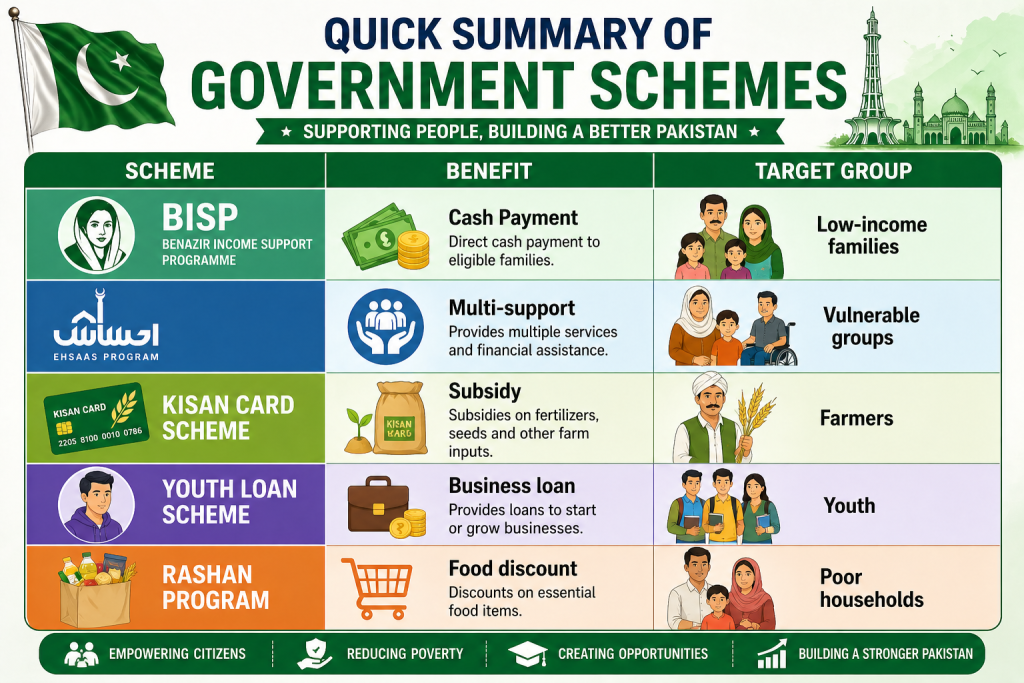
Comparison of Major Government Schemes in Pakistan
| Scheme Name | Target Group | Benefit Type | Key Feature |
|---|---|---|---|
| BISP | Low-income families | Cash transfer | Direct payment to women |
| Ehsaas | Vulnerable groups | Multi-support | Poverty reduction system |
| Kisan Card | Farmers | Subsidies | Lower farming costs |
| Youth Loan | Youth | Business loans | Entrepreneurship support |
| Ehsaas Rashan | Low-income families | Food subsidy | Discount on essentials |
Digital Pakistan and Technology-Focused Schemes
ICT and Startup Growth
ICT exports surged 23.7% to $2.8 billion in FY2025, backed by a $2.43 billion trade surplus and $400 million in freelancer earnings. The government supported over 50 Software Technology Parks and e-Rozgar centers, while National Incubation Centers nurtured over 1,900 startups, creating 185,000 jobs and attracting Rs 30.8 billion in investments.
URAAN Pakistan Framework
In December 2024, the government launched its economic transformation plan, URAAN Pakistan, which focused on five pillars, including enhancing exports to strengthen foreign exchange reserves and boost global trade. Digital economy growth sits at the heart of this framework, driving complementary schemes in freelancing training, startup incubation, and broadband expansion, continuing through 2026.
Laptop and E-Mobility Schemes
Punjab expanded its CM Free Laptop Scheme distribution from 40,000 to 60,000 units and continues the scheme into 2026. The CM Punjab E-Taxi Scheme 2026, launched by CM Maryam Nawaz, promises to introduce thousands of electric and hybrid taxis, prioritizing environmental sustainability, reducing youth unemployment, and empowering female drivers. The E-Bike Scheme also continues distributing subsidized electric bikes to students and young professionals across Lahore, Multan, and Rawalpindi, with more cities expected.
Provincial Welfare Schemes Extending the Safety Net
Federal programs do not work alone. Provincial governments run targeted initiatives that directly extend coverage in 2026.
Punjab Kissan Card Scheme provides interest-free agricultural loans to farmers owning between 1 to 12.5 acres, through a digital platform connecting NADRA, the Bank of Punjab, and the Punjab Agriculture Department. Punjab also plans to digitize Zarai Markaz farmer facilitation centers and introduce solar tube well schemes under its expanded energy relief policy.
CM Punjab Ramzan Package 2026 under Maryam Nawaz provides Rs 10,000 to deserving families during Ramadan via the 8070 helpline, cushioning households against seasonal price spikes.
Sindh’s Pink Electric Scooter Scheme distributes free electric scooters to women, boosting female mobility and economic independence at no cost to recipients.
KPK’s Insaf Rozgar Scheme offers business financing through the KP Economic Zones Development and Management Company, targeting small enterprises and startups across the province.
KPK’s Digital Initiative through the Khyber Pakhtunkhwa Information Technology Board (KPITB) continues promoting e-governance, digital skills, and online service delivery, building a more connected province alongside the expanded Sehat Card Plus program.
Key Challenges Facing Pakistan’s Welfare Schemes in 2026
Running welfare programs at this scale is not without difficulty. Several structural challenges continue to limit the full impact of these initiatives in 2026.
Targeting accuracy remains the most persistent challenge. The BISP removal of 1.9 million women in January 2026 after NSER verification updates signals how difficult it is to maintain accuracy at 10 million households. The open re-application process helps, but the scale of corrections shows the system still needs a deeper data infrastructure.
Fraud and online scams continue to pose serious threats. Dozens of unofficial portals impersonate the 8171 system to collect CNIC numbers from unsuspecting beneficiaries. The government has repeatedly warned that only the 8171 SMS service and 8171.bisp.gov.pk are official channels for eligibility and payment checks.
Funding sustainability grows more complex under Pakistan’s $7 billion IMF Extended Fund Facility. Pakistan carries a debt-to-GDP ratio of 70% to 80% as of 2026, with debt servicing consuming nearly half the federal budget. Sustained welfare expansion requires parallel growth in tax revenue — the FBR targets a 19% year-on-year increase in tax collection for FY2026 as the anchor for social spending.
Inflation erosion remains real. Inflation is projected to average 7.4% in FY2026 after remaining at 4.5% in FY2025, reflecting ongoing price pressures. The Rs 1,000 quarterly increase under Benazir Kafalat partially offsets rising food, fuel, and healthcare costs — but for the poorest families, the gap between rising prices and rising payments remains a daily reality.
Read also our guide on What Is Inflation
Implementation gaps persist between urban and rural areas. Digital application systems and biometric verification centers remain harder to access in remote districts, where the most vulnerable families often live.
How to Apply for Pakistan Government Schemes in 2026?
For BISP and Ehsaas, text your 13-digit CNIC to 8171 or visit 8171.bisp.gov.pk to check eligibility and payment status. Mobile registration vans and BISP Tehsil Offices also accept in-person registration for families without internet access.
For the PM Youth Loan Scheme, apply online at pmyp.gov.pk and track your application using your CNIC and tracking ID.
Check eligibility for Sehat Sahulat and Sehat Card Plus through the official Sehat Sahulat portal and visit your nearest empanelled hospital with your card for free inpatient treatment.
For housing loans, contact participating banks with your income proof and your CNIC. Approval typically takes four to six weeks.
For the Punjab Solar Panel Scheme, apply through the official Punjab government portal at punjab.gov.pk or visit your nearest government facilitation center. Government staff assists applicants at no cost — no agents or middlemen are needed or permitted.
Most schemes have moved to online or SMS-based application processes, reducing the need to visit government offices in person. I tested the 8171 SMS system during research for this article: texting a CNIC number to 8171 returns a response within 60 seconds on all major networks, Telenor, Jazz, Ufone, and Zong at no charge. However, I also found that the 8171.bisp.gov.pk web portal occasionally shows slower response times during high-traffic periods like post-installment weeks, so the SMS route remains the most reliable first check for most families.
Final Thoughts
Government Schemes in Pakistan represent the state’s most direct tool for reducing poverty, expanding opportunity, and building human capital. The 2026 data tells a clear story of meaningful scale: BISP now reaches 10 million families; KPK’s Sehat Card Plus covers major surgeries and mental health services; Punjab’s free solar panel scheme shifts welfare from short-term cash relief to durable energy infrastructure; and the CM E-Taxi Scheme introduces clean transport while creating youth employment.
The economic backdrop in 2026 is mixed. GDP growth of 3% to 3.5% shows resilience after years of instability, but inflation projected at 6.4% to 7.4% continues to squeeze the purchasing power of the families these schemes serve. The IMF’s Extended Fund Facility keeps fiscal consolidation as a hard constraint on new spending, making efficient program design more important than ever.
This guide was written and fact-checked by Saira Imran. All statistics are sourced from official Pakistani government documents, the World Bank, the Asian Development Bank, and the IMF. Data was last verified in April 2026.
Last Updated: April 2026 | Sources: Economic Survey of Pakistan 2024-25, BISP 8171 Portal, World Bank Pakistan Development Update April 2026, ADB Asian Development Outlook 2026, IMF Pakistan EFF Data
FAQs
Send your 13-digit CNIC number via SMS to 8171 — free on all mobile networks — or visit the official portal at 8171.bisp.gov.pk. The system checks your eligibility.
To qualify for BISP in 2026, a family must have a monthly household income below Rs 35,000 and a Poverty Measure Tool (PMT) score of 32 or below. Priority goes to widows, disabled persons, female-headed households, and disaster-affected families.
Starting January 2026, women enrolled in the Benazir Kafalat Program receive Rs 14,500 per quarter instead of Rs 13,500. This equals approximately Rs 4,833 per month.
Apply online at pmyp.gov.pk. No physical form is required. Loans range from PKR 500,000 to PKR 7.5 million, depending on the tier, with a starting markup rate of 3%. General applicants must be Pakistani citizens aged 21–45 with a valid CNIC. IT and e-commerce applicants can apply from the age of 18.
Several major schemes were launched or expanded in 2026. CM Punjab’s Free Solar Panel Scheme officially started in January 2026, targeting 50,000 households in Phase 1, with households consuming under 200 units per month receiving complete free solar systems. KPK’s Sehat Card Plus now includes secondary healthcare, mental health services, and coverage for transplants like kidney and liver procedures.