Saira Imran
How Electricity Bills Work in Pakistan Explained
How Electricity Bills Work in Pakistan is a question I started asking seriously after my family’s bill jumped from Rs. 8,000 to Rs. 22,000 in a single summer month — without any obvious change in our usage. If you’ve had a similar shock, this guide breaks down exactly why that happens.
In reality, the billing system follows a structured method based on electricity units, tariff slabs, fuel costs, and government-imposed charges. Each part plays a role in shaping your final bill.
Once you understand how each component works, you can clearly see why your electricity bill changes every month. Let’s learn how it works!
How Electricity Bills Work in Pakistan?
Electricity billing in Pakistan follows a multi-layered pricing system. It does not rely only on how much electricity you use. Instead, it combines usage, pricing slabs, fixed costs, and variable adjustments.
The system uses a slab-based tariff structure, which means electricity becomes more expensive as consumption increases. This approach encourages energy conservation but also leads to sharp bill increases when usage crosses certain limits.
Pakistan’s power sector operates under a regulated system where the National Electric Power Regulatory Authority (NEPRA) sets tariffs, while distribution companies such as LESCO, MEPCO, and FESCO apply them.
According to NEPRA’s State of Industry Report 2023–24, electricity tariffs in Pakistan rose by over 70% in two years, driven by fuel import costs, circular debt exceeding Rs. 2.3 trillion, and rupee depreciation.
Energy economist Dr. Abid Qaiyum Suleri of the Sustainable Development Policy Institute has noted that Pakistan’s power sector costs are structurally high because consumers are also paying for idle capacity — a problem that won’t resolve without systemic reform.
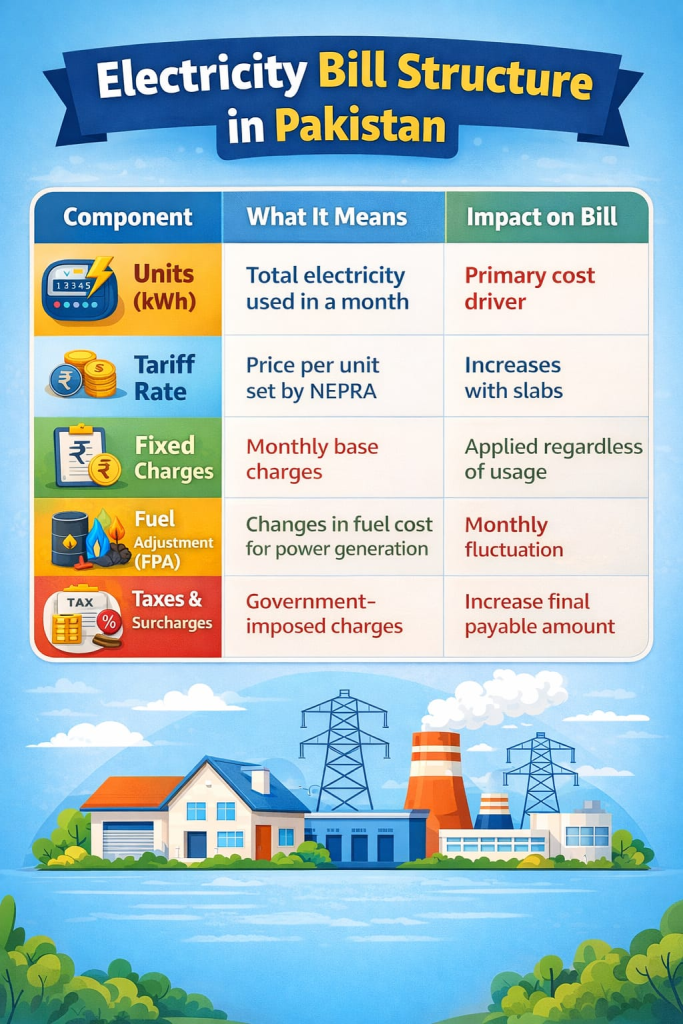
Here is how electricity bills work in Pakistan:
1. Electricity Units (kWh Consumption)
Electricity usage is measured in kilowatt-hours (kWh), commonly known as units. One unit equals using 1,000 watts of power for one hour.
For example:
- A 1000-watt appliance running for 1 hour = 1 unit
- A 100-watt fan running for 10 hours = 1 unit
Your electricity meter records total consumption during the billing period, usually 30 days. This reading forms the base of your bill.
In Pakistan, average household consumption ranges between 200 to 500 units per month, depending on appliance usage, season, and household size. According to NEPRA’s 2024 annual report, domestic consumers account for roughly 47% of total electricity consumption nationally, making residential billing the most widely impactful segment of the tariff system.
Learn more in our complete guide on How to Reduce Electricity Bill in Pakistan
2. Tariff Structure and Unit Rates
The tariff structure defines how much you pay per unit. NEPRA sets these rates based on production costs, fuel prices, and economic conditions.
Read Also: Electricity Base Tariff Reduction Plan Submitted to NEPRA
Tariffs vary across user categories:
- Domestic users (homes)
- Commercial users (shops)
- Industrial users (factories)
Domestic users follow a progressive slab system.
Tariff Impact Table:
| Usage Level | Unit Price Behavior |
|---|---|
| 1–100 units | Highly subsidized |
| 101–200 units | Moderately priced |
| 201–300 units | Higher cost |
| 300+ units | Premium rate |
This structure means even a small increase in units can significantly increase your total bill.
3. Slab System in Electricity Billing
The slab system divides electricity usage into ranges. Each slab has a different price per unit.
In Pakistan, slabs are designed to protect low-income households by offering lower rates for minimal usage. However, once consumption crosses a slab threshold, the entire billing structure shifts.
Slab System Overview:
| Slab Range | Cost Behavior |
|---|---|
| 1–100 units | Lowest cost |
| 101–200 units | Moderate cost |
| 201–300 units | Expensive |
| 300+ units | Very expensive |
This is why consumers often see sudden jumps in their electricity bills when they exceed certain unit limits.
4. Fixed Charges in Electricity Bills
Fixed charges are mandatory costs added to your bill regardless of electricity usage. These depend on your sanctioned load, which is the maximum power capacity approved for your connection.
Recent updates in Pakistan’s tariff system increased fixed charges significantly. For example:
- Protected users (low consumption) pay minimal fixed charges
- Non-protected users pay higher fixed charges
This means even households using fewer units may still receive noticeable bills.
5. Fuel Adjustment and Taxes
Fuel Adjustment Charges (FPA) reflect changes in global fuel prices used for electricity generation, such as oil, gas, and coal.
Pakistan relies heavily on imported fuels. When global fuel prices increase or the Pakistani rupee weakens, electricity generation becomes more expensive. This cost is passed to consumers through FPA.
Other charges include:
- Quarterly tariff adjustments
- GST (General Sales Tax)
- Electricity duty
- TV fee (in some regions)
These additions can increase your bill by 20% to 40% beyond base charges.
6. Billing Categories in Pakistan
Electricity users are divided into categories such as domestic, commercial, industrial, and agricultural.
Each category has different tariff rates and rules. For example, commercial users usually pay higher per-unit costs compared to residential users.
This classification helps distribute energy costs based on usage type.
7. Final Bill Calculation Formula
Electricity bills combine multiple components into a final payable amount.
Electricity Bill Formula:
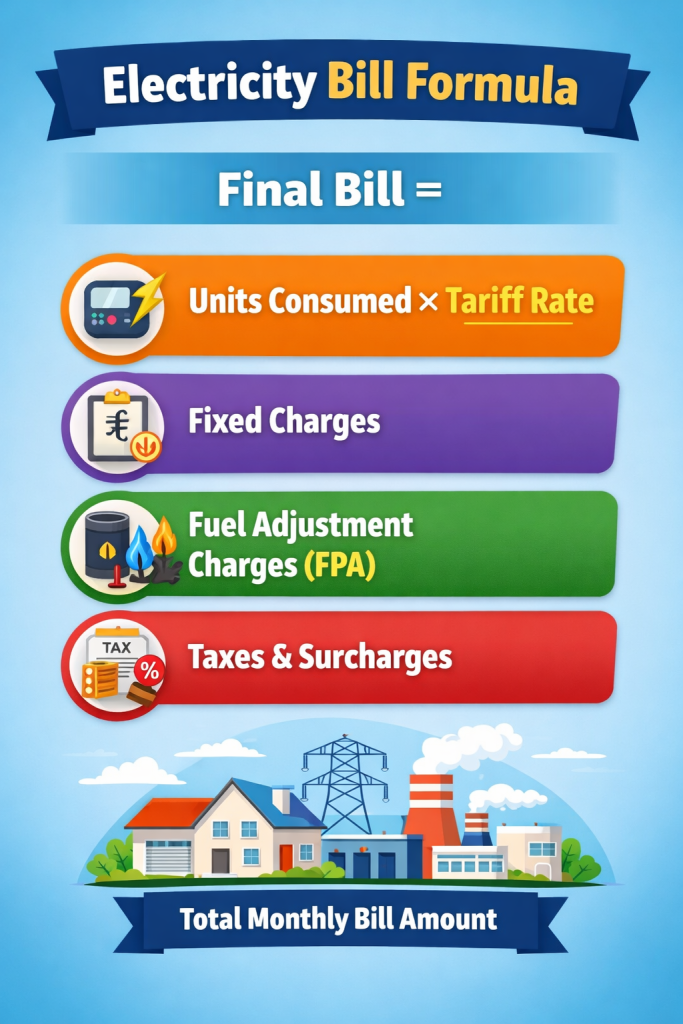
This layered calculation explains why your bill is higher than just unit consumption.
Why Bills Keep Changing?
Electricity bills in Pakistan often change even when your usage stays the same because several external factors affect the final cost.
Fuel Price Changes
One major reason is fuel price changes. When the cost of oil, gas, or coal increases, power generation becomes more expensive. That increase often appears on your bill as Fuel Price Adjustment (FPA) charges. Currency depreciation can also raise electricity costs because Pakistan imports fuel, and a weaker rupee makes those imports more expensive.
Slab Movement and NEPRA Tariff Revisions
Another reason is slab movement and NEPRA tariff revisions. If your monthly consumption crosses into a higher slab, even by a small margin, your per-unit rate can increase. This can raise your total bill noticeably. On top of that, when NEPRA revises electricity tariffs, updated rates can affect your bill even if you use the same number of units as the previous month.
“Learn more in our complete guide on Why Electricity Bills Are High in Pakistan“
Seasonal Demand
It also plays a big role. Summer months often bring higher bills because people use more fans, air conditioners, and refrigerators. Increased national demand can also put pressure on the power system, which can affect costs. That is why your bill can rise due to a mix of usage patterns, policy changes, and external economic factors, not just because you consumed more electricity.
Final Thoughts
Understanding How Electricity Bills Work in Pakistan gives you better control over your monthly expenses. When you clearly understand units, tariff slabs, fixed charges, and additional taxes, you can predict your bill more accurately.
Electricity billing in Pakistan reflects both your usage and the country’s broader energy economics. Rising fuel costs, policy changes, and demand patterns all influence your bill.
If you manage your electricity consumption carefully and stay within lower slabs, you can reduce your overall cost and avoid sudden bill shocks.
This article was last reviewed in April 2026 against NEPRA’s current domestic tariff schedule. Tariff slabs and FPA rates change periodically — always cross-check your bill against the latest NEPRA notifications at nepra.org.pk.
Written by Saira Imran | This guide is based on a review of NEPRA’s published tariff schedules, official DISCOs billing structures, and three years of tracking our household electricity bills across seasonal cycles.
FAQs
Electricity bills are calculated by multiplying the consumed units by the tariff rate and then adding fixed charges, fuel adjustments, and taxes.
A unit is one kilowatt-hour (kWh), which means using 1,000 watts of electricity for one hour.
Your bill becomes high due to increased unit consumption, higher slab rates, fuel adjustment charges, and government taxes.
The slab system divides electricity usage into ranges. Each range has a different per-unit price, and higher usage leads to higher costs.
Yes, bills can increase due to fuel price changes, new taxes, and NEPRA tariff updates, even if your electricity usage remains unchanged.