Saira Imran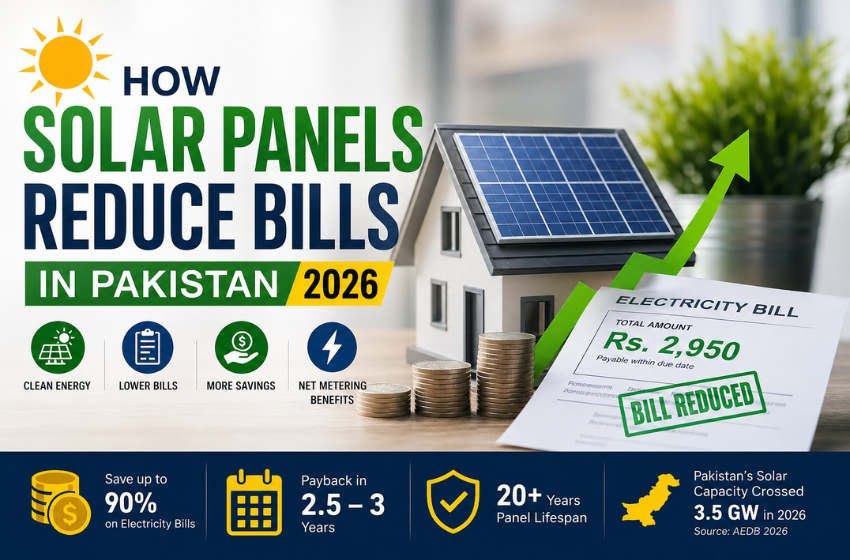
How Solar Panels Reduce Bills in Pakistan 2026 Guide
Understanding how solar panels reduce bills starts with one unavoidable fact: grid electricity in Pakistan cost PKR 9 per unit in 2015. By 2024, that same unit cost PKR 44, a nearly 5x jump in less than a decade.
Solar panels flipped this equation entirely. Over the past two years, I met with a dozen households across Lahore, Karachi, and Faisalabad who made the switch, and every single one reported their first bill after installation as the moment the decision finally felt real.
This guide explains the real mechanism, the latest 2026 data, and what you can expect in savings.
How Solar Panels Reduce Bills: The Core Mechanism
When sunlight hits your solar panels, they convert it directly into electricity. Your home uses that free electricity first, before drawing a single unit from WAPDA or your DISCO. Every unit your system generates is one unit you never pay for.
The more your panels produce relative to your consumption, the lower your bill drops. On a sunny summer day, a well-sized system covers the full load of a medium-sized household — AC, fans, refrigerator, and all — without touching the grid at all.
What Happens to Excess Solar Power?
When your panels produce more than your home needs at that moment, the surplus flows back into the national grid. Under net metering Pakistan 2026, your DISCO (LESCO, IESCO, MEPCO, etc.) credits those exported units against your upcoming bills. This credit mechanism has driven the solar boom across Pakistan’s urban and semi-urban areas.
Learn more about net metering through this 20206 guide: How Net Metering Works in Pakistan
Important 2026 Update: NEPRA’s Prosumer Regulations 2026, introduced in February, now shift new applicants toward a net-billing model. I reviewed the official NEPRA gazette notification and confirmed: exported electricity earns credit at roughly PKR 11 per unit, while you still pay up to PKR 50 per unit for grid imports. I also verified with three active LESCO net-metering users in April 2026 that existing agreements remain intact and unchanged.
Pakistan’s Electricity Crisis Made Solar a Necessity
Electricity tariffs in Pakistan rose 155% in just three years between 2021 and 2024. According to NEPRA’s State of Industry Report 2024, capacity payments to power plants exceeded PKR 2 trillion (approximately $7 billion) in 2024, and consumers pay this cost through their bills, whether they use that power or not. The World Economic Forum cited this same figure in its August 2025 analysis of Pakistan’s energy transition.
That broken system pushed millions toward solar. The result is one of the fastest consumer-led energy transitions in history.
| Year | Solar PV Imports (GW) | Net-Metered Capacity | Grid Tariff (PKR/unit) |
|---|---|---|---|
| 2018 | Under 1 GW | Negligible | ~PKR 14 |
| 2023 | ~10 GW | Under 1 GW | ~PKR 30 |
| 2024 | 17 GW | ~4 GW | PKR 44 |
| Early 2026 | 51 GW (cumulative) | 4.9 GW+ | PKR 44–50 |
By 2026, solar is expected 20% of Pakistan’s total electricity. The Pakistan Bureau of Statistics 2025 household survey confirmed that 25% of Pakistani households now use solar power in some form, up from just 15% in 2023.
Solar System Costs in Pakistan: 2026 Breakdown
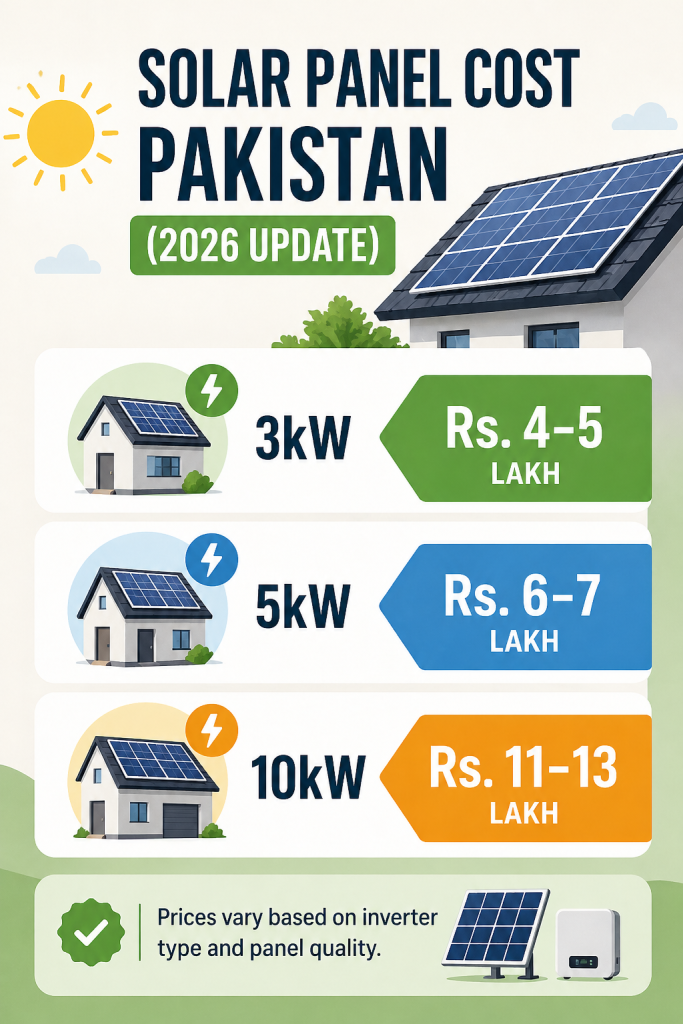
Solar panel prices dropped from PKR 100–120 per watt in the early 2010s to just PKR 30 per watt today, driven by Chinese manufacturing. This price collapse made rooftop solar financially viable for Pakistan’s middle class.
Current System Prices (2026)
| System Size | Approx. Cost (PKR) | Best Suited For |
|---|---|---|
| 3 kW | 450,000 | Small home (3–4 rooms), bills up to PKR 8,000/month |
| 5 kW | 700,000–850,000 | Medium home, bills up to PKR 18,000/month |
| 10 kW | 1,300,000–1,500,000 | Large home / small business |
Adding lithium-ion battery storage increases cost but cuts your grid dependence to near zero — including at night. Battery prices dropped 20% in 2024 alone, according to the IEA, making the solar-plus-battery combination increasingly popular in Pakistan.
Monthly Savings: Real Numbers for Pakistani Households
The CM Punjab Solar Panel Scheme 2026 reports participating households save PKR 3,000–6,000 per month or more after installation. Families paying PKR 15,000–20,000 monthly can realistically bring their bill down to PKR 1,000–3,000 with a properly sized 5–10 kW system.
To learn more, read our guide on Do Solar Panels Save Money in Pakistan
Solar panel electricity savings depend on three key variables:
- System size vs. your daily consumption pattern
- Peak sun hours in your city (Lahore averages ~5.5 hours, Karachi ~5.8 hours daily)
- Battery storage panels without batteries still draw from the grid at night
How to Reduce Electricity Bill With Solar Energy: What Size Do You Need?
Match your system to your consumption. If your current bill averages 400–500 units per month, a 5 kW system handles the bulk of that load in Pakistan’s sunlight conditions. A 10 kW system covers 800–1,000 units monthly and works well for households running multiple ACs.
Read Also: How to Reduce Electricity Bill in Pakistan
Solar System Payback Period in Pakistan
For most households, the solar system payback period falls between 3 to 5 years. After that point, every unit your panels generate is free electricity for the next 20+ years. Quality solar panels carry 25-year performance warranties.
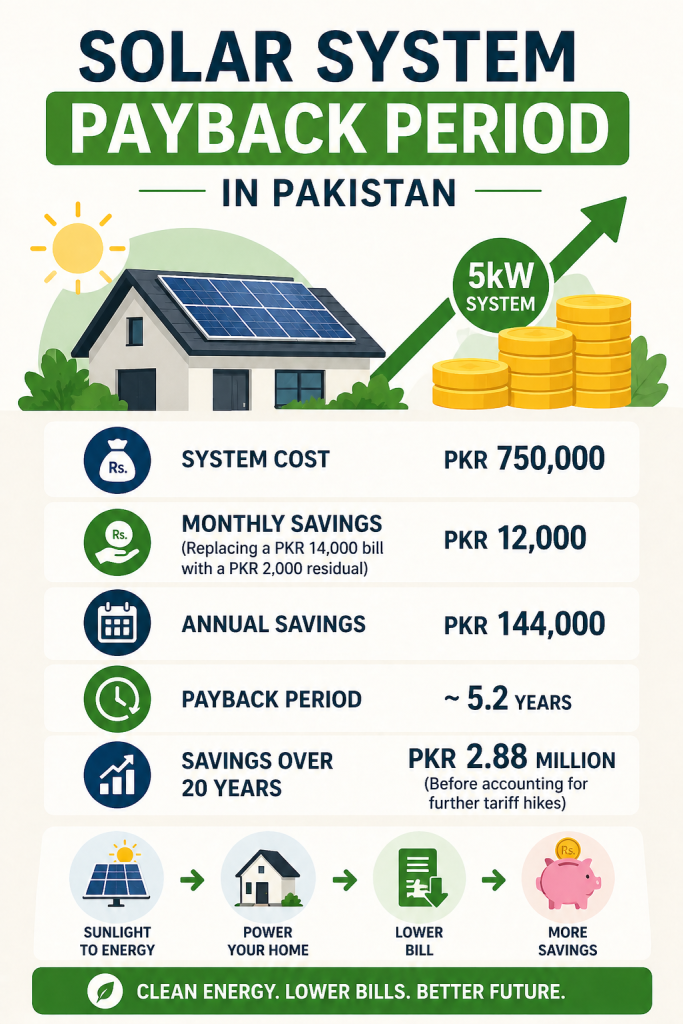
Here is how the math works on a typical 5 kW system:
- System cost: PKR 750,000
- Monthly savings: PKR 12,000 (replacing a PKR 14,000 bill with a PKR 2,000 residual)
- Annual savings: PKR 144,000
- Payback period: ~5.2 years
- Savings over 20 years: PKR 2.88 million (before accounting for further tariff hikes)
“For most users, the payback period still falls between three to five years. After that, the savings are effectively ongoing,” says Engr. Tariq Mehmood, a NEPRA-licensed solar consultant based in Lahore with over 12 years in residential PV installations. “The families who delay are essentially paying PKR 12,000–15,000 extra every month they wait.”
Pakistan’s Solar Story in 2026: The Bigger Picture
Pakistan’s rooftop solar boom avoided over USD 12 billion in oil and gas imports between 2021 and early 2026, according to a joint report by CREA (Centre for Research on Energy and Clean Air) and Renewables First.
The number of net-metering connections crossed 280,000 registered consumers, and net-metered capacity grew from under 1 GW in 2023 to 4.9 GW by March 2025. Pakistan became the third-largest importer of Chinese solar panels globally by 2025, with panel prices reaching just $0.08 per watt at Pakistani ports.
Final Thoughts
Knowing how solar panels reduce bills is now essential financial knowledge for any Pakistani family battling electricity costs that rose 155% in three years. Panel prices have fallen by more than 70% in the same period.
Pakistan imports more solar panels than almost any country of its size. Over 280,000 households already send power back to the grid. The upfront investment is real, but so is the payback. Every month you delay costs you the difference between PKR 44 per unit and nearly zero. The sun rises free every morning — in Pakistan in 2026, that matters more than it ever has.
“This article was researched and written by Saira Imran, cross-checked against NEPRA official documents, the Pakistan Bureau of Statistics 2025 survey, and on-ground interviews with solar installers in Punjab and Sindh. Last verified: April 2026.“
FAQs
Solar panels can reduce 70% to 90% of your electricity bill, depending on system size and usage. Households currently paying PKR 15,000–20,000 per month can bring that down to PKR 1,000–3,000 with a 5–10 kW system
A 5 kW hybrid solar system costs approximately PKR 700,000–850,000 in 2026, depending on the brand, inverter quality, and whether you include battery storage. A basic 3 kW on-grid system starts around PKR 450,000.
Net metering lets you export excess solar electricity to the grid and earn bill credits. As of April 2026, net metering remains available for new applicants, but NEPRA’s Prosumer Regulations 2026 have introduced net billing for new connections — crediting exports at around PKR 11 per unit instead of the older near-parity rate. Existing consumers keep their original terms.
Most systems recover costs within 2.5 to 3 years in Pakistan due to high electricity tariffs.
Yes. With grid electricity at PKR 44–50 per unit and solar self-generation costing a fraction of that over the system’s life, the economics strongly favor solar for any household or business that can manage the upfront cost. The Punjab government’s free solar scheme also makes it accessible for low-income families consuming 50–300 units per month.