Saira Imran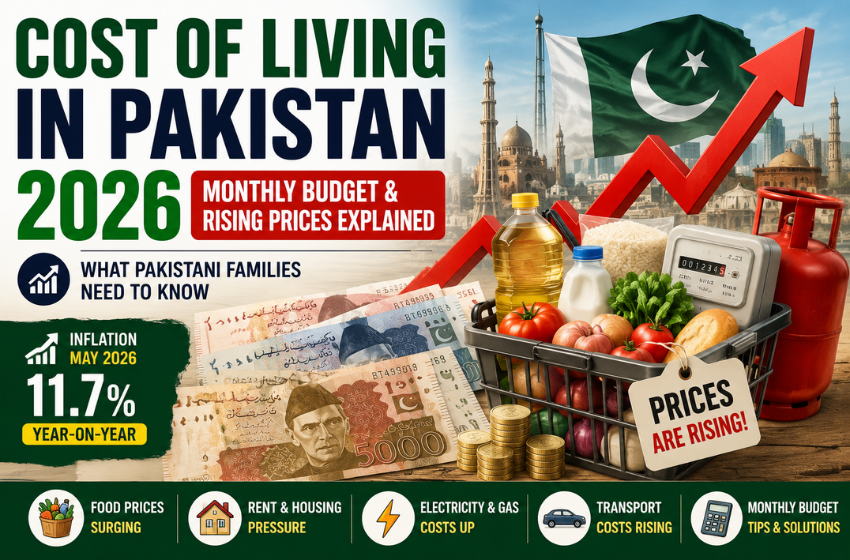
Cost of Living in Pakistan 2026: Budget Guide & Rising Expenses Explained
The cost of living in Pakistan in 2026 continues to rise as inflation, housing pressures, and rising utility costs reshape everyday household budgets. Pakistan’s CPI inflation accelerated to 11.7% year-on-year by May 2026. Early 2026 saw sharply rising prices across essentials.
For example, consumer prices rose ~5.6% in Dec 2025 and jumped to 11.66% by May 2026. This broad inflation reflects steep increases in food, rent, energy, and transport costs over a short period. Households now face much tighter budgets as basic expenses claim a larger share of income.
Let’s discuss this in detail!
What is the Cost of Living in Pakistan 2026?
The cost of living in Pakistan in 2026 means the monthly income needed to pay for basic needs and some comforts. It covers housing (rent or mortgage), food, utilities (electricity, gas, water), transport, healthcare, education, and communication. In practical terms, it is the income required to live without constant money stress. In 2026 Pakistan, this means earning enough to cover rapidly rising prices in all these categories.
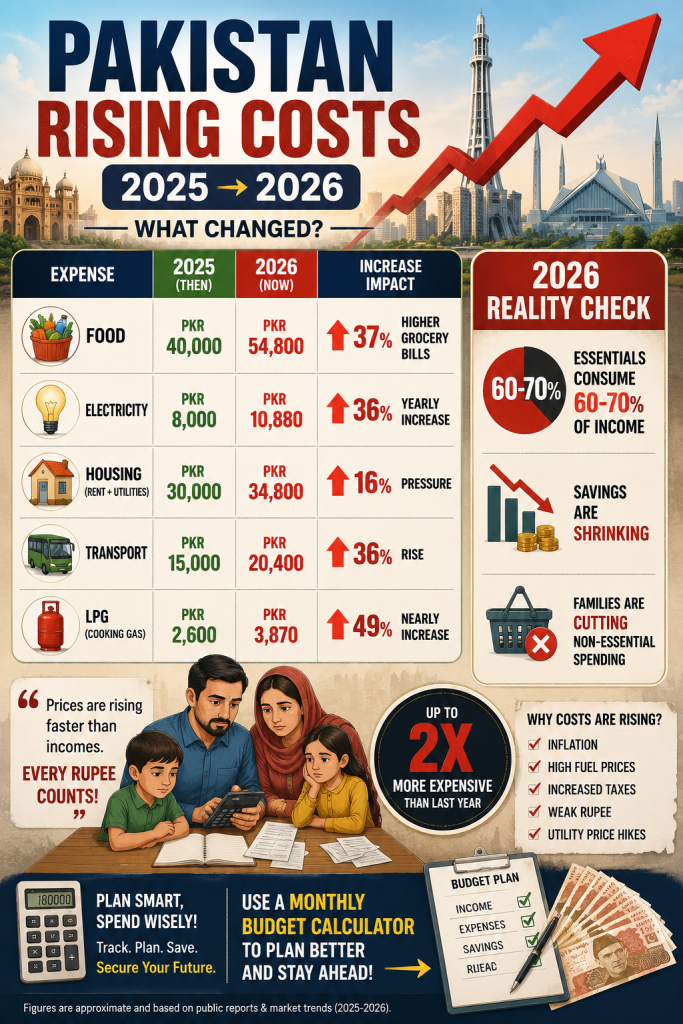
Roughly speaking, the cost of living is the amount required to afford a decent standard of living. For example, if a household spends more than ~60% of its income on essentials (food, rent, utilities), it will feel continual pressure. As we’ll see, in 2026 many families spend such a high share that very little remains for savings or emergencies.
Why Cost of Living Matter in 2026?
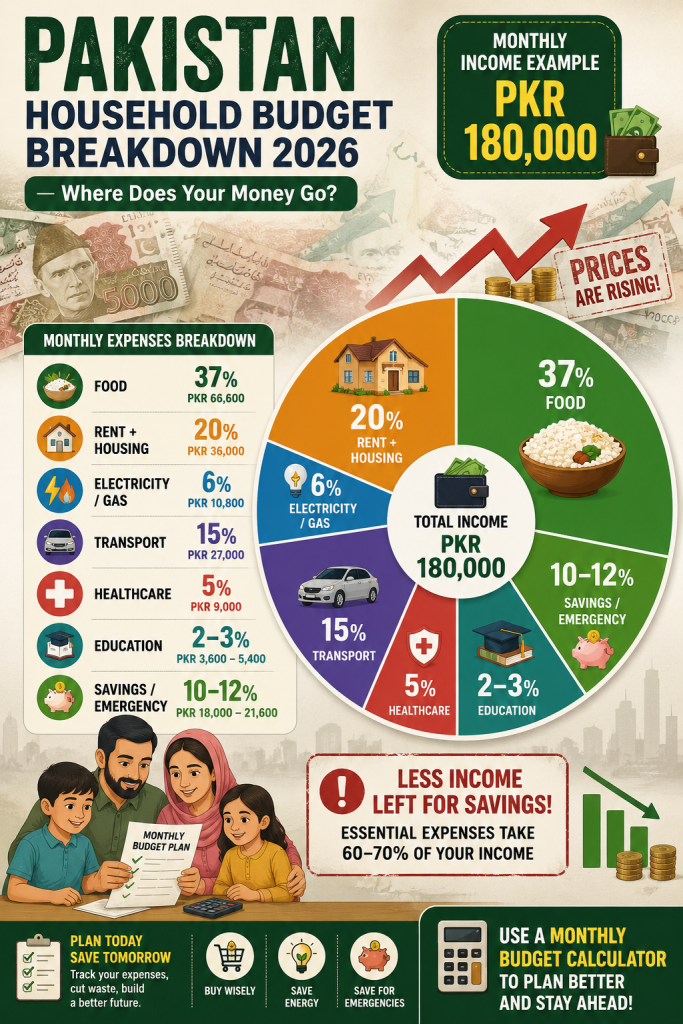
As prices rise faster than incomes, every household feels the pinch. Middle-class families often find themselves spending most of their pay on basics. A recent government survey found that Pakistani households now spend about 63% of income on food and housing/energy. In practical terms, food alone took ~37% of income and housing+electricity/gas 26%, leaving only ~2–3% for things like education.
Because so much income is locked into food, rent, and utilities, even small price hikes force big cutbacks. When salaries barely keep up with inflation, families postpone plans, save less, and fall into debt. In 2026, careful budgeting is no longer optional; it’s a survival necessity for most.
What Is Driving the Cost of Living in Pakistan 2026?
Several factors combine to push the cost of living up. No single item is to blame; instead, many essentials have risen together. The main drivers are:
Inflation and Rising Food Prices
Pakistan’s inflation rate surged in early 2026. Official data show annual CPI inflation of ~5.8% in Jan 2026, rising to ~11.7% by May 2026. Food inflation alone has been particularly painful.
For example, the national “Food & Non-Alcoholic Beverages” index was up about 7.9% year-on-year in May 2026. Staples like wheat, rice, oil, vegetables, and dairy all cost more than before. Since food is a non-negotiable expense, even modest food-price rises quickly erode a household’s disposable income.
Growing Urban Population and Housing Pressure
Cities keep growing, squeezing housing supply. Major cities (Karachi, Lahore, Islamabad) see high demand for apartments and homes.
As demand outstrips supply, rents climb. In PBS data for May 2026, the broader “housing, water, electricity, gas & fuels” category jumped +16.78% year-on-year, reflecting sharply higher rents and utility costs. Many families now spend a large share of income just on rent or mortgage payments, a clear long-term pressure on budgets.
Unstable Electricity and Gas Costs
Utility tariffs have been volatile. In late 2025 and early 2026, regulators approved higher power and gas charges. For instance, NEPRA added about Rs.0.35 per unit to electricity bills (Oct–Dec 2025), and future adjustments remain a wildcard.
On top of this, subsidy cuts and fuel cost pass-throughs have pushed electricity and LPG prices up steeply. By May 2026, PBS reports electricity charges were up 36.5% year-on-year, and liquefied gas prices nearly +49%. Such jumps make monthly bills unpredictable; one month’s bill may spike without a clear change in usage. Households increasingly treat electricity/gas costs as variable rather than fixed.
Transport and Fuel-Driven Cost Pressure
Pakistan imports most of its fuel. Global oil price swings and geopolitical tension have led to big domestic fuel hikes. In March 2026, the government raised petrol/diesel by ~20% (adding ~Rs.55/liter to prices), and in early April 2026 another ~43–55% hike was imposed (diesel to ~Rs.520/L, petrol to ~Rs.458/L).
Rising fuel prices immediately push up the cost of bus fares, ride-sharing, and delivery of goods. This ripples into the prices of almost everything: by May 2026 the CPI transport index was up 36.8% YoY. In short, when fuel goes up, food and goods tend to go up too.
How Small Changes Affect the Entire Budget
The interplay of these factors means that even a single increase can cascade. A tiny hike in petrol makes bus fares and delivery costs rise. Those higher transport costs can drive up vegetable and grocery prices. Meanwhile, a small increase in LPG or electricity can force small businesses to raise prices.
As a result, households find expenses increasing in multiple areas even if their income stays flat. For example, PBS data show transport prices +36.8% YoY and housing/utilities +16.8% YoY as of May 2026. This chain reaction of many essentials rising together is what makes budgeting so hard. Even if you haven’t bought more goods, your money doesn’t stretch as far as before.
Average Monthly Cost of Living in Pakistan 2026
Monthly living costs vary widely by city and lifestyle, but we can sketch typical budgets.
- Single Person: In urban Pakistan, a working individual might spend roughly PKR 120,000–150,000 per month for a basic to moderate lifestyle. Typical breakdown (monthly): rent ~PKR40k, food ~PKR40k, transport ~PKR20k, utilities/other ~PKR40–50k. According to Numbeo (May 2026), a single person’s non-rent expenses average ~PKR 98,770. With rent added, totals approach PKR 120–150k. In other words, a single earner often needs on the order of Rs.1.2–1.5 lakh each month.
- Family of Four: Expenses multiply for families. Numbeo estimates about PKR 332,455 per month (excluding rent) for a family of four. Adding rent (perhaps PKR 80k–100k for a modest apartment) brings total needs to roughly PKR 450,000 or more. In practice, many middle-class families find themselves in the Rs.250,000–400,000+ range, depending on schooling, housing quality, and lifestyle. (For example, private school fees or a second car can push costs even higher.)
These figures line up with other sources. In USD terms, Pakistan is still relatively cheap compared to Western countries: monthly living costs are roughly $300–600 for an individual and $800–1500 for a family of four. However, local salaries are low, so what looks affordable in dollars remains a heavy burden for most Pakistanis.
Cost of Living in Pakistan in USD (2026)
By one measure, living costs in Pakistan are about 70–90% lower than in the U.S. For example, an average city-center 1‑bedroom rent might be only ~$100–120 per month, compared to many hundreds or thousands in a Western city. Wise.com notes that in 2026 a single person’s estimated monthly cost (excl. rent) was £290 (≈$355) and a family of four £953 (≈$1,165). Even so, that much local currency often just covers basics, leaving little room for savings.
Average Rent in Pakistan in USD (2026)
Rent is a major part of budgets. Wise reports (Feb 2026) that the average monthly rent for a 1‑bedroom apartment in a city center is about £99 (≈PKR 35,000), while outside the center it’s about £56 (≈PKR 20,000). A 3‑bedroom in the city center averages £228 (~PKR 80,000). Islamabad and Karachi tend to have the highest rents (popular areas can easily exceed these averages), with Lahore somewhat cheaper. In short, prime-city rents generally fall in the few tens of thousands of PKR per month.
Cost of Living in Pakistan 2026 Calculator Concept
A simple budgeting method is to list all expected expenses, subtract from income, and see what’s left. For example, if someone earns PKR 180,000 and spends PKR 150,000, they have only PKR 30,000 remaining.
As price pressures rise, that remaining amount quickly shrinks or turns negative. Many households now find budgets nearly balanced, meaning any unexpected expense can tip them into debt. Calculating your own budget (with estimates for rent, food, bills, transport, savings, etc.) makes clear just how narrow the margins are.
Here is the Cost of Living in Pakistan calculator. Click on preview and calculate your cost:
City-Wise Cost Differences in Pakistan 2026
Costs vary by city. Here is how:
- Islamabad is the most expensive, especially in housing: rents in Islamabad’s sectors and residential areas tend to be higher than similar property in other cities.
- Karachi also has very high costs in prime neighborhoods (and higher transport/logistics costs).
- Lahore is typically a bit cheaper than Karachi, offering a more moderate cost profile.
- Smaller cities (Multan, Peshawar, Quetta, etc.) are significantly cheaper than these big three.
These differences mean that a family’s monthly budget in Karachi or Islamabad can easily exceed the same budget in Lahore or elsewhere. (For example, housing might take 30–40% of income in Karachi/Islamabad, but perhaps 25–30% in Lahore.) Location is thus one of the biggest factors in any cost-of-living calculation.
Hidden Expenses Most People Ignore
Beyond the regular monthly bills, there are irregular or seasonal costs that can catch households off guard. Common examples include:
- Health Emergencies: Sudden medical treatments or hospital stays can add tens of thousands of rupees in one month.
- Education and Fees: Exam fees, school uniforms, new textbooks, or admission deposits are not monthly but recur annually. Over time, they add significantly.
- Home/Vehicle Repairs: A broken pipe, roof leak, or car repair might occur once a year, but costs can be high.
- Seasonal Fluctuations: Prices of certain foods or goods can spike seasonally (e.g., tomatoes, onions, or fuel before festivals).
Though these don’t appear in every month’s budget, they often amount to an extra 20–30% of annual household spending. Savvy families try to set aside a small emergency fund for these, but with tight budgets that’s difficult. Without planning, such hidden costs force last-minute borrowing or sacrifice of other expenses.
How People Are Managing Rising Costs in 2026
Households are adopting all sorts of coping strategies to make ends meet. Common approaches include tracking expenses meticulously and cutting non-essential spending. For example:
- Families have started budgeting daily expenses with apps or notebooks, and strictly reducing eating out or luxury purchases.
- Many buy groceries and staples in bulk when prices are lower (e.g., buying a 20kg bag of flour instead of repeatedly paying slightly more).
- To save on utilities, people limit appliance use (like using fans instead of AC, or cooking off-peak) and repair leaks promptly.
- Some households send extra workers or students to work, or rely more on remittances and financial support from relatives to cover gaps.
In extreme cases, families have relocated to cut costs. As one report noted, a Karachi furniture handler earning PKR 35,000/month could no longer cover food, rent and tuition costs, so he sent his wife and children back to his home village. Similarly, a Lahore plumber moved with his family to a smaller town, cutting his living expenses by about half. Each family’s tactics differ, but the goal is the same: stretch every rupee of income.
What This Means for Pakistanis in 2026
By mid-2026, Pakistan’s cost-of-living crisis is unmistakable. For most households, the challenge is not just to earn more, but to manage what they earn across multiple rising costs simultaneously. When staples and bills take ~60–70% of income, there’s almost nothing left for savings or investment. In this environment, even modest economic growth does not easily translate to better living standards unless price pressures ease.
Careful budgeting has become a daily necessity. As one analysis puts it, with two-thirds of income absorbed by food and housing, only about 2.5% is left for education – a clear sign of how tight budgets are. Going forward, households that plan their spending, build small savings buffers, and stay informed about price trends will fare better. For the country as a whole, the squeeze underscores the need for policies that curb inflation and boost incomes sustainably.
Final Thoughts
The cost of living in Pakistan in 2026 is rising quickly while incomes lag. Official data and independent estimates show that families now routinely spend far more of their pay on basic needs than a few years ago. On paper, Pakistan still looks inexpensive globally, but for the average Pakistani, the pressure is very real.
The monthly budget is no longer a formality; it’s a lifeline. Households must balance rents, groceries, bills, transport and unexpected costs, often with little left to spare. Understanding where the money goes (and cutting waste where possible) has become as important as earning it. In short, economic survival in 2026 depends on tight budgets and smart choices more than on raw income.
This Article was written by Saira Imran, who covers Pakistan’s economy, energy sector, and public policy for everyday readers. Sources include: Official PBS and SBP inflation reports, recent economic analysis, and cost-of-living surveys, among others. These illustrate current price trends and household expense patterns in Pakistan.
FAQs
It varies by city and lifestyle. In urban areas, a single person’s basic budget is often around PKR 120,000–150,000 per month, while a family of four may need PKR 250,000–450,000 or more. These ranges cover rent, food, utilities, transport, etc., and can be higher with private school fees or nicer housing.
A single working adult in a city typically spends on the order of PKR 120,000–150,000 monthly for a moderate lifestyle. Numbeo estimates non-rent costs ~PKR 98,770, and adding modest rent (perhaps PKR 20–40k) brings totals into that range.
Relatively, yes. On average, Pakistan’s cost-of-living is over 70% lower than the U.S. For example, one cost-of-living site estimates a single person needs about £290 (~$350) per month (excluding rent). However, local incomes are low, so even these “low” prices strain Pakistani budgets.
The biggest drivers are essentials: food, housing, utilities, and transport. According to PBS, food prices alone account for ~37% of household spending, and housing + electricity/gas ~26%. Rising rents, staple food inflation, and surging fuel/electricity costs together push overall living costs up. Transport costs driven by fuel have also spiked (up ~36.8% YoY as of May 2026), feeding into higher prices for goods and services. These categories dominate most monthly budgets.