Saira Imran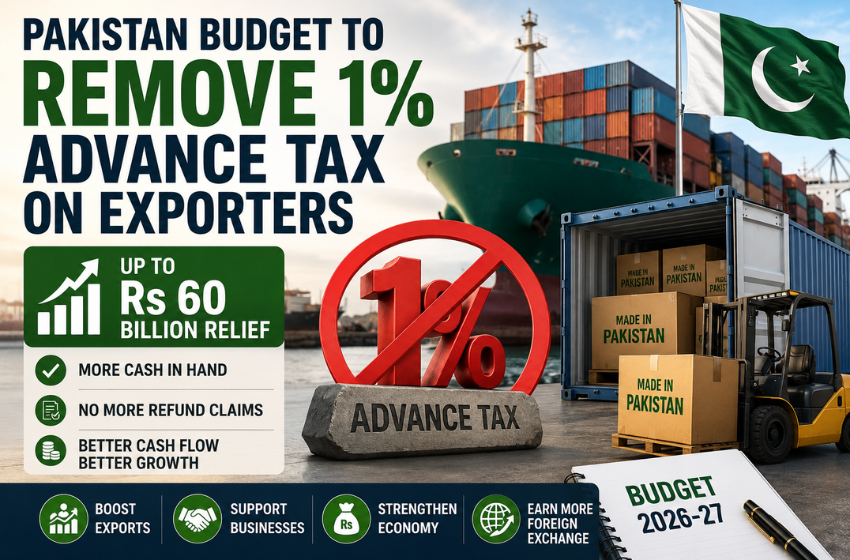
Pakistan Budget to Remove 1% Advance Tax on Exporters
The government plans to scrap the 1% advance tax on exporters, currently paid on every shipment. This will give exporters direct financial relief of up to Rs 60 billion. It will also end the need to file refund claims, which were piling up because of this tax.
Pakistan’s upcoming federal budget has big relief in store for exporters. The government is preparing to remove the 1% advance tax on exports in the 2026-27 budget. This single decision could unlock Rs 60 billion in relief and help clear refund claims that businesses have waited months to receive.
Here is everything you need to know.
Why the Removal of 1% Advance Tax on Exporters Matters to You?
If you run an export business in Pakistan, this change directly affects your cash flow and tax compliance workload.
Right now, you pay 1% advance tax on every export transaction. That money sits locked in the tax system. To get it back, you have to file a refund claim. However, authorities have not processed these claims on time. This creates a cash crunch.
The government has heard the complaints. And now it is taking action.
What Is Advance Tax on Exporters?
Advance tax is a pre-payment of tax that businesses make before their actual tax liability is calculated. For exporters, this means paying 1% on every shipment they send out of Pakistan.
The idea was to collect tax upfront. But in practice, it created problems. Exporters often qualify for tax refunds because of zero-rated or export-linked exemptions. When businesses pay a 1% advance tax but later owe less tax—or no tax at all—they must file refund claims to recover the excess amount.
Authorities failed to process many of these refund claims quickly, leaving billions of rupees tied up and unavailable to businesses. And exporters were running short on working capital.
The Rs 60 Billion Relief
Sources close to the budget planning process have confirmed that removing this 1% advance tax will give exporters up to Rs 60 billion in financial relief in the next fiscal year.
This is not a small number. For a country trying to boost its exports and grow foreign exchange earnings, freeing up Rs 60 billion in exporter cash could have a real economic impact.
More cash in the hands of exporters means more ability to buy raw materials, expand production capacity, and increase shipments.
IMF Was Also Consulted
This is not a decision Pakistan made alone. The government has held discussions with the International Monetary Fund (IMF) about removing this advance tax in the next fiscal year.
Pakistan is currently working under an IMF loan program. Any major tax change requires either IMF approval or at least a green light in principle.
The fact that the IMF was consulted and talks have already happened suggests this relief measure is likely to move forward. It is not just a promise. It is a planned policy shift that has been discussed at an international level.
What Happens to Pending Refund Claims?
Once the 1% advance tax is removed, the situation changes completely.
Right now, exporters pay 1% advance tax on shipments. They then file refund claims to recover that money. Those claims pile up in the FBR system. Processing is slow. Cash remains locked.
When the advance tax goes away, there is nothing to pay in advance. So there are no refund claims to file. The entire cycle ends.
Exporters will no longer need to chase the Federal Board of Revenue for money that was rightfully theirs. This will reduce administrative burden, improve cash flow, and make doing business easier.
Why Were Exporters Asking for This?
Pakistan’s export sector has been under pressure for years. Rising energy costs, high interest rates, and global demand slowdowns have squeezed margins.
On top of that, the advance tax was creating a hidden cost. Exporters were effectively giving the government an interest-free loan every time they made a shipment. And they were spending time and resources filing refund claims to get their own money back.
Exporters formally requested that the advance tax condition be removed. The government listened. That request is now expected to be fulfilled in the budget announcement.
What Does This Mean for Pakistan’s Export Growth?
Pakistan has been trying to double its exports and grow its share of global trade. One of the biggest complaints from the export sector has been the tax refund problem.
When exporters cannot get their refunds on time, they face a liquidity problem. That limits how much they can produce and how much they can export.
Removing the advance tax solves this problem at the source. No advance payment means no refund backlog. Clean transactions. Faster business cycles.
This could push more businesses to export. It could make existing exporters more competitive. And it could help Pakistan earn more foreign exchange at a time when the country desperately needs it.
Budget 2026-27: The Big Picture
The government is preparing the federal budget for the fiscal year 2026-27. It is expected to be presented to parliament very soon.
This budget is being shaped under IMF conditions that require fiscal discipline. But there is still room for targeted relief measures that support economic growth. Removing the advance tax on exporters fits this goal. It reduces a friction point without blowing up the tax base.
The government sees a healthier export sector as essential to economic stability. This tax removal is one piece of that larger plan.