Saira Imran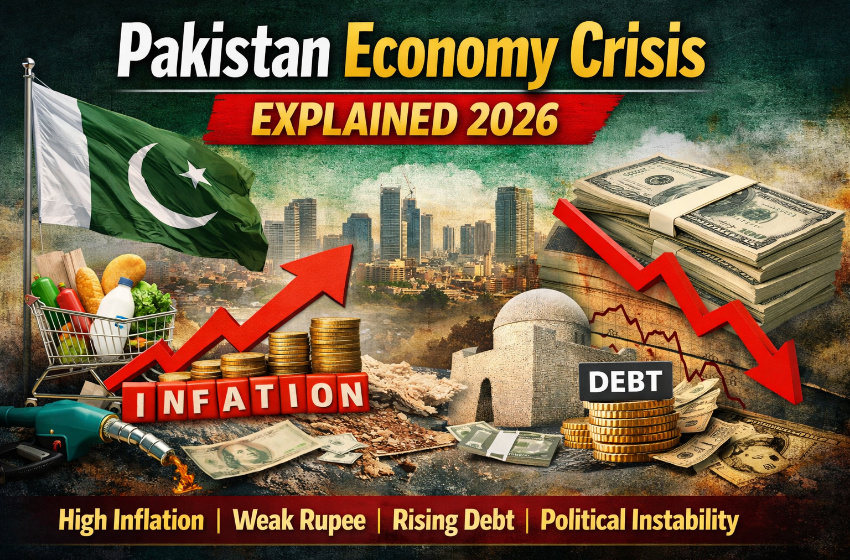
Pakistan Economy Crisis Explained 2026 – Key Reasons
Pakistan’s economy is showing signs of stabilisation in 2026 but has not recovered. GDP growth is projected at 3.6% for FY26. However, rising debt, a widening trade deficit, weak exports, and higher inflation still create serious risks for ordinary citizens.
Pakistan’s economy is at a crossroads in 2026. Inflation is creeping back up. The trade gap is widening again. Public debt has crossed Rs. 80 trillion. And the government is still under an IMF program to keep things from falling apart.
Many families feel the pressure every month. Bills are higher. Jobs are fewer. Savings are losing value. Covering Pakistan’s economy for Ajjkibaat, I have spoken to shopkeepers in Lahore who cannot plan for next month and salaried workers in Karachi who say their take-home pay buys 30% less than it did two years ago. So what is actually going on, and why does this crisis keep returning?
This article breaks it all down, backed by the latest numbers from the IMF, State Bank of Pakistan, and government data.
Where Does Pakistan’s Economy Stand Right Now?
Pakistan’s GDP in 2026 stands at approximately $410.5 billion in nominal terms. GDP growth is projected at 3.6% for FY2026, up from 2.7% in 2025. That sounds positive, but it barely covers population growth of around 2.5% per year. In simple terms, the economy is growing just fast enough to stay in place.
Per capita income sits at just $1,710, ranking Pakistan 162nd in the world. This is the reality for most Pakistani households. Economic growth at the top does not reach the bottom fast enough.
Inflation fell sharply from 23.4% in FY2024 to around 4.5% in FY2025. That was good news. But prices are rising again. The IMF projects inflation at 7.2% for FY2026 and expects it to climb further to 8.4% in FY2027. Higher global oil prices and energy cost pass-throughs are pushing domestic prices up again.
Main Reasons Behind the Pakistan Economy Crisis
Pakistan’s economic crisis in 2026 is driven by seven key problems: a Rs. 80 trillion debt burden, a widening trade deficit, weak exports, rising inflation, an FBR revenue shortfall, low foreign investment, and a chronic energy crisis.
1. Crushing Debt Burden
This is the single biggest problem. Pakistan’s total government debt reached Rs. 80,524 billion (over Rs. 80 trillion) as of March 2026. That figure keeps climbing every month.
A large portion of government revenue goes straight to debt repayment. Interest payments alone consume a massive share of the budget, leaving almost nothing for schools, hospitals, or infrastructure. The country has entered 25 IMF programs since becoming a member in 1950. That pattern shows how deep the structural problem runs.
The IMF currently holds outstanding loans worth SDR 7,138 million from Pakistan as of March 2026. The latest third review under the Extended Fund Facility (EFF) was completed in May 2026, with an additional disbursement of $1.3 billion approved to help cover rising oil import costs.
2. Trade Deficit That Will Not Close
Pakistan imports far more than it exports. In the first seven months of FY2026, goods imports reached $36.7 billion while goods exports were just $18.3 billion. That is a merchandise trade gap of over $18 billion in just seven months.
In April 2026 alone, imports surged to $6.86 billion while exports were only $3.47 billion. This pushed the current account back into a $324 million deficit that month.
The State Bank of Pakistan has admitted that exports are falling due to low productivity, weak global integration, and structural problems in key sectors. The trade gap is not just a number. It means Pakistan needs more dollars than it earns, which constantly pressures the rupee and foreign reserves.
3. Weak Exports and Heavy Reliance on Remittances
Pakistan’s export base is dangerously narrow. Textiles still dominate, with about $16.3 billion in annual textile exports. Total goods exports stood at around $40.7 billion in 2025, while imports reached $78 billion, creating a structural trade deficit that does not go away.
What fills that gap? Remittances. According to the State Bank of Pakistan, workers abroad sent home $38.3 billion in FY2025. The SBP has since revised its FY2026 forecast upward to $42 billion, reflecting strong diaspora support around festive periods. Data published by The Friday Times confirms that over 54% of these inflows originate from Gulf countries: Saudi Arabia, UAE, and Qatar, making Pakistan’s external finances directly exposed to GCC economic conditions.
This reliance is a risk. If political instability or an economic slowdown hits the Gulf, Pakistan’s external finances could collapse within months.
4. Rising Inflation Hurting Real People
After a brief period of relief, inflation is climbing again in 2026. The IMF projects consumer prices at 7.2% for FY26, driven by global commodity prices passing through to domestic energy costs.
Food and fuel prices remain the most volatile categories. These hit lower and middle-income families hardest. When electricity bills and gas prices rise alongside food costs, household purchasing power falls fast. The government has maintained energy subsidies partially, but IMF conditions push for cost recovery pricing, which raises bills.
5. FBR Revenue Shortfall and Fiscal Pressure
The Federal Board of Revenue posted a shortfall of over Rs. 600 billion against its tax collection target in FY2025-26. The government has set an FY2027 revenue target of Rs. 15,564 billion, which requires 19% growth over a base that already missed the target.
The tax-to-GDP ratio remains very low. A large informal economy, tax evasion, and political resistance to taxing agriculture and real estate mean the burden falls on salaried workers and formal businesses. This is both unfair and economically damaging.
6. Low Foreign Direct Investment
Foreign Direct Investment (FDI) dropped sharply to $517 million in the first seven months of FY2026, down from $1.483 billion in the same period a year earlier. Political uncertainty, energy costs, and complex regulations push investors away.
Pakistan ranks very low on global ease of doing business indicators. Without FDI, the country cannot build factories, create jobs at scale, or modernise its export sector. The cycle of low investment, slow growth, and recurring crises continues.
7. Energy Crisis and Power Cuts
Pakistan introduced two-hour daily power cuts in 2026 after the Middle East war disrupted oil and gas shipments and forced the government into austerity. Manufacturing output fell in April 2026 as a direct result.
Circular debt in the power sector remains a massive hidden liability. Capacity charges paid to idle power plants cost the national exchequer billions every year. High electricity tariffs reduce industrial competitiveness and hurt households at the same time.
Timeline: Pakistan’s Major Economic Crises
Pakistan’s economy has faced recurring crises throughout its history. Understanding the pattern helps explain why structural reform, not just emergency aid, is needed.
- 1998: Nuclear tests triggered international sanctions. Foreign exchange reserves collapsed. Pakistan defaulted on external payments.
- 2008: Global financial crisis combined with domestic instability caused a severe balance of payments crisis. The IMF rescued Pakistan with a $7.6 billion program.
- 2018–2019: A current account deficit of over $19 billion and falling reserves forced Pakistan into another IMF program worth $6 billion.
- 2022–2023: Catastrophic floods, global commodity price shocks after Russia’s Ukraine invasion, and political upheaval pushed Pakistan to the brink of default. Inflation hit 38% at its peak in May 2023.
- 2024–2026: Stabilisation under an IMF EFF program. Inflation came down sharply in FY2025, but structural problems remain unresolved. The Middle East war and rising oil prices created new stress in 2026.
How This Affects Ordinary Pakistanis?
Numbers on paper become real problems in daily life. Here is what the crisis means for the average family in Pakistan in 2026.
- Electricity bills remain extremely high due to capacity charges and fuel cost adjustments
- Food prices are volatile, especially wheat, cooking oil, and pulses
- Unemployment is officially at 6.9%, but underemployment is far higher
- 21.6% of the population lives below the poverty line
- Youth employment is a major concern as GDP growth barely keeps pace with new workers entering the market
- The salaried class faces higher income taxes to compensate for tax evasion in informal sectors
According to the UNDP Human Development Report 2025, Pakistan’s Human Development Index score stands at 0.544, ranked 168th out of 193 countries. This places Pakistan in the low human development category, meaning that for millions of people, the economic crisis is not just about numbers on a spreadsheet. It is about shorter lives, fewer years in school, and lower living standards than most of the world.
Will Pakistan’s Economy Collapse?
Total economic collapse is unlikely in the short term. Pakistan has a large population, a growing IT sector, strong remittance inflows, and active IMF support. These factors provide a floor.
However, the IMF itself warned that risks to public debt remain high. A shock to GDP growth, interest rates, or the exchange rate could push debt to unsustainable levels. The primary surplus of 1.6% of GDP expected in FY26 is a positive sign but not enough to reverse the debt trajectory quickly.
The bigger question is not collapse but stagnation. Pakistan risks staying stuck in a low-growth, high-debt, crisis-prone cycle unless deeper reforms happen. That means tax reform, energy sector restructuring, export diversification, and political stability working together.
What Needs to Happen for Recovery?
According to the IMF’s May 2026 third review statement, “Pakistan needs to maintain strong macroeconomic policies while accelerating reform efforts, which are critical to managing further shocks and fostering higher sustainable medium-term growth.” The review identified several priorities that must be addressed urgently.
- Expand the tax base by taxing agriculture and real estate properly
- Resolve circular debt in the power sector and bring electricity costs down for industry
- Diversify exports beyond textiles into IT, pharmaceuticals, and processed food
- Attract stable FDI by improving the regulatory environment and reducing policy uncertainty
- Invest in education and skills to raise productivity
- Control population growth, which dilutes every economic gain
The IMF’s third review noted that Pakistan has made progress on fiscal consolidation. But it also stressed that reform implementation must accelerate, especially in energy and structural areas, to achieve sustainable medium-term growth.
Final Thoughts
Pakistan’s economic crisis in 2026 is real but not hopeless. Stability has returned after the chaos of 2022 to 2024. Inflation has come down from its peak. Reserves are rebuilding. The IMF remains a backstop.
But the structural roots of the crisis- weak exports, a narrow tax base, energy sector dysfunction, and political instability- have not been fixed. Every time external conditions get tough, Pakistan finds itself back in the same place.
For ordinary Pakistanis, recovery means more jobs, lower bills, and a currency that holds its value. That requires consistent policy, honest governance, and long-term investment in the real economy. The data shows the path. The question is whether the will exists to walk it.
About This Article
Written by Saira Imran, Author at Ajjkibaat.com.pk and a Pakistan economy and business journalist covering fiscal policy, energy sector reforms, and consumer impact. This article draws on IMF official review statements (May 2026), State Bank of Pakistan balance of payments data, the Government of Pakistan Monthly Economic Update (April 2026), and reporting by Dawn, The Express Tribune, and ProPakistani. Last updated: June 2026.
FAQs
Pakistan’s nominal GDP is approximately $410.5 billion in 2026. In purchasing power parity terms, it is $1.76 trillion. GDP growth is projected at 3.6% for FY2026 according to IMF data.
After falling to 4.5% in FY2025, inflation is rising again. The IMF projects inflation at 7.2% for FY2026 and 8.4% for FY2027, driven by global commodity prices passing through to domestic energy costs.
Pakistan’s total government debt reached Rs. 80,524 billion (over Rs. 80 trillion) as of March 2026, according to Trading Economics data sourced from the State Bank of Pakistan.
Yes. The IMF completed its third review of Pakistan’s Extended Fund Facility (EFF) in May 2026 and approved an additional $1.3 billion disbursement. Pakistan has entered 25 IMF programs since 1950.
In the first seven months of FY2026, Pakistan’s merchandise trade deficit was over $18 billion. Goods imports reached $36.7 billion against goods exports of only $18.3 billion.
Most economists say a total collapse is unlikely given IMF support, strong remittance inflows, and a large domestic economy. However, the IMF warns that high debt levels and structural weaknesses keep the risk elevated if reforms are delayed.
SBP gross reserves increased to $17.20 billion in April 2026 from $16.69 billion in March. Total reserves, including commercial banks, stood at around $21.3 billion in early 2026.