Saira Imran
How to Reduce Electricity Bill in Pakistan
How to reduce electricity bill in Pakistan is the question that everyone asks nowadays. Electricity bills in Pakistan continue to rise in 2026. Higher base tariffs, fuel adjustments, and taxes make monthly bills difficult for middle-class households. But the situation is not hopeless. With the right habits and a few smart decisions, you can cut your bill significantly—without heavy investment.
This guide shows you exactly how to reduce your electricity bill in Pakistan with real, actionable steps that work for every home.
Understand Your Electricity Bill First
You cannot reduce what you do not understand. Your WAPDA or DISCO bill has several parts. Knowing each one helps you spot savings. Your electricity bill check includes:
- Energy charges (per unit cost)
- Fuel Price Adjustment (FPA)
- GST (18%)
- Fixed charges (meter rent, TV fee, etc.)
Quick Fact: Pakistan uses a slab-based tariff system. The more units you consume, the higher the rate per unit. Staying in a lower slab saves you money on every single unit.
The Slab System Explained
Pakistan uses a progressive tariff. Your rate per unit rises as your consumption rises. Here is a simplified breakdown for residential consumers in 2026:
| Monthly Units | Rate (Rs/unit) | Insight |
|---|---|---|
| 0 – 100 | 10 – 15 | Protected slab (subsidized) |
| 101 – 200 | 18 – 25 | Moderate usage |
| 201 – 300 | 28 – 32 | Costs rise quickly |
| 301 – 500 | 33 – 38 | Heavy usage zone |
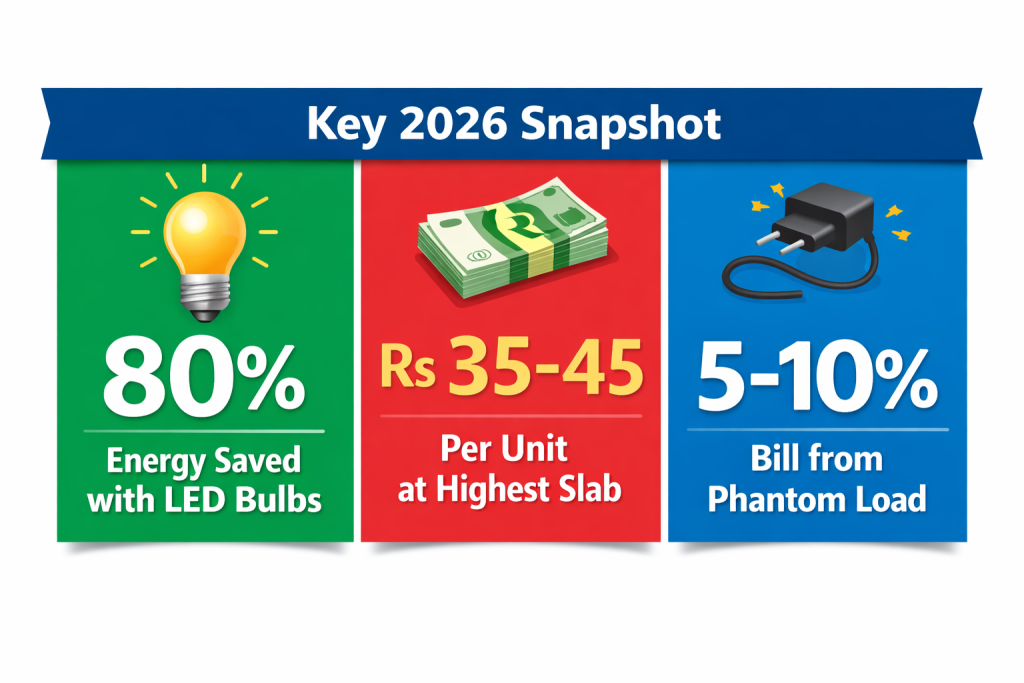
| 500+ | 40 – 45+ | Most expensive slab |
The key insight: Crossing a slab increases the cost of additional units sharply. Staying just below a slab can save thousands of rupees.
Hidden Charges on Your Bill
Your bill is not just the unit cost. It includes GST at 18%, fuel price adjustment (FPA), meter rent, and other fixed charges. These add up fast. Reducing your unit consumption is the most powerful lever — because it reduces both your usage cost and the taxes added on top.
Read Also: Power Distribution Companies Loss 472 Billion Rupees Pakistan
Switch Off and Unplug: The Easiest Wins
This sounds obvious. Most people still do not do it consistently. A fan left running in an empty room wastes hundreds of rupees every month.
- Switch off lights, fans, and TVs when leaving any room
- Unplug phone chargers, laptops, and adaptors when not in use
- Turn off appliances fully — do not leave them on standby
- Open curtains during the day and use natural light
- Position your desk or reading chair near a window
Standby Power Warning: Plugged-in devices consume power even when turned off. This “phantom load” accounts for 5–10% of residential electricity use in Pakistan. Unplug everything you are not actively using.
Upgrade Your Lighting to LED
Old incandescent bulbs and tube lights waste most of their energy as heat. LEDs do not. This single change makes a visible difference on your next bill.
LED bulbs use up to 80% less energy than traditional bulbs. They also last 25 times longer. Switching 8 to 10 bulbs in your home can cut your lighting bill by 15 to 20%.
“Switching just 8–10 bulbs to LED can reduce your electricity bill by 15–20% — without changing any other habit.”
Yes, LEDs cost more upfront. But they pay for themselves within a few months. After that, every month is pure savings.
Control Your Air Conditioner Wisely
In Pakistan, the AC is the single biggest electricity consumer in summer. It can triple your bill if you use it carelessly.
The 26°C Rule
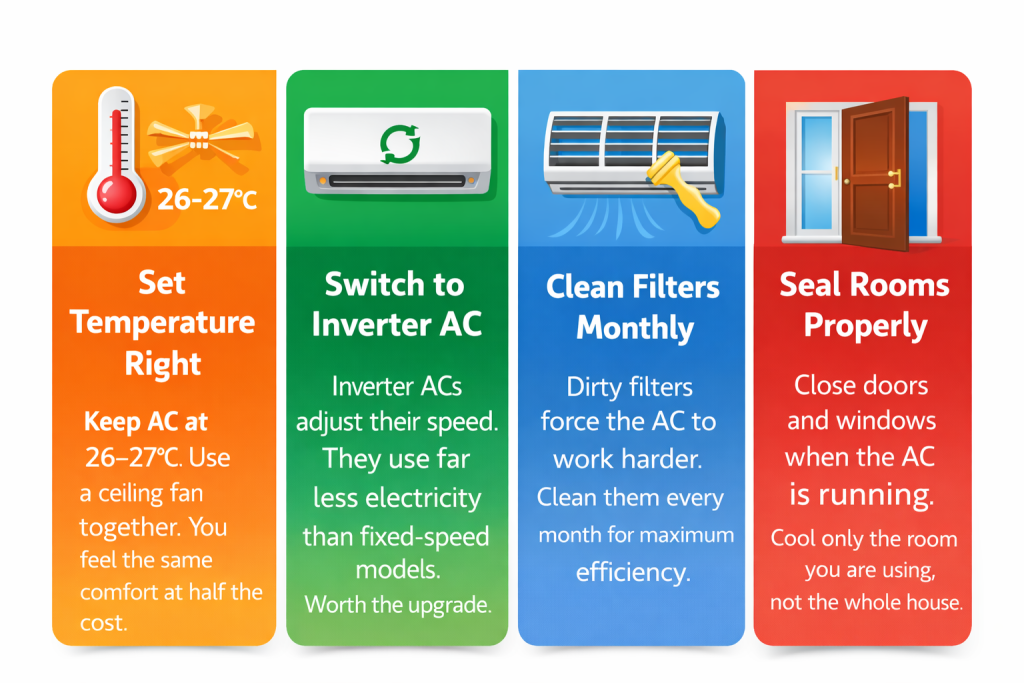
Set your AC to 26–27°C. Do not go below 24°C. Every degree lower increases energy consumption by 3 to 5%. At 18°C, your AC runs almost non-stop. At 26°C with a ceiling fan, the room feels just as cool — and your bill drops significantly.
Avoid Peak Hours to Save on Bills
In Pakistan, electricity demand spikes in the evening. From 6 PM to 10 PM, everyone turns on lights, fans, TVs, and ACs at the same time. This is the peak window.
For consumers with three-phase meters and Time of Use (TOU) tariffs, electricity costs more during these hours. Everyone should avoid running heavy appliances in this window.
- Run the washing machine before 6 PM or after 10 PM
- Iron clothes in the morning, not the evening
- Avoid running the water motor during peak hours
- Use the microwave and oven earlier in the day
- Charge laptops and phones during off-peak hours
Peak Hour Tip: Keep heavy appliance use limited between 10 PM and 6 PM. If you shift just two or three daily habits, you noticeably reduce your load — and your bill.
Replace Old Appliances with Energy-Efficient Ones
Old refrigerators, water heaters, and motors consume far more power than modern equivalents. An old fridge from 10 years ago can use twice the electricity of a new energy-rated model.
What to Look for When Buying
Always check for NEPRA-approved, energy-rated appliances. The energy label shows you how much the appliance costs to run each year. A higher rating means lower running costs, even if the purchase price is slightly higher.
For water heating, instant electric geysers use a lot of power for short bursts. Solar geysers or gas geysers are far cheaper for family use over time.
For laundry, front-loading washing machines use 30 to 40% less water and electricity than top-loaders. They cost more, but they save every single month.
Go Solar: The Long-Term Solution
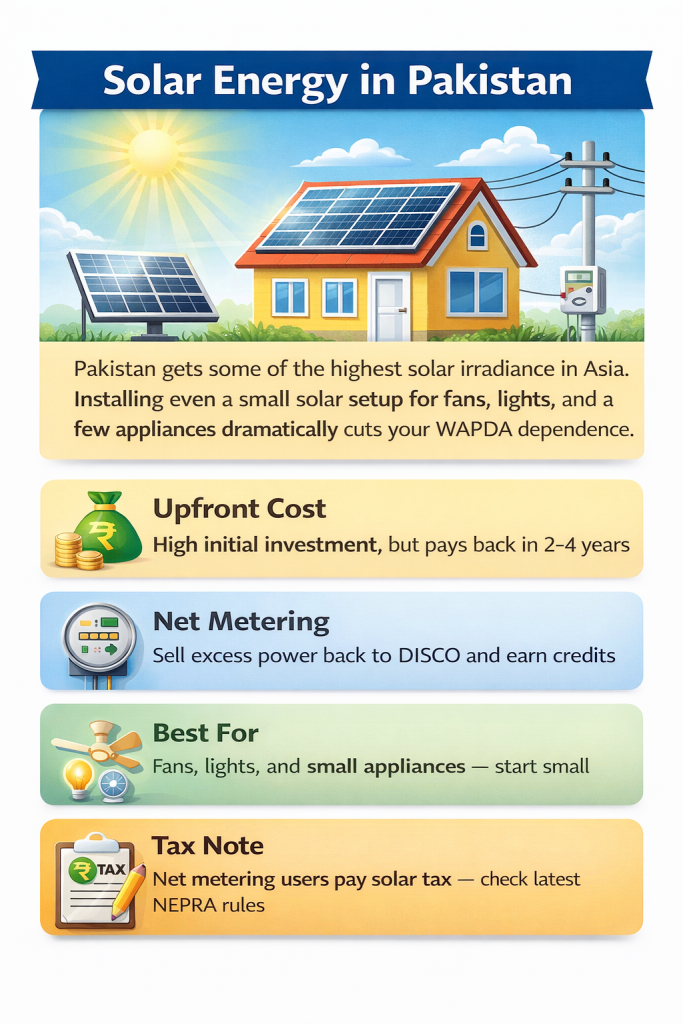
Solar panels are no longer a luxury. Prices have dropped significantly in Pakistan. Many families have cut their monthly WAPDA bill to near zero using a medium-sized solar system. Even a small setup for lights and fans gives you months of relief each summer.
Read Also: Historic Increase in Energy Production in Pakistan
Use Seasonal Tips for Winter and Summer
Summer Tips
Keep curtains and blinds closed during peak sunlight hours. This blocks heat from entering the room. Your AC works less. Use light-coloured curtains that reflect heat outward.
Plant trees or install shading near windows if possible. Natural shading reduces indoor temperature by 3 to 5 degrees — meaning your AC runs less.
Winter Tips
Open curtains during the day to let in sunlight. It warms the room naturally. Wear warm clothes inside instead of cranking up an electric heater. Keep unused rooms closed so heat stays concentrated in occupied spaces.
Use central or wall heaters over room heaters. Place rugs on floors — cold floors make rooms feel colder, forcing you to use more heating.
Check Your Meter and Verify Your Bill
Sometimes the problem is not your usage — it is your meter or bill. Overbilling does happen in Pakistan. Reading your own meter and comparing it with your bill protects you.
- Read your meter every two weeks and note the units
- Use your DISCO’s online bill calculator to estimate your expected bill
- If actual units match but the bill seems high, check for wrong tax slab application
- Report suspected overbilling to your DISCO immediately
- Download the Power Smart App (Apna Meter Apni Reading) to submit your own reading
Apna Meter Apni Reading: Pakistan’s Ministry of Power launched the Power Smart App so consumers can submit their own meter readings. This prevents wrong readings and stops unnecessary slab upgrades from delayed meter visits.
Make It a Family Effort
One person cannot save electricity in a home of five. Everyone must participate. Teach children to switch off lights when leaving rooms. Remind elders not to leave fans running in empty spaces. Make it a habit, not a one-time effort.
When the whole family works together, the bill drops faster than any single habit change can achieve. Some families in Pakistan have reduced their monthly bill by 30 to 40% simply through consistent household discipline.
“Saving electricity is not one person’s job. When all family members help, the bill goes down faster.”
Final Thoughts: Start Today
You do not need expensive gadgets or a major renovation to reduce electricity bill in Pakistan. You need consistent, small changes.
Start with the easy wins: switch off lights, unplug chargers, and set your AC to 26°C. Then upgrade your bulbs to LED. Then shift heavy appliance use away from peak hours. Over time, consider an inverter AC or a small solar setup.
Every habit you build saves you money this month, next month, and every month after that. The national grid also benefits — less demand means less load shedding for everyone.
Start today. Your next bill will already be lighter.