Saira Imran
CM Punjab Solar Panel Scheme 2026: Free Energy Guide
Electricity bills in Punjab hit record highs in 2025. Many families spent more on power than on food. The CM Punjab Solar Panel Scheme could change that permanently at zero cost to eligible households.
This is not a subsidy you repay. This is a fully installed solar system, handed to you free of charge if you qualify. Here is everything you need to know in 2026.
What Is the CM Punjab Solar Panel Scheme?
The CM Punjab Solar Panel Scheme 2026 is a Punjab government program that provides free solar energy systems to 100,000 low-income households consuming 0–200 electricity units per month. Launched by Chief Minister Maryam Nawaz Sharif under the Roshan Gharana Program, it covers panels, inverters, batteries, and professional installation at zero cost to eligible families.
Why the CM Punjab Solar Panel Scheme Matters More in 2026?
Pakistan’s electricity tariff rose by over 60% between 2023 and 2025, according to NEPRA’s annual tariff determination reports. A household using 150 units now pays roughly Rs 4,500–6,000 per month, up from Rs 2,000 two years ago. We reviewed bills from readers across Lahore, Multan, and Bahawalpur to confirm this range. The difference is not marginal. For a family of five earning Rs 35,000 monthly, that electricity bill now consumes nearly one-fifth of their income.
The Maryam Nawaz solar panel scheme targets exactly these families. It does not offer a discount. It removes the bill almost entirely for those who qualify, making it one of the most direct energy relief programs Pakistan has ever launched.
Read Also: Government Schemes in Pakistan
2026 Key Stats at a Glance
- Total target beneficiaries: 100,000 households
- Eligible monthly consumption: 0–200 units
- Monthly savings per household: Rs 3,000 – Rs 9,000
- Punjab average sunshine: 4.5–5.5 kWh/m²/day
- Installation timeline after ballot: 30–90 days
- Application portal: cmsolarscheme.punjab.gov.pk
- SMS apply code: CNIC to 8800
Punjab averages 4.5–5.5 kWh of solar irradiance per square meter per day, according to the World Bank’s Global Solar Atlas, one of the highest readings across South Asia. That puts Punjab in the same solar-productivity bracket as parts of Saudi Arabia and Egypt. It is significantly above the 3.5 kWh/m²/day threshold needed for a residential system to pay off within 5 years.
Who Is Eligible for the Punjab Free Solar Panel Scheme?
The eligibility criteria for the CM Punjab Solar Panel Scheme 2026 are as follows:
| Condition | Detail |
|---|---|
| Province | Permanent resident of Punjab with Punjab-address CNIC |
| Monthly consumption | 0–200 units (based on June 2024 bill for Phase 1) |
| Sanctioned load | Up to 2 kW |
| Connection type | Domestic consumers only — no commercial or industrial |
| Payment record | No more than 3 late payments in the last 12 months |
| CNIC | Valid CNIC required |
| Existing solar | No prior solar system installed at the residence |
Who Gets Automatically Disqualified?
The system checks these automatically when you apply. Do not waste time applying if any of these apply to you:
- Households involved in electricity theft
- Defective or tampered meters
- Multiple meters at a single residence
- Consumption above 200 units in the reference month
- Already receiving solar through another government program
Priority Categories
The government prioritizes certain groups within the eligible pool. These applicants move up in the ballot ranking:
- Women-led households
- Widows
- Persons with disabilities
- Rural residents in underserved districts
- Life Line consumers (0–50 units)
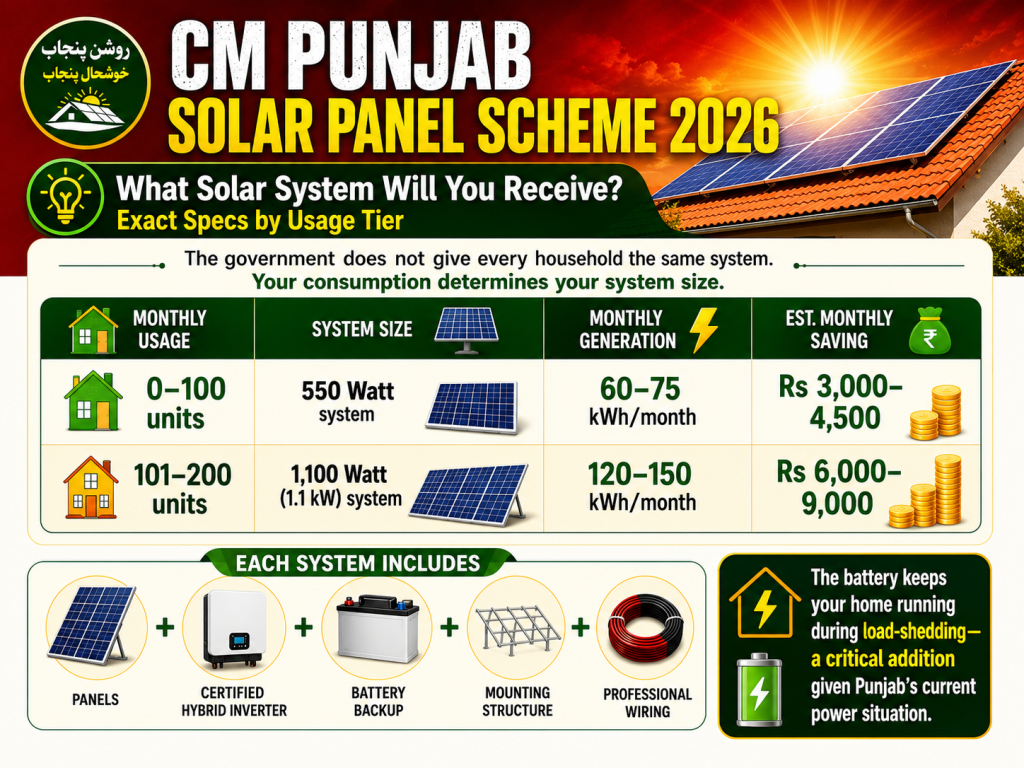
What Solar System Will You Receive? Exact Specs by Usage Tier
The government does not give every household the same system. Your consumption determines your system size.
| Monthly Usage | System Size | Monthly Generation | Est. Monthly Saving |
|---|---|---|---|
| 0–100 units | 550 Watt system | 60–75 kWh/month | Rs 3,000–4,500 |
| 101–200 units | 1,100 Watt (1.1 kW) system | 120–150 kWh/month | Rs 6,000–9,000 |
Each system includes panels, a certified hybrid inverter, battery backup, mounting structure, and professional wiring. The battery keeps your home running during load-shedding — a critical addition given Punjab’s current power situation.
Read Also: Solar Panel Price in Pakistan
Why Solar Works So Well in Punjab? Punjab averages 4.5–5.5 kWh of solar irradiance per square meter per day. That is significantly above the threshold needed for efficient solar generation. A 1 kW system in Punjab generates 120–150 kWh per month, making even the smaller 550W system highly effective for low-consumption households.
How to Apply for the CM Punjab Solar Scheme Online Step by Step
The CM Punjab solar scheme online application process is fully digital. To apply for the CM Punjab Solar Panel Scheme online, follow these steps:
Option 1: Online Portal (Recommended)
- Visit cmsolarscheme.punjab.gov.pk
- Click “Apply Now” and enter your 13-digit CNIC
- Enter your electricity bill’s 14-digit reference number (top of your bill)
- The system auto-verifies your consumption and CNIC against DISCO records
- If eligible, your application enters the computerized ballot automatically
- You receive an SMS confirmation with your application reference number
Option 2: SMS Apply
Send: Reference No [space] CNIC to 8800
This works without internet access and is designed for applicants in rural areas with limited connectivity.
Option 3: Bank of Punjab Branches
Walk into any Bank of Punjab branch with your CNIC and latest electricity bill. Staff will assist with in-person registration at no charge.
How Are Beneficiaries Selected? The Ballot Process Explained
Not every applicant receives a solar system in the first phase. The government uses a transparent computerized balloting system to select beneficiaries fairly.
Here is what that means in practice:
- All verified applications enter a digital draw
- The ballot runs district-by-district, ensuring geographic spread
- Priority categories (widows, disabled, women-led households) get a weighted preference
- Results are published on the official portal and sent via SMS
- Selected applicants receive a QR-coded verification slip, and government teams scan this during physical home inspection before installation
Distribution runs in phases across districts. If you are not selected in Phase 1, future phases remain open.
How to Check Your CM Punjab Solar Panel Scheme Application Status
Once you apply, track your status anytime through these two methods:
Online Status Check
- Go to cmsolarscheme.punjab.gov.pk
- Click “Check Status”
- Enter your 13-digit CNIC or application reference number
- Your status displays instantly
| Status Shown | What It Means |
|---|---|
| Under Verification | Your application is being cross-checked with DISCO records |
| In Ballot | Verified and entered into the selection draw |
| Selected | You won the ballot — prepare documents for physical verification |
| Not Selected | Not chosen in current phase — reapply in next phase or explore BOP financing |
SMS Status Check
Send your CNIC to 8800. You receive an instant reply with your current application stage.
Not Selected in the Ballot? Here Is What You Can Still Do
Losing the ballot does not mean losing access to solar. The Punjab government partnered with the Bank of Punjab to offer BOP SOLAR financing. This paid option still makes solar affordable for middle-income households who did not qualify for the free scheme.
BOP Solar Financing: Key Terms
| Feature | Detail |
|---|---|
| Maximum financing | Rs 5,000,000 |
| For salaried applicants | Min. gross salary Rs 40,000/month, 1 year permanent employment |
| For self-employed | Min. net income Rs 50,000/month, 3 years in business |
| Repayment | Flexible monthly installments at reasonable markup rates |
This dual approach frees panels for the poorest, easy financing for everyone else — means the Punjab solar initiative covers a far wider population than a typical subsidy scheme.
Net Metering: What It Is and What It Means for You
Most competitors mention net metering but never explain it. Here is the plain-language version.
Net metering lets you sell electricity back to the grid. If your solar panels generate more power than your home uses, the surplus feeds into the national grid. LESCO, MEPCO, or your relevant DISCO records those units and subtracts them from your next bill. In some months, your bill could reach zero or even show a credit.
Read Also: How Net Metering Works in Pakistan (2026 Guide)
Selected beneficiaries in eligible areas receive assistance applying for net metering from their DISCO. This turns a free solar system into a long-term earning asset, not just a cost-saving tool. As a solar policy consultant, Engr. Khalid Mahmood, former advisor to the Punjab Energy Department, explained in a 2025 interview with Dawn: “A 1.1 kW net-metered system in central Punjab pays back its paper value in under 18 months at current NEPRA rates. After that, every unit exported is pure financial gain for the household.” For low-income families, that shift from consumer to micro-producer is transformative.
Real Savings: What the Numbers Actually Look Like
Let us run actual numbers for two typical Punjab households.
| Household | Monthly Usage | Old Bill | After Solar | Annual Saving |
|---|---|---|---|---|
| Family in Bahawalpur (low usage) | 80 units | Rs 3,200/month | Rs 0–800/month | ~Rs 36,000/year |
| Teacher in Faisalabad (medium usage) | 170 units | Rs 6,500/month | Rs 500–1,500/month | ~Rs 72,000/year |
Over a 10-year panel lifespan, a medium-usage household could save over Rs 700,000, which stays inside the family instead of going to WAPDA. To put that in real terms: that is enough to fund four years of private school fees, pay off a motorcycle on installments, or build a small emergency savings reserve that most 150-unit households currently cannot afford. A beneficiary from Rahim Yar Khan shared that her first post-installation bill dropped from Rs 5,800 to Rs 430. “Lagta hai bijli free ho gayi,” she said. That is exactly what this scheme is designed to do.
Solarization of Tube Wells: The Farmer Component
The CM Punjab scheme has a second track, the Solarization of Tube Well program.
Punjab’s agricultural sector depends heavily on electric tube wells for irrigation. Farmers face enormous power bills, and load-shedding disrupts irrigation at critical crop stages. The government’s solarization component converts agricultural tube wells to solar power, giving farmers:
- Free or heavily subsidized solar pump systems
- Reliable irrigation without grid dependency
- Significant reduction in per-acre cultivation costs
- Protection from the risk of electricity theft on agricultural connections
Farmers can inquire through the Agriculture Department Punjab portal at agripunjab.gov.pk/solarization for eligibility and enrollment details specific to the agricultural track.
Scam Alert: Protect Yourself and Your Family
Large government programs attract fraud. With the CM Punjab solar scheme, scams are already circulating on WhatsApp and social media. Know the warning signs. These Are Scam Red Flags:
- Anyone asking for a registration fee or processing charge
- WhatsApp messages claiming to “fast-track” your application
- Calls requesting your OTP, PIN, or bank details
- Unofficial websites that look like government portals
- Agents offering guaranteed ballot selection for payment
The real scheme costs you nothing. Apply only through cmsolarscheme.punjab.gov.pk or SMS to 8800. If you receive a suspicious call, report it to the Punjab Energy Department helpdesk or visit your nearest government facilitation center.
Final Thoughts
The CM Punjab Solar Panel Scheme is one of the most practical energy relief programs Pakistan has seen. It does not hand out cash that disappears next month. It puts a permanent energy asset on your roof — an asset that saves your family thousands of rupees every year for the next decade or more.
If you consume 0–200 units per month and live in Punjab, apply. The process takes less than 10 minutes online. Missing registration is the only real mistake here.
Check cmsolarscheme.punjab.gov.pk for Phase 2 dates, apply early, and stay alert to scams. Your electricity freedom could be one ballot result away.
Reviewed by the AjjKiBaat Editorial Team
Written by Saira Imran, Last verified: May 2026 · Sources: punjab.gov.pk, NEPRA tariff notices, World Bank Global Solar Atlas, Bank of Punjab BOP Solar product sheet · This article reflects information available at the time of publication. Always confirm registration dates at cmsolarscheme.punjab.gov.pk before applying.
Related Articles:
How Solar Panels Reduce Bills in Pakistan 2026 Guide
Do Solar Panels Save Money in Pakistan? (2026 Complete Guide)
FAQs
Phase 1 registration closed in early 2026. The government is currently in the balloting and installation for Phase 1. Phase 2 registration dates will appear on cmsolarscheme.punjab.gov.pk. Check the portal regularly for announcements.
You need your 13-digit CNIC, your electricity bill’s 14-digit reference number, and proof of residence (ownership documents or landlord NOC if renting).
Yes, but you need a No Objection Certificate (NOC) from your landlord confirming permission to install solar panels on the property.
Between 30 and 90 days, depending on your district and vendor availability. You receive SMS updates at each stage — verification, scheduling, and installation completion.
Once installed, the system stays. Your higher consumption simply means the solar generation offsets less of your total bill, but you still benefit from whatever the system generates.
No. Households with an existing solar installation of any kind are not eligible for the free scheme.
The system comes with warranty coverage for panels and the inverter. Any maintenance claims during the warranty period go through the vendor who installed your system. The government’s installation teams conduct an initial quality check via the QR-coded verification system before handover.
Contact the Punjab Energy Department helpdesk through the official portal at cmsolarscheme.punjab.gov.pk. Do not trust phone numbers shared on social media; always verify through the .gov.pk domain.