Saira Imran
Solar Panel Price in Pakistan Today (2026 Guide)
The solar panel price in Pakistan today sits between Rs. 28 and Rs. 43 per watt for A-grade Tier-1 brands — depending on the brand, technology, and your city. I have visited wholesale markets in Lahore’s Hall Road and Karachi’s Saddar twice in the past three months to track these rates directly from importers. Price alone is not the full story anymore. In February 2026, NEPRA quietly changed the rules of the game, and anyone buying solar without knowing this is making an expensive mistake.
This guide covers everything: current brand-by-brand prices, how to read the market, what the NEPRA Prosumer Regulations 2026 mean for your investment, and which brands give you the best value in 2026.
May 2026 Brand-by-Brand Solar Panel Price in Pakistan Today
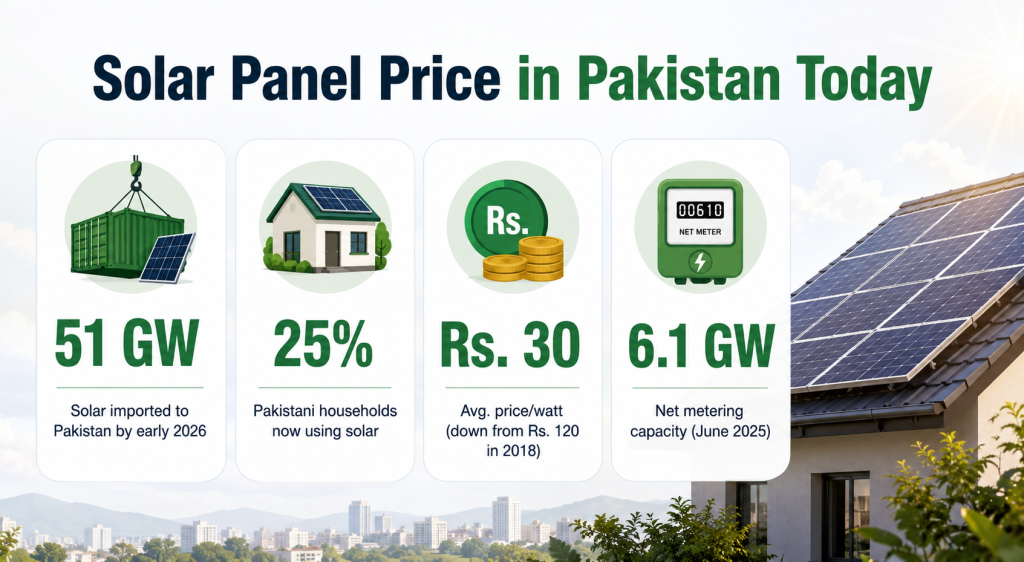
Solar panel price in Pakistan today ranges from Rs. 38 to Rs. 43 per watt for A-grade Tier-1 brands (May 2026). Jinko N-Type costs Rs. 42.50/watt, Longi Hi-Mo 7 costs Rs. 40–40.50/watt, and budget Tier-1 options start at Rs. 38/watt. Prices change daily with the USD/PKR rate.
| Canadian TopCon N-Type Tier 1 · 710W Large Format | Wattage | Price / Watt | Est. Panel Price |
|---|---|---|---|
| Jinko N-Type BifacialTiger Neo · Tier 1 Documented | 585W | Rs. 42.50 | Rs. 24,862 |
| Jinko HOT-3 N-TypeTier 1 · 720W Large Format | 720W | Rs. 43 | Rs. 30,960 |
| Canadian TopCon BifacialTier 1 · Double Glass | 585W | Rs. 42.50 | Rs. 24,862 |
| Canadian TopCon N-TypeTier 1 · 710W Large Format | 710W | Rs. 43 | Rs. 30,530 |
| Longi Hi-Mo 7 N-TypeBifacial · 18 Busbar · Tier 1 | 585W | Rs. 40–40.50 | Rs. 23,693 |
| Longi Hi-Mo 10X HPBC 2.0Premium · Monofacial Technology | 640–645W | Rs. 40–41 | Rs. 26,240 |
| Trina N-Type BifacialTier 1 · Documented | 585W | Rs. 40 | Rs. 23,400 |
| JA N-Type BifacialTier 1 · 16 Busbar | 610W | Rs. 40 | Rs. 24,400 |
| Astro Energy N-Type BifacialA-Grade · 20 Busbar | 585W | Rs. 40.50 | Rs. 23,693 |
| Sunpro Bifacial A-GradeTier 1 · Documented | 580W | Rs. 38 | Rs. 22,040 |
| Risen N-Type TopConTier 1 · Documented | 585W | Rs. 38 | Rs. 22,230 |
| TW Solar N-Type TopConTier 1 · Documented | 585W | Rs. 39 | Rs. 22,815 |
Prices were last verified on May 7, 2026, via the Lahore wholesale market. Dollar rate reference: PKR 278.5/USD (SBP, May 7, 2026).
A-Grade vs B-Grade Panels: Which One Should You Buy?
A-grade panels come directly from a brand’s primary production line and meet full efficiency, durability, and warranty specifications. They carry 25-year performance warranties and come with customs clearance documentation proving they are genuine Tier-1 imports.
B-grade panels are factory seconds; they may have micro-cracks, minor colour variations, or small physical blemishes. They cost Rs. 8–12/watt less, but their actual power output is often 5–10% below the rated wattage, and they degrade faster. Dealers rarely offer full warranty support on B-grade panels.
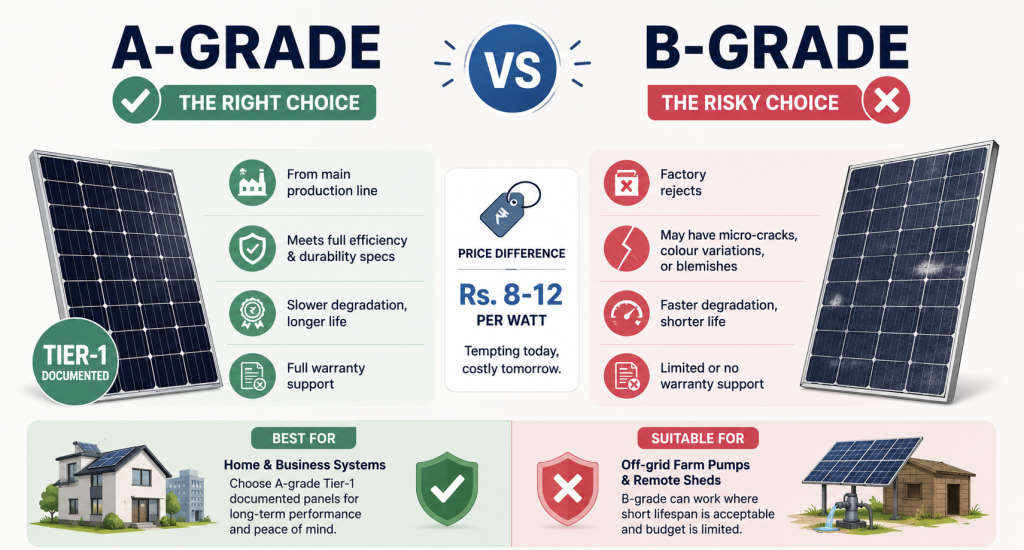
For any grid-tied home or business system, always choose A-grade Tier-1 documented panels. B-grade is only acceptable for off-grid setups like farm pumps or remote lighting, where long-term output matters less.
Solar Panel Price Per Watt in Pakistan: What Actually Drives the Rate?
The solar panel price per watt in Pakistan does not change randomly. Four specific forces move the market, and understanding them helps you time your purchase.
Dollar Exchange Rate
Pakistan imports almost all panels from China. Every transaction happens in USD. When the rupee weakens, panel prices rise the next day. In 2022–23, when the dollar jumped from Rs. 180 to Rs. 300, per-watt prices shot from Rs. 85 to Rs. 130+. In 2026, relative dollar stability has kept prices in the Rs. 28–43 range.
Import Duties & GST
The government has reduced some duties to encourage solar adoption. However, a 17% GST still applies to certain components. Even with the tax, solar remains far cheaper than a WAPDA bill in 2026. Government policy changes can create a 10–15% swing in prices overnight.
Panel Technology
N-Type TopCon and HJT (Heterojunction) panels dominate in 2026. They cost 15–20% more than older P-Type panels but produce more power per square foot. If your roof space is limited, spending more per watt on N-Type saves you money overall.
Shipping Costs
Panels travel from Chinese factories to Karachi Port, then to your city. In 2026, global shipping rates are relatively stable. But any geopolitical crisis like the Iran-Israel conflict affecting the Strait of Hormuz can push freight costs up sharply.
Pakistan’s Solar Boom in Numbers: From under 1 GW of solar imports in 2018, Pakistan reached a staggering 51 GW of imported solar capacity by early 2026, making it one of the fastest-growing solar markets in the world. A quarter of Pakistani households now generate their own power, a figure that would have seemed impossible just five years ago.
Solar System Price in Pakistan: The Real Total Cost (Not Just Panels)
Most buyers focus on panel prices and miss the full picture. The solar system price in Pakistan includes the inverter, battery (if hybrid), mounting structure, wiring, and installation. Here is what a complete setup actually costs in 2026.
Read Also: How Solar Panels Reduce Bills in Pakistan 2026 Guide
| System Size | Best For | On-Grid Cost | Hybrid Cost (with Battery) |
|---|---|---|---|
| 3 kW | Small home (2–3 ACs off) | Rs. 350,000–450,000 | Rs. 550,000–750,000 |
| 5 kW | Medium home (1–2 ACs) | Rs. 550,000–700,000 | Rs. 850,000–1,100,000 |
| 10 kW | Large home or small business | Rs. 950,000–1,200,000 | Rs. 1,400,000–1,800,000 |
| 20 kW | Commercial / factory | Rs. 1,800,000–2,200,000 | Rs. 2,500,000+ |
Hybrid systems include lithium battery backup. Prices include Tier-1 panels, inverter, structure, wiring, and installation. Installation alone typically costs Rs. 20,000–50,000 depending on system size.
Inverter Prices in Pakistan 2026
A good inverter is the brain of your solar system. Huawei SUN2000 and Growatt SPH are the top choices for residential systems. A 5 kW on-grid inverter (Solis) starts at around Rs. 120,000. A 10 kW hybrid inverter from Huawei or Growatt costs Rs. 300,000 and above. Budget inverters exist, but they come with reliability risks that cost more to fix later.
Batteries: Why They Matter More in 2026
Before February 2026, most homeowners skipped batteries because the grid acted as a free storage bank through net metering. That advantage is gone. Under the new net billing policy, the grid pays you only Rs. 11 per unit for exported power but charges you Rs. 40–50 per unit when you buy it back. Every unit you store in a battery and use yourself is now worth 3–4 times more than what you’d earn by exporting it.
Solar Panel Price in Pakistan by City May 2026
Panel prices vary by city for three reasons: logistics costs from Karachi Port, dealer margins, and local demand density. Here is a snapshot of city-level pricing for A-grade N-Type panels.
| City | Avg. Price / Watt | Wholesale Market | Reason for Difference |
|---|---|---|---|
| Karachi | Rs. 28–38 | Saddar, SITE Area | Direct port access — lowest logistics cost |
| Lahore | Rs. 38–42 | Hall Road | Highest demand city — most competitive |
| Islamabad | Rs. 38–43 | I-9 Industrial Area | Premium residential market, fewer dealers |
| Rawalpindi | Rs. 37–41 | College Road | High dealer density keeps prices competitive |
| Faisalabad | Rs. 38–42 | Susan Road | Industrial solar demand pushes volume pricing |
| Peshawar | Rs. 39–43 | Hayatabad Industrial | Farthest from port — higher transport cost |
Loose panel rate (single panel purchase) adds Rs. 0.25/watt over pallet (bulk) rate.
Net Metering vs Net Billing: NEPRA Prosumer Regulations 2026
Net billing is Pakistan’s new solar policy under NEPRA Prosumer Regulations 2026. Unlike the old net metering system, which credited exported electricity at the same rate you pay, net billing pays solar owners just Rs. 11 per exported unit while they buy electricity from WAPDA at Rs. 40–60 per unit. It replaced net metering on February 9, 2026.
In February 2026, NEPRA replaced Pakistan’s decade-old net metering system with a new “net billing” framework under the NEPRA Prosumer Regulations 2026 (officially notified February 9, 2026; full text available on nepra.org.pk). This is the single biggest change to solar economics in Pakistan since 2015, and most price-listing sites are not explaining it.
| ❌ Old Net Metering (Pre Feb 2026) | ✅ New Net Billing (Post Feb 9, 2026) |
| Exported 1 unit → credited 1 unit (1:1) | You export at Rs. 11/unit — buy back at Rs. 40–50/unit |
| Many households got zero bills monthly | No more 1:1 offset — separate buy/sell rates |
| Buyback at Rs. 25.9/unit | Contract term reduced to 5 years |
| 7-year contract term | Grid capacity cap: 80% per transformer |
| Unit-for-unit offset — very profitable | Self-consumption is now the winning strategy |
Who Is Affected? Existing net metering users (contracts signed before February 9, 2026) keep their old terms until their contracts expire as confirmed by NEPRA’s amendment. New buyers applying after February 9, 2026 fall entirely under the new net billing rules. If you are buying solar for the first time in 2026, you must plan your system around self-consumption, not grid export.
What This Means for Your Solar Strategy in 2026
Under the old rules, a large on-grid system made perfect sense; you sent surplus power to the grid and got full credit. Now, every unit you export earns Rs. 11 while every unit you pull from the grid costs Rs. 40–50. The gap is enormous.
The smart strategy for new buyers has three parts. First, size your system to match your actual daytime consumption; do not oversize. Second, shift your heavy loads (AC, water heater, washing machine) to solar hours (9 AM–4 PM). Third, add battery storage to capture afternoon surplus for evening use instead of exporting it at a loss.
ROI Is Still Strong — Just Different: Despite the policy change, solar remains one of the best investments in Pakistan in 2026. A well-designed system that maximises self-consumption pays back in 2.5–4 years. Rising WAPDA tariffs (Rs. 40–60/unit for high slabs) make every solar unit you self-consume more valuable — not less.
Solar Panel Brands in Pakistan: Tier-1 Versus Local, and How to Spot Fakes
With Pakistan’s solar boom, counterfeit and mislabelled panels have flooded the market. Understanding solar panel brands in Pakistan helps you avoid spending Rs. 200,000+ on panels that underperform or fail within three years.
Tier-1 Brands Worth the Premium
Tier-1 simply means the manufacturer is on Bloomberg’s bankability list — they have a proven track record, solid financials, and honour their warranties. Longi, Jinko, Canadian Solar, Trina, JA Solar, and Astro Energy are all Tier-1.
“In five years of installing solar systems across Lahore and Faisalabad, I have never seen a Tier-1 documented panel fail its performance warranty in the first decade. The only panel failures I replaced were B-grade and uncertified imports,” says Usman Tariq, a NEPRA-certified solar installer with over 400 installations completed since 2020.
They are pricier, but they back their 25-year performance warranty. For any home or commercial installation, a Tier-1 documented panel is non-negotiable.
Local and Budget Brands
Pakistani brands like Reon Energy and Premier Energy offer affordable alternatives with decent local support. B-grade panels from major brands also appear in this category. These work for non-critical applications. Do not use them for a grid-tied system where performance directly affects your electricity savings.
How to check solar panel is original in Pakistan?
- Scan the QR code using the brand’s official mobile app
- Check the model number on the brand’s Pakistan dealer portal
- Ask for the customs-cleared documentation at purchase
- Verify the dealer is listed on the brand’s authorised dealer list
- Confirm the warranty card registers in your name with the manufacturer
Solar Panel Installation Cost in Pakistan vs Long-Term Savings
The solar panel installation cost in Pakistan for a typical 5 kW on-grid system is Rs. 550,000–700,000 in 2026. At current WAPDA slab rates of Rs. 40–60 per unit, the same household saves Rs. 8,000–18,000 per month on electricity — depending on consumption and how well they shift loads to solar hours.
| Scenario | System Cost | Monthly Saving | Payback Period |
|---|---|---|---|
| 3 kW On-Grid (Avg. Home) | Rs. 400,000 | Rs. 8,000–12,000 | 3–4 years |
| 5 kW Hybrid (with Battery) | Rs. 950,000 | Rs. 14,000–20,000 | 4–5 years |
| 10 kW On-Grid (Business) | Rs. 1,100,000 | Rs. 25,000–40,000 | 2.5–3 years |
Solar panels last 25–30 years with less than 0.5% annual efficiency loss for Tier-1 brands. Once you recover the upfront cost in 2.5–5 years, the next 20+ years of power are essentially free. Pakistani homeowners, on average, recoup their investment in 4–6 years under normal usage patterns, and that number is shrinking as WAPDA tariffs keep rising.
Read Also: Do Solar Panels Save Money in Pakistan?
Practical Buying Guide Before You Call a Solar Company
Solar companies often quote higher than market rates. Knowing the market price before you call protects you from overpaying by 20–40%.
Smart Buyer’s Checklist for 2026
- Calculate your monthly unit consumption from your WAPDA bill. This tells you what system size you need
- Compare quotes from at least three dealers before committing
- Ask specifically for “A-Grade Tier-1 Documented” panels with customs clearance
- Verify the panel brand and model online before signing anything
- Check if the dealer handles DISCO net metering / prosumer application paperwork
- Under the new 2026 rules, assess whether a battery makes sense for your load pattern
- Get the warranty terms in writing, panel, inverter, and installation separately
- Ask if the installation cost includes labour, structure, and wiring, or just panels
- Visit the wholesale solar market in your city first (Hall Road, Lahore, Saddar Karachi) for a price benchmark
⚠️Watch Out For This Common Trap: Solar companies frequently show you a low per-watt price but add inflated charges for installation, wiring, and the inverter. Always ask for an all-inclusive price per watt and an itemised breakdown. The real test is the total installed cost, not the panel price alone.
Final Thoughts
The solar panel price in Pakistan today has never been more accessible, Rs. 28–43 per watt compared to Rs. 100–120 just a decade ago. Pakistan now stands among the fastest-growing solar markets on the planet, with a quarter of all households already generating their own power.
But 2026 is also the year that demands smarter buying decisions. The NEPRA Prosumer Regulations have ended the generous 1:1 net metering era. New buyers must design systems for self-consumption, not grid export. That means right-sizing your system, shifting heavy loads to daylight hours, and seriously considering battery storage.
Buy A-grade Tier-1 documented panels, verify authenticity, get multiple quotes, and plan your system around your actual daytime usage. Do that, and solar will be one of the best decisions you make this year.
This article was written by Saira Imran and is updated in May 2026 to reflect current market prices. Always confirm rates with your local dealer before purchase.
FAQs
As of May 2026, A-grade Tier-1 solar panels cost between Rs. 38 and Rs. 43 per watt in Pakistan, depending on brand and technology. Jinko N-Type Bifacial sits at Rs. 42.50/watt, Longi Hi-Mo 7 at Rs. 40–40.50/watt, and budget Tier-1 options like Risen and TW Solar start at Rs. 38–39/watt.
Yes — but the strategy has changed. Under the old net metering system, you exported surplus power at Rs. 25.9 per unit and got a 1:1 credit. Under the new NEPRA Prosumer Regulations 2026, new buyers export at Rs. 11 per unit but still pay Rs. 40–60 per unit when they buy from WAPDA. This makes self-consumption far more valuable than export.
Karachi consistently offers the lowest solar panel prices in Pakistan because it has direct access to the port. Panels arrive from China to Karachi Port first, which cuts logistics costs. Buyers in Karachi can find A-grade panels starting from Rs. 28–32 per watt at wholesale markets in Saddar and the SITE Area.
A standard 1-ton AC draws 1.0 to 1.5 kW of power. To run it comfortably during daylight hours, you need at least 3 to 4 panels of 585W, giving you roughly 1.75–2.3 kW of panel capacity.