Saira Imran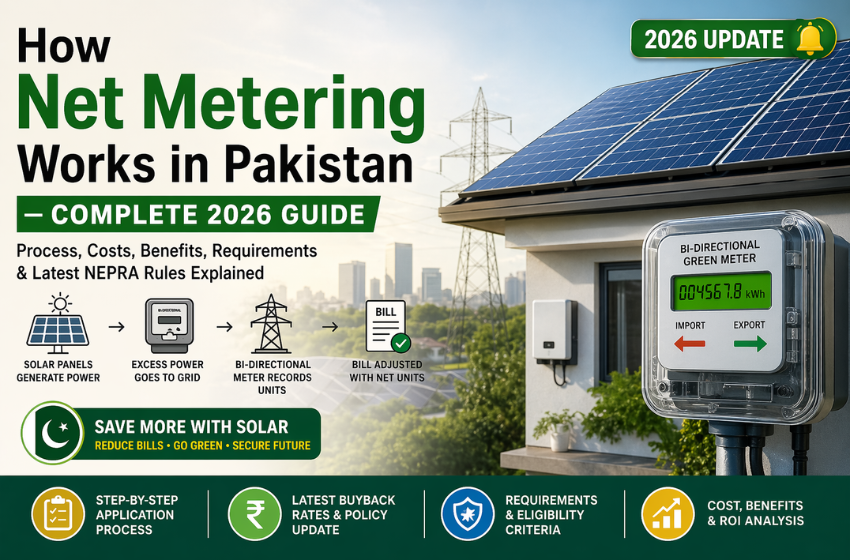
How Net Metering Works in Pakistan (2026 Guide)
If you pay sky-high electricity bills every month, understanding how net metering works in Pakistan could change your life financially. I have tracked Pakistan’s solar and electricity policy since NEPRA first introduced net metering in 2015, and the changes in 2026 are the most significant shift in that entire decade. Pakistan’s electricity tariffs now range between Rs. 40 and Rs. 60 per unit for many households in 2026.
Net metering is now governed by the new NEPRA Prosumer Regulations 2026, which give solar panel owners a direct way to slash that cost and gain energy independence. This article explains the concept and everything you need to know.
What is Net Metering in Pakistan?
Net metering in Pakistan is a billing system that lets you sell your extra solar electricity back to the national grid. Your DISCO (Distribution Company) installs a special bi-directional meter at your home. This meter records two things: how much electricity you pull from the grid and how much you push back into it.
At the end of the billing cycle, you only pay for the net difference. If you exported more than you imported, those extra units carry over as a credit to the next month.
Think of it this way: the grid acts as your battery. You store energy there during the day and take it back at night.
However, Pakistan crossed a major threshold on February 9, 2026. NEPRA officially notified the Prosumer Regulations 2026 (SRO 251(I)/2026), which suspended the original 2015 Net Metering Regulations and shifted the entire system to a net billing framework. Understanding what changed and what stayed the same is now critical before you apply.
How Net Metering Works in Pakistan Step by Step?
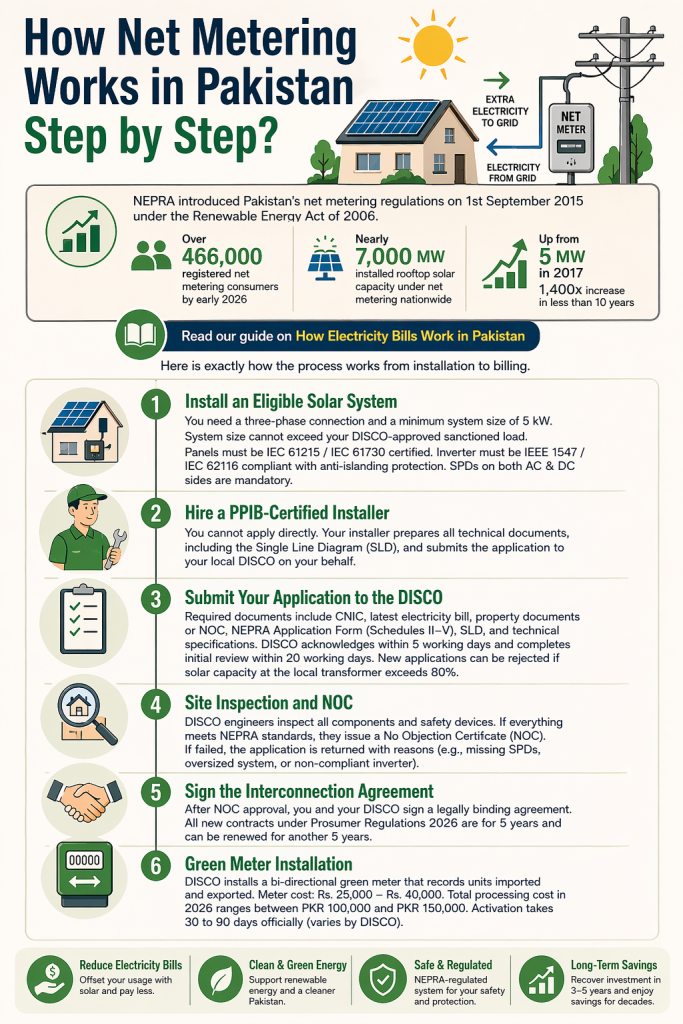
NEPRA introduced Pakistan’s net metering regulations on 1st September 2015 under the Renewable Energy Act of 2006. In just over a decade, the system grew from a handful of users to over 466,000 registered net metering consumers by early 2026. Total installed rooftop solar capacity under net metering now stands at nearly 7,000 MW nationwide, up from just 5 MW in 2017, a 1,400-fold increase in less than ten years.
Read our guide on How Electricity Bills Work in Pakistan
Here is exactly how the net metering works in Pakistan from installation to billing.
Step 1: Install an Eligible Solar System
Your solar system must be either on-grid or hybrid. A single-phase connection does not qualify. You need a three-phase electricity connection and a minimum system size of 5 kW. Under the Prosumer Regulations 2026, your system size cannot exceed your DISCO-approved sanctioned load. The previous allowance of 150% is permanently removed.
Your panels must carry IEC 61215 / IEC 61730 certification. Your inverter must comply with IEEE 1547 / IEC 62116 standards and include mandatory anti-islanding protection. Surge Protection Devices (SPDs) on both AC and DC sides are now required. DISCO engineers check for these during inspection, and missing any one of them can delay or reject your application.
Step 2: Hire a PPIB-Certified Installer
You cannot apply for net metering directly. NEPRA regulations require you to work through a PPIB (formerly AEDB) certified solar installer. The installer prepares all technical documents, including the Single Line Diagram (SLD), and submits the application to your local DISCO on your behalf.
Step 3: Submit Your Application to the DISCO
Your installer submits the complete application to your relevant DISCO, whether that is LESCO, IESCO, MEPCO, GEPCO, FESCO, PESCO, HESCO, SEPCO, or K-Electric. The required documents include:
- CNIC copy of the applicant
- The latest paid electricity bill
- Property ownership documents or NOC if the property is rented
- NEPRA Application Form (Schedules II–V)
- Single Line Diagram prepared by the installer
- System technical specifications and inverter datasheet
Your DISCO acknowledges receipt within five working days and completes the initial technical review within twenty working days. Under the 2026 regulations, DISCOs can now reject new applications entirely if solar capacity at the local transformer level already exceeds 80%.
Step 4: Site Inspection and NOC
DISCO engineers visit your property and inspect every component of solar panels, inverter, wiring, mounting structure, SPDs, and safety devices. If everything meets NEPRA standards, the DISCO issues a No Objection Certificate (NOC).
If the inspection fails, the DISCO returns your application with the reason for rejection. Common rejection reasons in 2026 include missing surge protection devices, oversized system capacity relative to sanctioned load, and non-compliant inverters.
Step 5: Sign the Interconnection Agreement
After NOC approval, you and your DISCO sign a legally binding Interconnection Agreement. This document covers billing procedures, maintenance responsibilities, and operational terms. Under the Prosumer Regulations 2026, all new contracts run for five years, down from the previous seven-year term. After five years, the contract can be renewed for another five-year term, subject to mutual agreement.
Step 6: Green Meter Installation
Your DISCO installs a bi-directional green meter that simultaneously records units imported from the grid and units exported to it. The meter cost falls on the consumer, typically Rs. 25,000 to Rs. 40,000. In 2026, the total processing cost, including documentation, official fees, and meter charges, ranges between PKR 100,000 and PKR 150,000, depending on your DISCO and city.
Once the meter activates, your net billing cycle begins. The complete process from application to activation takes 30 to 90 days officially, though real-world timelines at most DISCOs stretch to 3 to 4 months.
How Solar Net Metering Billing Works in Pakistan?
This is where most people get confused, especially after the 2026 regulation change. Let’s simplify it.
Monthly Billing Cycle
At the end of each month, your DISCO calculates:
Net Units = Units Imported from Grid minus Units Exported to Grid
You pay for the net units consumed at the prevailing government tariff. If you exported more than you imported, surplus units carry forward as credit to the next billing month.
Read Also: How to Reduce Electricity Bill in Pakistan
What Happens to Surplus Credits?
Under the old 2015 rules, exported units received credit at the same rate consumers paid for grid electricity, a true one-for-one exchange. The Prosumer Regulations 2026 ended that system. Now, exported units receive credit at the National Average Energy Purchase Price (NAEPP), approximately Rs. 8.13 per unit, while imported units cost Rs. 40 to Rs. 60 per unit at the applicable consumer tariff slab.
Consumers who provide surplus electricity to the grid still receive payment on a quarterly basis, the same as before. But the rate they earn per exported unit is now less than one-third of what they previously received.
Net Metering Rates in Pakistan (2026 Update)
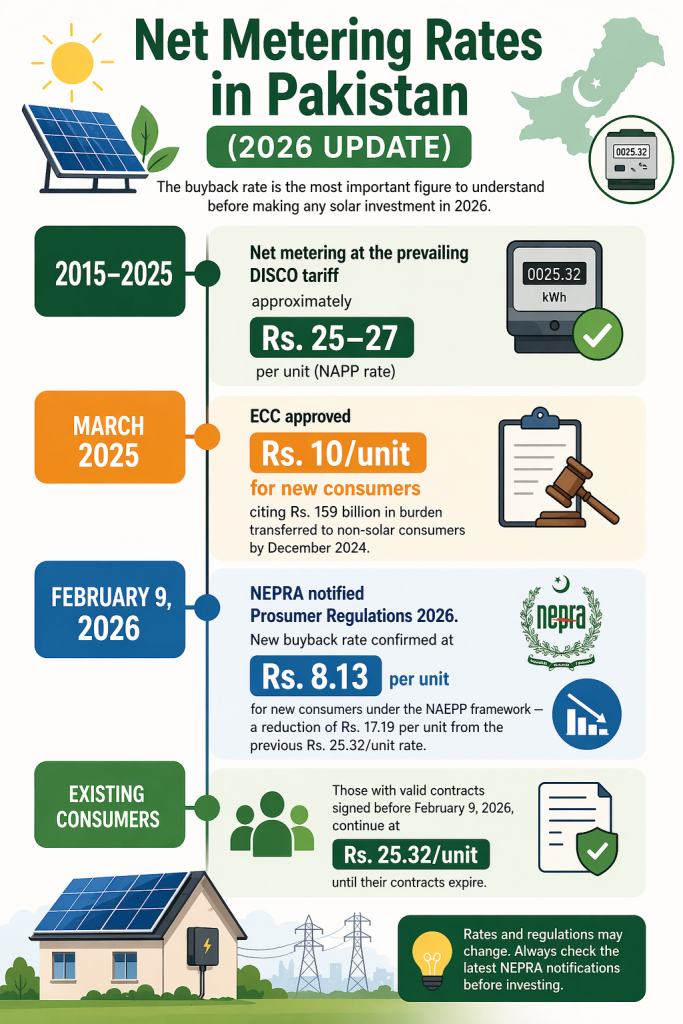
The buyback rate is the most important figure to understand before making any solar investment in 2026. Here is the complete timeline:
- 2015–2025: Net metering at the prevailing DISCO tariff, approximately Rs. 25–27 per unit (NAPP rate)
- March 2025: ECC approved Rs. 10/unit for new consumers, citing Rs. 159 billion in burden transferred to non-solar consumers by December 2024
- February 9, 2026: NEPRA notified Prosumer Regulations 2026. New buyback rate confirmed at Rs. 8.13 per unit for new consumers under the NAEPP framework — a reduction of Rs. 17.19 per unit from the previous Rs. 25.32/unit rate
- Existing consumers: Those with valid contracts signed before February 9, 2026, continue at Rs. 25.32/unit until their contracts expire
The numbers behind this policy shift are significant. Pakistan now has 466,000 net metering consumers, less than 1% of the country’s 39 million total electricity consumers. Yet Power Division officials stated at a NEPRA public hearing in February 2026 that these consumers imposed a Rs. 270 billion burden equivalent to Rs. 2.87 per unit on the remaining 99% of non-solar grid users.
NEPRA Chairman Waseem Mukhtar, who chaired that public hearing, stated directly that “unchecked net metering is no longer sustainable,” arguing the policy had turned a green initiative into a regressive economic burden on lower-income households who cannot afford solar. NEPRA projects installed net metering capacity will surge beyond 14,000 MW by 2034 if growth continues at its current pace.
Additionally, 5,165 pending applications submitted before February 8, 2026, representing 250.822 MW of capacity, will be processed under the old net metering policy, as confirmed by Power Minister Awais Leghari.
Does Solar Still Make Financial Sense?
The answer depends entirely on how you design and use your system.
Under the old Rs. 25–27/unit export rate, the financial math was straightforward. Under the new Rs. 8.13/unit export rate, the strategy must change completely.
The smart approach in 2026 is maximising self-consumption rather than exporting to the grid. Every unit you generate and use directly saves you Rs. 40–60 per unit — the full grid tariff you avoid paying. Every unit you export earns you only Rs. 8.13/unit. That gap is enormous.
This means running heavy loads, such as air conditioners, water pumps, geysers, and washing machines, during solar hours between 10 AM and 4 PM. It also means seriously considering battery storage to capture solar energy for night use instead of feeding it back to the grid at low export rates.
A well-sized 5 kW to 10 kW system designed primarily for self-consumption still achieves payback in 5 to 7 years in most Pakistani cities. Solar panels last 25 years. The return on self-consumed solar energy remains strong even under the new framework, but oversized systems that export large volumes will take significantly longer to break even.
Net Metering Eligibility Pakistan: Who Qualifies?
Not every household automatically qualifies. NEPRA’s Prosumer Regulations 2026 set clear eligibility conditions.
Basic Requirements
You must have a three-phase electricity connection. Single-phase meters do not qualify. Your solar system must be at least 5 kW — NEPRA’s practical minimum in 2026. System capacity cannot exceed your sanctioned load, with no exceptions. You must be a registered consumer of a licensed DISCO or K-Electric. The 2026 NEPRA net metering rules cover residential, commercial, industrial, agricultural, and general services consumers connected at 400V or 11kV.
System Size Limits
Residential and small commercial systems up to 25 kW do not require a separate generation license from NEPRA. Systems above 25 kW require additional licensing. The absolute maximum under the prosumer framework remains 1 MW for commercial and industrial consumers.
NEPRA Net Metering Policy Pakistan 2026: What Changes for You?
NEPRA notified the Prosumer Regulations 2026 on February 9, 2026. These regulations permanently replaced the 2015 Net Metering framework. Here is what changes and what stays the same.
What Changes for New Applicants After February 9, 2026?
Net billing replaces net metering. The one-for-one unit credit system is gone. Exported electricity earns Rs. 8.13/unit while imported electricity costs Rs. 40–60/unit at prevailing tariffs. This is a reduction of Rs. 17.19 per exported unit from the previous rate.
Contract periods now run five years instead of seven, renewable for another five years upon mutual agreement.
New installations cannot exceed 100% of your sanctioned load. DISCOs can reject new applications if local transformer-level solar capacity already exceeds 80%. The 2026 regulations also bring biogas-based prosumers under the same framework alongside solar and wind systems.
What Stays the Same for Existing Consumers
If you hold a valid net metering contract signed before February 9, 2026, you continue under your original terms — including the higher Rs. 25.32/unit buyback rate — until your contract expires. NEPRA’s draft amendment of February 16, 2026, explicitly protects these consumers following direct PM-level intervention. The 30-day public consultation period on this protection amendment closed in March 2026.
According to Power Division data, 82% of Pakistan’s 466,000 net metering consumers concentrate in 11 major cities. Lahore leads with 24% of total consumers, followed by Multan at 11%, Rawalpindi at 9%, Karachi at 7%, and Faisalabad at 6%.
Benefits of Net Metering in Pakistan
Despite the 2026 regulatory shift, rooftop solar with net billing remains one of the most effective tools for managing Pakistan’s electricity crisis.
Massive savings through self-consumption come first. A 10 kW system generating 40–50 units per day during summer directly offsets Rs. 1,600–3,000 per day in grid electricity costs at current tariffs. No other investment delivers that kind of daily return on your household budget.
Read Also: Why Electricity Bills Are High in Pakistan: Key Reasons
Protection against tariff hikes matters too. Once your system is installed, you generate electricity at a fixed cost. Future NEPRA tariff increases do not affect the electricity you produce yourself, and tariffs have only moved in one direction over the past five years.
Load shedding resilience remains a huge selling point. A hybrid solar system with battery storage gives you daytime independence and backup power at night, a genuine, practical solution to Pakistan’s chronic load shedding.
Long-term asset value seals the case. Solar panels carry 25-year performance warranties. The investment you make today keeps paying back for decades, regardless of future changes to export rates.
According to a study by the Policy Research Institute for Equitable Development (PRIED), Pakistan’s total solar deployment across the country, both grid-connected and off-grid, has now surpassed 33 GW, with approximately 6 GW connected to the national grid through net metering and the remaining 27 GW operating off-grid or behind the meter. This scale proves the economics hold even through major policy changes.
Challenges You Should Know Before Applying
Here are some of the challenges people should know before applying:
Much Lower Export Returns Under Net Billing
The biggest change for new applicants in 2026 is the sharply lower export rate. At Rs. 8.13/unit for exports versus Rs. 40–60/unit for imports, the financial model must shift entirely toward self-consumption. Oversizing your system to sell electricity to the grid no longer works as a financial strategy.
Long Processing Times
Most consumers wait 3 to 4 months from application to meter activation. Applications surge between October and December, extending delays further at high-volume DISCOs. Documentation errors add more weeks. Working with an experienced PPIB-certified installer who handles paperwork correctly the first time is the single most effective way to speed up the process.
High Upfront Investment
A complete 5 kW on-grid system costs approximately Rs. 554,000 to Rs. 780,000 in 2026. A 20 kW on-grid system runs Rs. 1,800,000 to Rs. 2,000,000. Add net metering file charges of Rs. 100,000 to Rs. 150,000 on top. Under the new lower export rate, payback periods for new consumers extend compared to those who installed under the 2015 framework.
Grid Rejection Risk
DISCOs now legally reject applications where the local transformer already carries 80% solar capacity. This is a growing problem in dense urban neighbourhoods in Lahore, Rawalpindi, and Karachi, where solar adoption is concentrated fastest. In my experience covering solar applications across Punjab, this is now one of the top three reasons applications stall, and it blindsides buyers who already purchased panels without checking first. Always confirm transformer capacity with your DISCO or a PPIB-certified installer before you spend a single rupee on equipment.
Final Thoughts
Understanding how net metering works in Pakistan is now more important than ever because the rules just fundamentally changed. Pakistan’s solar revolution reached 466,000 connected consumers and nearly 7,000 MW of capacity. That growth triggered the Prosumer Regulations 2026, which replaced the decade-old 2015 framework on February 9, 2026, ending the one-for-one unit exchange system.
If you signed a net metering contract before February 9, 2026, you remain protected at your original rate until it expires. If you apply today as a new consumer, you enter net billing at Rs. 8.13/unit for exports. The strategy shifts from maximising exports to maximising self-consumption, and that shift still makes solar one of the strongest financial decisions available to Pakistani households in 2026.
Grid tariffs keep rising. Solar costs keep falling. The equation still favours going solar — just smarter than before.
This article was written by Saira Imran. She is a content writer with years of experience in Pakistan’s digital publishing industry. She writes data-driven articles on energy, economy, and public-interest topics.Her work focuses on simplifying complex policies like electricity billing, solar systems, and government regulations so everyday readers can make informed decisions.
FAQs
Yes, most DISCO-covered areas allow net metering, but implementation speed varies by region.
It usually takes two to four months, depending on documentation and workload.
No, net metering works with a grid connection. Off-grid systems operate separately.
Your extra units go to the grid and adjust your future electricity bills.
Yes, rising electricity prices make net metering financially beneficial for most users.
A standard on-grid net metering system does not work during load shedding because mandatory anti-islanding protection automatically shuts it down when the grid goes offline.