Saira Imran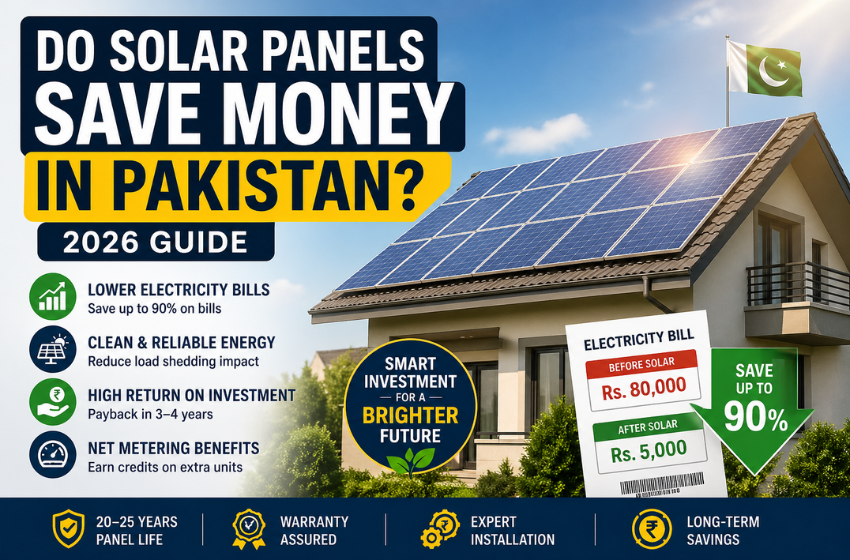
Do Solar Panels Save Money in Pakistan? (2026 Complete Guide)
Do solar panels save money in Pakistan in 2026? Yes, but the actual savings depend on your electricity usage, system size, and your understanding of net metering.
In my experience analyzing residential electricity bills and solar adoption trends in Pakistan, I have seen a clear pattern. Households that install properly sized solar systems reduce their bills significantly within the first year. This shift is happening because electricity prices continue to rise, while solar gives long-term cost stability.
This guide breaks it all down, actual costs, real savings figures, and the latest NEPRA regulations, so you can make a clear-headed decision. Every figure in this article comes from official NEPRA notifications, Pakistan Bureau of Statistics data, or verified market quotes collected in April 2026.
Do Solar Panels Save Money in Pakistan?
Solar panels save money in Pakistan by replacing expensive grid electricity with cheaper self-generated power.
In 2026, the base electricity tariff starts around Rs. 33 per unit, but most households pay between Rs. 45 to Rs. 60 per unit after taxes and fuel adjustments. In comparison, solar electricity costs roughly Rs. 8 to Rs. 12 per unit over its lifetime.
This large price gap creates real and measurable savings.
Energy professionals working in Pakistan’s power sector often highlight that solar is currently the only reliable way for consumers to reduce exposure to rising tariffs and unpredictable fuel costs.
Read our guide on How Net Metering Works in Pakistan (2026 Guide)
Pakistan’s Solar Market in 2026: The Numbers Tell the Story
Solar imports primarily from China collectively produced below 1GW in 2018. By early 2026, that figure grew to a staggering 51GW, making Pakistan one of the fastest-growing solar markets globally.
The solar share in the country’s energy mix jumped from 2.9% in 2020 to a massive 32.3% in 2025, according to EMBER, an independent energy think tank.
Since 2018, Pakistan’s rooftop solar boom has helped the country save more than $12 billion in fuel imports, according to a joint study by Renewables First and the Centre for Research on Energy and Clean Air, one of the most cited independent energy analyses of 2026. At current market prices, those savings are expected to reach approximately $6.3 billion in 2026 alone.
A household survey by the Pakistan Bureau of Statistics showed that 25% of Pakistani households now use solar power in some form. That is one in every four homes. This shift is not driven by environmental concern; it is driven by painful electricity bills and endless load-shedding.
What Does Electricity Actually Cost You in Pakistan Right Now?
The national average electricity price in Pakistan is around Rs. 39.64 per unit as of late 2025, and this rate continues into 2026. This figure includes taxes and transmission costs.
But if you are a heavy user and most urban families are, your per-unit rate is higher. NEPRA’s 2026 tariff rates range from Rs. 4.78 to Rs. 62.47 per unit, depending on your consumer category and consumption slab.
Read Also:How Electricity Bills Work in Pakistan
Here is the slab structure that applies to most residential consumers in 2026:
| Monthly Consumption | Category | Approx. Rate per Unit |
|---|---|---|
| 1 – 100 units | Protected | Rs. 7.74 |
| 101 – 200 units | Protected | Rs. 13.01 |
| 201 – 300 units | Non-Protected | Rs. 22 – 27 |
| 301 – 500 units | Non-Protected | Rs. 35 – 45 |
| 500+ units | Non-Protected | Rs. 50 – 62 |
Rates are base tariffs. Final bill includes FPA, FC surcharge, GST, and quarterly adjustments.
A family consuming 600-800 units a month easily pays Rs. 35,000 to Rs. 55,000 per month, and that bill keeps climbing every year.
Solar Panel Cost in Pakistan: 2026 Price Breakdown
The solar panel cost in Pakistan has reached a historic low in 2026 because of a global oversupply of Chinese-manufactured panels. This makes right now arguably the best time to buy.
Per Watt Panel Prices in 2026
Solar Panel prices in Pakistan vary in a wider range from Rs. 40 to Rs. 100 per watt, depending on grade and quality. However, Tier-1 brands tell a different story.
| Brand | Technology | Price per Watt (2026) |
|---|---|---|
| LONGi (550W–600W) | Mono PERC | Rs. 31 – 34 |
| Jinko Solar (585W) | N-Type Bifacial | Rs. 30 – 34 |
| Canadian Solar | HiKu6/HiKu7 | Rs. 34 – 40 |
| JA Solar | N-Type Bifacial | Rs. 30 – 33 |
| Local / B-Grade | Polycrystalline | Rs. 24 – 28 |
Source: Market rates compiled from multiple Pakistani solar vendors, April 2026.
Complete Solar System Costs by Size (2026)
Panel cost is only one part of the equation. A complete system also includes an inverter, mounting structure, wiring, and installation. Here is what a full setup costs in 2026:
| System Size | Best For | On-Grid Cost | Hybrid Cost (with Battery) |
|---|---|---|---|
| 3 kW | Small home, basic loads | Rs. 500,000 – 580,000 | Rs. 700,000 – 900,000 |
| 5 kW | Medium home, 1 AC | Rs. 600,000 – 800,000 | Rs. 800,000 – 1,000,000 |
| 10 kW | Large home, 2-3 ACs | Rs. 850,000 – 1,200,000 | Rs. 1,400,000 – 2,300,000 |
Prices vary by city, brand, and installer. Karachi systems near ports cost slightly less than those in northern cities like Islamabad or Peshawar due to lower transport costs.
Installation costs alone typically range from PKR 20,000 to PKR 50,000, depending on system size, roof type, and location.
Read Also: What are Capacity Charges in Pakistan
Do Solar Panels Save Money on Your Electricity Bill?
Yes, solar panels save money, and the savings are substantial. The key is understanding what you save based on your system size and how much you consume during daylight hours.
How much money do solar panels save per month?
A 5kW on-grid solar system produces roughly 500 to 600 units per month under Pakistan’s excellent solar conditions. Here is what that translates into:
| System Size | Monthly Units Generated | Monthly Bill Savings | Annual Savings |
|---|---|---|---|
| 3 kW | 300 – 360 units | Rs. 12,000 – 18,000 | Rs. 144,000 – 216,000 |
| 5 kW | 500 – 600 units | Rs. 20,000 – 30,000 | Rs. 240,000 – 360,000 |
| 10 kW | 1,000 – 1,200 units | Rs. 40,000 – 60,000 | Rs. 480,000 – 720,000 |
Savings calculated at Rs. 40-50 per unit for non-protected consumers. Results vary based on sunlight hours, shading, and seasonal variation.
These are not theoretical numbers. A homeowner in Lahore’s Johar Town that I spoke to in March 2026 installed a 5kW on-grid system in mid-2024 for Rs. 680,000. His previous monthly bill averaged Rs. 28,000. After installation, it dropped to Rs. 3,500, a saving of Rs. 24,500 per month. At that rate, he recovered his full investment in just over 28 months.
Read Also: How to Reduce Electricity Bill in Pakistan
Solar Payback Period in Pakistan: How Long Does It Actually Take?
The solar payback period in Pakistan depends on your bill size, system cost, and how well you size your setup.
In most residential cases, the payback period runs 3 to 3.5 years. Homes with higher daytime usage recover costs even faster.
With electricity rates exceeding PKR 60 per unit and net metering available, a solar system pays for itself in 3 to 4 years. After that, you enjoy free or near-free electricity for 25+ years.
| Scenario | System Cost | Annual Savings | Payback Period |
|---|---|---|---|
| Small home (3kW, low bill) | Rs. 550,000 | Rs. 180,000 | ~3 years |
| Average family (5kW) | Rs. 700,000 | Rs. 300,000 | ~2.5 years |
| Heavy user (10kW, 2 ACs) | Rs. 1,100,000 | Rs. 600,000 | ~2 years |
Once the system pays for itself, every unit it generates is pure savings for 20 to 25 more years.
How to install a solar system in Pakistan?
The solar system installation process in Pakistan follows a clear sequence. Most homeowners complete it within 30 to 90 days from application to commissioning, depending on their DISCO and documentation.
Step 1: Assess Your Load
Calculate your average monthly electricity bill over the past 12 months. This tells you what system size you actually need. Avoid oversizing — under the new net billing rules, excess exported units earn you only Rs. 11 per unit instead of the Rs. 40+ you save by self-consuming.
Step 2: Get Multiple Quotes
Solar panel prices vary by city. You can find lower prices near ports in Karachi compared to Islamabad or Peshawar. Visit wholesale markets in Karachi’s Saddar, Lahore’s Hall Road, or Rawalpindi’s College Road for competitive rates.
Step 3: Choose Your System Type
| System Type | Load Shedding Backup | Net Metering Eligible | Recommended For |
|---|---|---|---|
| On-Grid | No | Yes | Areas with low load-shedding |
| Hybrid | Yes (with batteries) | Yes | Areas with frequent outages |
| Off-Grid | Yes | No | Remote areas without grid access |
Step 4: Apply for Net Billing Connection
In 2026, the market rate for a complete net metering file — including processing, meter, installation, and DISCO coordination — ranges between PKR 100,000 to 150,000, depending on your DISCO.
Step 5: Commissioning and Go Live
A standard 5kW system is physically installed in one to two days. DISCO inspection and approval add the remaining time to your total wait.
Who Benefits Most from Going Solar in 2026?
Not every household gets the same return. Solar works best for people who:
- Use electricity heavily during daytime hours: Families that run ACs, run businesses from home, or have water motors during the day consume solar energy directly. They save the maximum amount because they avoid buying grid electricity at Rs. 40 to 60 per unit.
- Pay bills above Rs. 20,000 per month: Below this threshold, payback periods stretch longer, and the financial case weakens. Above it, solar starts to make serious sense.
- Live in high-irradiance areas: Pakistan averages 4.5 to 6 peak sunlight hours per day, depending on the city. Lahore, Multan, Karachi, and Faisalabad consistently rank among the best for solar output in Pakistan.
- Can invest upfront: On average, Pakistani homeowners recoup the cost of their solar panels in about 4 to 6 years, based on an estimated 20 to 30% reduction in electricity bills. If you stay in your home for 10+ years, the financial return is almost guaranteed.
How to Maximize Electricity Bill Savings from Solar in 2026?
Under the new net billing rules, smart habits matter more than ever. These steps directly increase your electricity bill savings from solar:
Shift heavy loads to daylight hours:
Run your washing machine, iron, electric kettle, and water motor between 9 AM and 4 PM. This way, your solar panels power them directly, and you pay nothing.
Right-size your system:
Oversizing your system beyond what you can consume during the day results in exported units at half value. Work with your installer to match system size to your actual daytime consumption, not just your total monthly bill.
Consider battery storage:
Lithium batteries store surplus daytime solar energy for use at night. This further reduces your dependence on the grid and boosts overall savings, especially now that export rates are lower.
Maintain your panels regularly
Dust accumulation on panels is a serious issue in Pakistan’s dry climate. Regular cleaning helps maintain panel efficiency, with cleaning services ranging from PKR 2,000 to PKR 5,000 depending on system size. A 10% drop in efficiency is a real financial loss over time.
Final Thoughts
Do solar panels save money in Pakistan? Absolutely, and the math has never been clearer than in 2026. With electricity hitting Rs. 40 to 62 per unit and solar panels available at Rs. 28 to 40 per watt, the economics strongly favor going solar.
The shift from net metering to net billing changes the strategy, not the conclusion. You now earn more by consuming your solar energy directly than by exporting it. So size your system right, run heavy appliances during the day, and consider a battery backup if load-shedding is frequent in your area.
This guide is based on analysis of electricity billing trends, installer pricing data, and solar adoption patterns across Pakistan from 2024 to 2026. All data in this article draws from: NEPRA’s official Prosumer Regulations 2026 notification (February 9, 2026), NEPRA’s Solar Regulations Amendment (April 2, 2026), the Renewables First / CREA joint study on Pakistan’s solar savings, the Pakistan Bureau of Statistics 2025 household survey, EMBER’s Global Electricity Review 2025, and solar market price checks conducted across Karachi, Lahore, and Islamabad vendors in April 2026.
FAQs
Yes. With electricity rates exceeding PKR 60 per unit and net billing available, a solar system pays for itself in 3 to 4 years, after which you enjoy free or near-free electricity for 25+ years. Government incentives and tax benefits make it even more attractive. The key is sizing your system to match your daytime consumption rather than your total monthly units.
In 2026, the cost of a 5kW system ranges from PKR 600,000 to PKR 800,000 for an on-grid setup. Homes that add lithium batteries will be on the higher side. This system comfortably handles one inverter AC, a refrigerator, a washing machine, fans, and lighting for an average family.
Most systems recover their cost within 3 to 4 years due to high electricity tariffs. Homes with higher daytime usage recover costs even faster. For heavy consumers running multiple ACs on a 10kW system, the payback can drop to 2 years. After recovering the cost, every unit the system generates is pure savings for the next 20+ years.
Grid-tied systems shut down during outages, but hybrid systems with batteries provide backup.
Solar panels typically last 20–25 years, while inverters last around 8–10 years.