Saira Imran
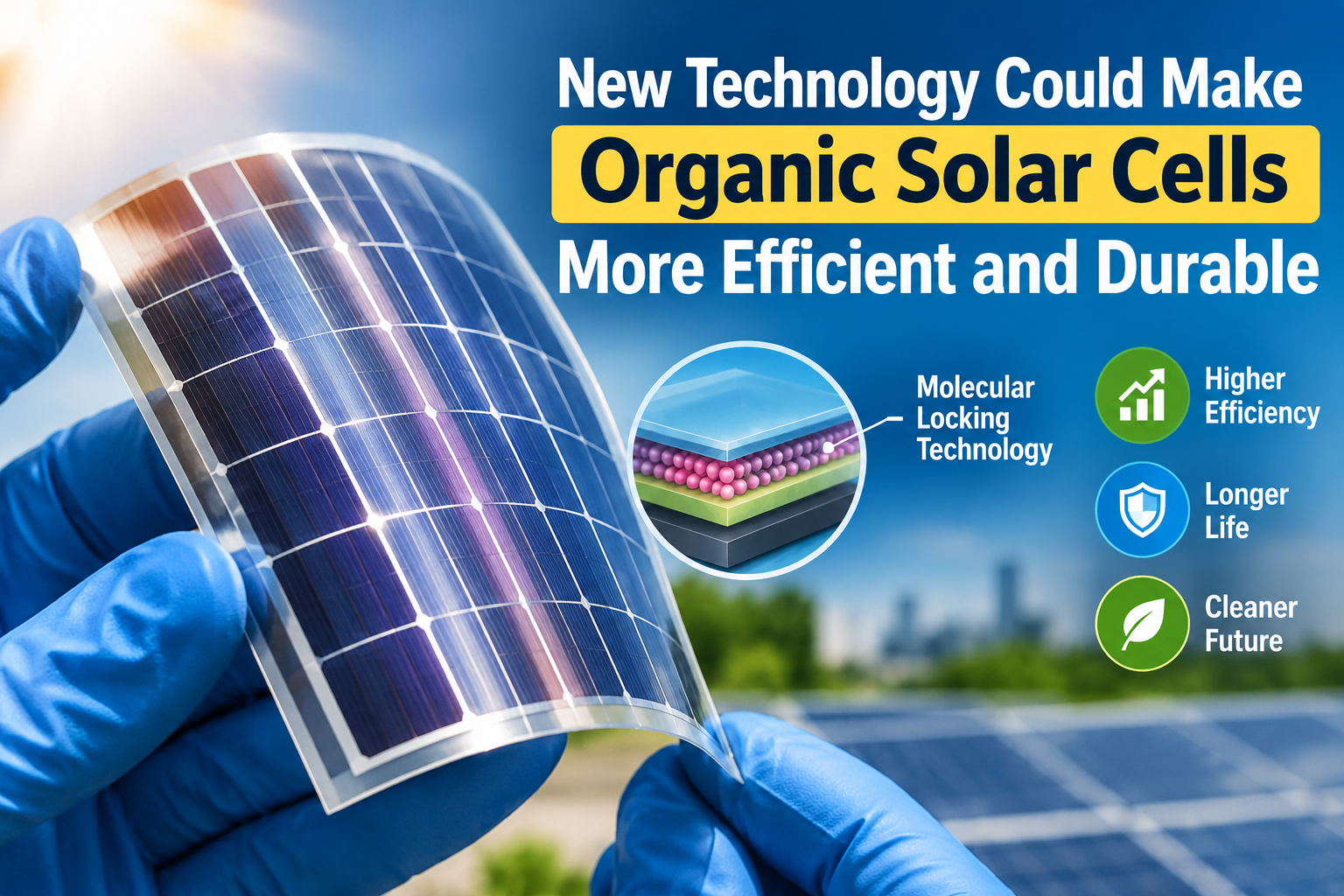
Scientists develop a molecular locking method to improve organic solar cell stability
Chinese scientists have developed a new technology that could make organic solar cells more efficient, stable, and suitable for large-scale production. The research may help overcome a major problem that has limited the wider use of this type of solar energy technology.
The new method strengthens the connection between key layers inside a solar cell. It also helps these layers remain stable under heat and continuous light. Researchers reported promising results in tests, including improved performance in larger solar modules. The findings could support future advances in flexible solar power.
What Is the New Solar Technology?
The research team developed a method called molecular locking. It uses a thin layer of an indium-based material to strengthen the connection between the electrode and a layer that helps move electrical charges inside an organic solar cell.
According to the study, small organic solar cells achieved 20.4% power conversion efficiency. Larger modules reached 18.8% efficiency across their active area. The researchers also found that the devices maintained much of their initial performance during long periods of testing.
The study appeared in the scientific journal Joule on October 21, 2026. The Chinese Academy of Sciences published details of the findings.
What Are Organic Solar Cells?
Organic solar cells convert sunlight into electricity using carbon-based materials instead of the silicon found in conventional solar panels.
These cells offer several potential benefits. Manufacturers can process the materials into thin layers. This may allow them to produce lightweight and flexible solar devices at a lower cost.
Organic solar technology could also support solar applications on surfaces where traditional rigid panels may not fit easily. Examples include flexible structures, portable devices, and certain building materials.
However, scientists still need to improve the long-term stability of these cells. Their performance can decline when heat and sunlight weaken the materials inside them.
Why Do Organic Solar Cells Need Better Stability?
One major challenge involves the thin molecular layers that connect with the transparent electrode inside a solar cell.
Researchers often use self-assembled monolayers, or SAMs, to help control how electrical charges move through the device. These layers must form a strong and even connection with the electrode.
Over time, heat and continuous light can weaken this connection. Some molecules may detach from the surface. This can interfere with charge movement and reduce the cell’s ability to convert sunlight into electricity.
This problem matters because commercial solar products need to maintain their performance over long periods. A cell that works well in a laboratory may not deliver the same results after months or years of outdoor use.
The research team focused on this weak connection to improve the stability of organic solar cells.
How Does the New Molecular Locking Method Work?
Researchers from the Ningbo Institute of Materials Technology and Engineering, part of the Chinese Academy of Sciences, developed the new method under the leadership of Professor Ge Ziyi’s research group.
The team introduced a thin intermediate layer made from an indium chloride material. They deposited this layer onto the electrode using a vacuum-based process.
The material then helps form stronger chemical bonds between the electrode and the molecular layer above it. These bonds create a more stable network that holds the molecules in place.
This process also helps the molecular layer spread more evenly across the surface. A more uniform layer can improve the contact between materials and support the movement of electrical charges.
In simple terms, the new method works like a molecular lock. It helps prevent important layers from separating and allows the solar cell to maintain better performance.
The researchers designed the method to work with different types of phosphonic acid-based molecular layers. This could make the approach useful for more than one organic solar cell design.
What Results Did the Researchers Achieve?
The study reported encouraging results in both small solar cells and larger modules.
Small devices reached a power conversion efficiency of 20.4%. This figure measures how much of the incoming sunlight a solar cell converts into electricity.
The researchers also tested the method in larger modules with an active area of 15.6 square centimetres. These modules achieved an active area efficiency of 18.8%.
The team then examined how well the devices performed during continuous operation. After 2,000 hours of testing at 25°C, the cells retained more than 85% of their initial efficiency.
These findings suggest that the molecular locking method can improve both efficiency and operational stability. They also show that researchers can apply the method to modules beyond very small laboratory devices.
However, these tests do not yet establish how the technology will perform over many years in real outdoor conditions. Manufacturers will need further testing before they can confirm its long-term reliability and commercial value.
How Could This Technology Affect Solar Energy Users?
More stable organic solar cells could eventually expand the ways people use solar power. Their lightweight and flexible design may allow manufacturers to develop products for applications that cannot easily accommodate traditional panels.
For example, flexible solar materials could support portable electronics, lightweight structures, and some building surfaces. Better stability may also help reduce performance losses during use.
Manufacturing costs will remain an important factor. Organic solar cells have the potential for low-cost production, but their final price will depend on materials, manufacturing methods, product life, and production scale.
For Pakistan, where households and businesses have a strong interest in alternative energy, advances in solar technology deserve attention. However, this research does not mean that organic solar cells are ready to replace conventional rooftop solar panels in the country.
The study focuses on a new material design and its performance in tested devices. It does not provide evidence of immediate price reductions or commercial availability in Pakistan.
What Happens Next?
The next step is to determine whether manufacturers can produce these improved organic solar cells at a commercial scale while keeping costs under control.
Researchers will also need to assess performance under different temperatures, weather conditions, and longer operating periods. Outdoor testing can reveal problems that laboratory experiments may not capture.
The team’s molecular locking method offers a potential way to address one of the main barriers to wider use of organic solar technology. If future studies confirm its durability and manufacturers can scale up production, it could support new types of solar products.
For now, the results mark a promising research development rather than an immediate change in the solar market.
Final Word
The new molecular locking method could help scientists develop organic solar cells that deliver better efficiency and remain stable for longer periods. By strengthening the connection between key material layers, the technology addresses a problem that has slowed the wider use of organic photovoltaics.
Further research will determine whether manufacturers can turn these laboratory results into affordable commercial products. Until then, the development offers a promising direction for future solar energy technology.