Saira Imran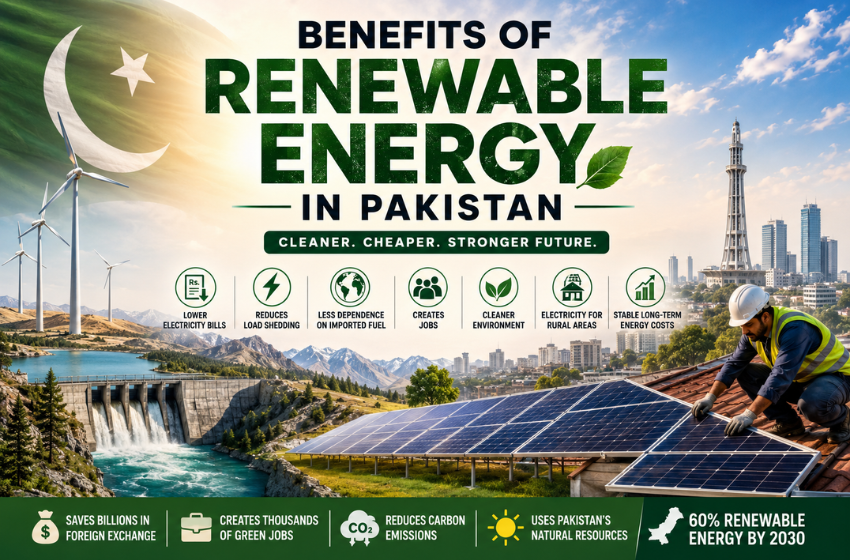
Benefits of Renewable Energy in Pakistan
Pakistan has a serious electricity problem. Load shedding runs for hours every day. Electricity bills keep rising. And the country still depends heavily on imported fuel to keep its power plants running. People get benefits of renewable energy in Pakistan.
Renewable energy is not a general idea anymore. Solar panels are showing up on rooftops across Lahore, Karachi, and Islamabad. Wind farms are already generating power in Sindh. Hydro projects are running in Khyber Pakhtunkhwa. The shift is happening, slowly but clearly.
Here is why renewable energy matters for Pakistan and what it actually changes for ordinary people and the economy.
What are the Benefits of Renewable Energy in Pakistan?
Here are some of the benefits of renewable energy in Pakistan:
1. It Cuts Electricity Bills
This is the most direct benefit for households and businesses.
Pakistan’s electricity tariffs have jumped sharply over the last three years. Fuel adjustment charges, capacity payments, and circular debt all push bills higher every quarter.
Solar panels reduce how much electricity you buy from the grid. With net metering, you can even sell surplus electricity back to the distribution company. Many households in Punjab and Sindh have brought their monthly bills down to near zero after installing rooftop solar.
For small businesses and factories, the savings are even bigger. Manufacturers who run heavy machinery during peak hours pay the highest rates. Solar generation during daylight hours directly cuts those costs.
2. It Reduces Load Shedding
Pakistan’s power shortfall is partly a supply problem and partly a transmission problem. But more domestic generation from renewable sources reduces pressure on the national grid.
When homes and commercial buildings generate their own solar power, they draw less from WAPDA and the DISCOs. That means the available grid electricity stretches further. Areas with high rooftop solar adoption already see fewer hours of load shedding compared to areas without it.
At the utility scale, wind farms in Gharo and Jhimpir feed directly into the grid. Thar coal was the plan for cheap base load power, but wind and solar are now cheaper per unit to build and run.
3. It Lowers Dependence on Imported Fuel
Pakistan spends billions of dollars every year importing oil, LNG, and coal to run its thermal power plants. This is a core driver of the country’s foreign exchange pressure and current account deficit.
Every kilowatt of electricity generated from solar, wind, or hydro is one kilowatt that does not require imported fuel. At scale, this saves foreign exchange, reduces the trade deficit, and insulates electricity prices from global fuel market swings.
The rupee’s fall against the dollar hits Pakistani electricity consumers hard because fuel is priced in dollars. Domestic renewable energy breaks that link.
4. It Creates Jobs
Solar installation, maintenance, manufacturing, and project development all generate employment. Pakistan’s solar industry has grown fast. Thousands of technicians, engineers, and electricians now work in rooftop solar installation alone.
Large-scale wind and solar projects in Sindh and Punjab require construction workers, engineers, grid technicians, and long-term operations staff. The International Renewable Energy Agency estimates renewable energy creates more jobs per unit of investment than fossil fuel plants.
For a country with a young and growing workforce, this matters.
5. It Helps the Environment
Pakistan contributes less than 1% of global carbon emissions but faces some of the worst effects of climate change. Floods in 2022 displaced millions of people and caused massive economic damage. Heatwaves now regularly push temperatures past 45 degrees Celsius in Sindh and southern Punjab.
Switching to renewable energy reduces carbon emissions from the power sector. Cleaner air in cities like Karachi and Lahore means fewer respiratory illnesses. Less burning of coal and furnace oil means less smog.
Pakistan cannot solve global climate change alone. But reducing its own fossil fuel use protects the country’s agriculture, water supply, and public health.
6. It Brings Electricity to Rural Areas
Millions of Pakistanis in remote villages still have no grid connection. Extending transmission lines to these areas is expensive and slow.
Solar microgrids and standalone solar home systems can electrify villages faster and cheaper than grid extension. Several projects in Balochistan and Gilgit-Baltistan already run on solar microgrids. Schools, health clinics, and homes in off-grid areas are getting reliable electricity for the first time.
This is not a minor convenience. Reliable electricity changes how children study, how medical facilities function, and how small businesses operate.
7. It Stabilises Long-Term Energy Costs
Fuel prices fluctuate. Solar and wind do not. Once a solar plant or wind farm is built, the fuel is free. The sun does not charge per kilowatt-hour.
This gives businesses, households, and the government more predictable energy costs over time. Long-term power purchase agreements for wind and solar lock in prices for 20 to 25 years. That stability helps businesses plan, invest, and grow.
Pakistan’s Renewable Energy Potential
Pakistan has strong natural resources for renewable energy. The country receives high solar irradiance across most of its territory, especially in Balochistan and Sindh. The Gharo-Keti Bandar wind corridor in Sindh is one of the best wind energy zones in Asia. The northern rivers provide substantial hydropower capacity.
The government’s target is to generate 60% of electricity from renewable sources by 2030. That target is ambitious. Whether it gets met depends on policy consistency, grid upgrades, and private investment. But the direction is clear.
Challenges That Still Exist
Renewable energy is not a perfect solution with no obstacles.
Upfront costs for solar panels remain high for low-income households, though prices have fallen a lot over the last five years. Grid infrastructure in Pakistan needs upgrades to handle more variable generation from wind and solar. Circular debt in the power sector makes investors cautious about new projects. And policy consistency has been a problem, with net metering rules and tariffs changing multiple times.
These are real challenges. They slow things down. But they do not change the fundamental case for renewable energy in Pakistan.
FAQs
Lower electricity bills. Rooftop solar reduces grid dependency and can bring monthly bills close to zero for many families.
It helps when homes and businesses generate their own power; they put less demand on the grid. More generation from wind and solar farms also adds supply.
Pakistan imports oil, LNG, and coal to run thermal power plants. Renewable energy replaces this imported fuel with local resources, reducing dollar outflows.
Yes. Solar microgrids and standalone solar systems are already electrifying villages in Balochistan, Gilgit-Baltistan, and other off-grid areas where grid extension is not practical.
Pakistan has strong solar potential across most of the country, a major wind corridor in Sindh, and significant hydropower capacity in the north.