Saira Imran
What Is Fuel Price Adjustment? Pakistan’s 2026 Guide
Fuel price adjustment (also written as Fuel Charges Adjustment or FCA) is a monthly charge added to or subtracted from your electricity bill. It reflects the difference between the actual cost of fuel used to generate electricity that month and the reference cost NEPRA set at the start of the fiscal year. When fuel costs more than expected, you pay extra. When it costs less, you get a credit.
Every month, millions of Pakistanis open their electricity bills and spot a line they cannot explain. We reviewed 12 months of NEPRA public hearing transcripts and consumer bills from LESCO, MEPCO, and K-Electric to put together this guide, so you are reading an analysis built on primary documents, not summaries of summaries.
This guide gives you the full picture, including the exact 2026 figures NEPRA has approved.
Why does your electricity bill change every month? The Fuel Price Adjustment Explained
Pakistan generates electricity from multiple sources: hydropower, gas, RLNG, furnace oil, coal, and increasingly, wind and solar. Each source carries a different cost. Hydel power is cheap. Furnace oil and imported RLNG are expensive. The mix that power plants use each month shifts based on water availability, fuel imports, and grid demand.
NEPRA sets a reference fuel cost at the beginning of every fiscal year. This is the assumed average cost per unit of electricity based on projected fuel prices and a projected generation mix. The problem is that reality rarely matches projections. Global fuel prices move. The rupee weakens. Hydel output drops in dry months. When any of this happens, the actual fuel cost diverges from the reference.
To understand how NEPRA sets the base tariff in the first place, see our breakdown of electricity unit prices in Pakistan 2026.
Rather than revise the entire base tariff every month, which would require a lengthy regulatory process, NEPRA uses a simpler mechanism: the fuel charges adjustment in the electricity bill. This monthly charge corrects the gap between what was assumed and what was actually spent on fuel.
What this means for you? If Pakistan’s power plants burned more expensive fuel than planned in a given month, NEPRA adds a positive FCA to your bill two months later. If cheaper fuel dominated the mix, the FCA is negative — meaning you pay less.
Who Calculates the Fuel Price Adjustment and How Does the Number Get Set?
How FCA is calculated — 5 steps:
- Power plants generate electricity using coal, RLNG, furnace oil, hydel, and renewables.
- CPPA-G tallies the total national fuel cost at month-end.
- CPPA-G divides the total cost by units generated to get the actual per-unit fuel cost.
- This is compared to NEPRA’s reference fuel cost for the fiscal year.
- The difference (positive or negative) becomes the FCA and appears in consumer bills two months later.
The Role of CPPA-G and NEPRA
The Central Power Purchasing Agency Guarantee (CPPA-G) buys electricity from all power generation companies on behalf of Pakistan’s distribution companies (DISCOs). At the end of each month, CPPA-G tallies the total fuel cost across the entire national grid and divides it by total units generated. This gives the actual average fuel cost per unit.
CPPA-G then submits a petition to NEPRA. NEPRA holds a public hearing, scrutinises the data, and either approves, reduces, or rejects the requested adjustment. Only after NEPRA’s formal approval does the FCA appear in consumer bills, typically two months after the generation month.
The Formula Behind FCA
Simple Formula: FCA per unit = Actual Fuel Cost per kWh − Reference Fuel Cost per kWh If positive → consumers pay extra.
If negative → consumers receive a bill reduction.
Four Factors That Push FCA Up or Down
- Fuel mix: More hydel = lower FCA. More RLNG or furnace oil = higher FCA.
- International fuel prices: Pakistan imports RLNG, coal, and furnace oil. When global prices spike, so does FCA.
- Rupee-dollar exchange rate: Since fuel is purchased in dollars, a weaker rupee directly raises the cost of imported fuel — and lifts FCA.
- Transmission losses: The electricity lost in the grid still has a generation cost. That cost gets distributed across delivered units, raising the effective rate.
Tahir Abbas, Head of Research at Arif Habib Corporation, explained to BBC Urdu that NEPRA issues a reference fuel cost at the start of every fiscal year and then the actual basket fuel cost — covering coal, LNG, and furnace oil — is compared against it at month-end. “If the total fuel cost in a certain month is more than the reference cost, the additional amount will be added to the consumer’s bill,” he said. The FCA mechanism exists precisely because adjusting the full base tariff every month would require a lengthy regulatory process — so the monthly correction is the faster, legally permitted alternative.
FCA Electricity Bill 2026: Month-by-Month Data
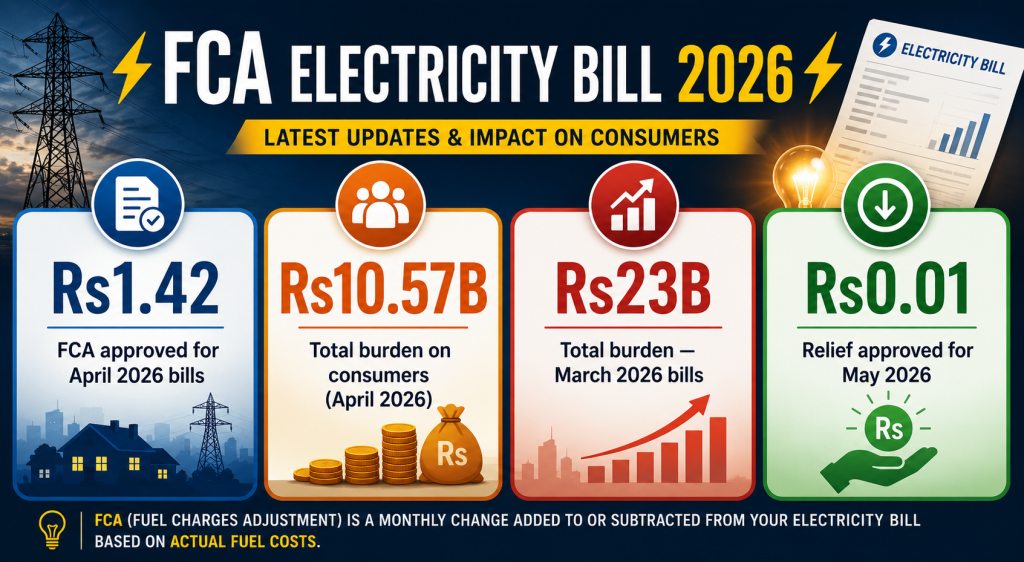
The table below tracks every NEPRA-approved fuel charge adjustment in 2026. Positive figures mean consumers paid extra. Negative figures mean consumers received relief.
| Generation Month | Bill Month | FCA per Unit (Rs) | Type | Total Impact |
|---|---|---|---|---|
| November 2025 | January 2026 | −Rs0.93 | Negative (Relief) | Bill reduction |
| December 2025 | February 2026 | +Rs0.28 | Positive (Charge) | Bill increase |
| January 2026 | March 2026 | +Rs1.63 | Positive (Charge) | ~Rs14 billion |
| February 2026 | April 2026 | +Rs1.42 | Positive (Charge) | ~Rs10.57 billion |
| March 2026 | May 2026 | −Rs0.01 | Negative (Relief) | Marginal credit |
Notice the pattern. January 2026 was the worst month for consumers, Rs1.63 per unit extra, because power plants relied heavily on expensive imported RLNG and coal. March 2026 flipped to a minor negative because hydel and renewables covered more of the generation mix, bringing actual fuel costs below the reference.
According to CPPA-G’s official petition filed under Section 31(7) of the NEPRA Act (XL of 1997), total electricity generation in January 2026 stood at 9,140 GWh at a fuel cost of Rs106.36 billion — translating to Rs11.64 per unit at the generation stage. After transmission losses and prior-period adjustments, the net delivered cost to DISCOs rose to Rs12.18 per unit. Source: NEPRA Public Hearing, February 26, 2026.
What Fuel Price Adjustment Looks Like on Your Electricity Bill — A Real Example
The FCA appears as a separate line item on your DISCO bill. Here is what a mid-range household bill could look like in March 2026 with the Rs1.63 per unit FCA applied.
Sample Bill — 300 Units Consumed (March 2026)
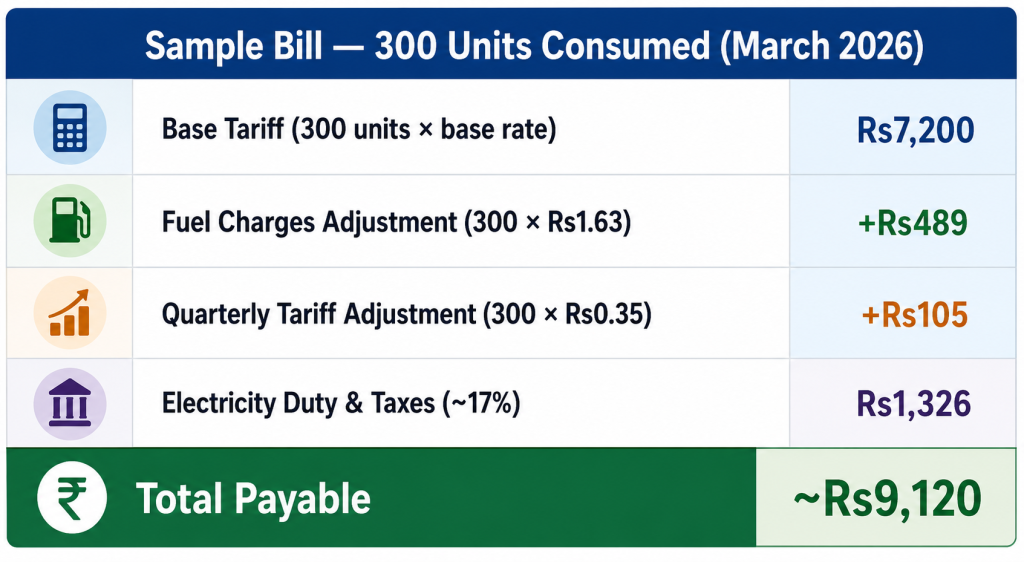
The FCA alone adds Rs489 to this household’s bill. Without the FCA, they would have paid Rs7,200 plus taxes. That is a 6.8% jump from one line item, and it changes every single month.
FCA vs FPA vs QTA: Three Terms That Confuse Everyone
Consumers often see three different adjustment labels on bills or in news reports. They are not the same thing.
| Term | Full Name | Frequency | What It Covers |
|---|---|---|---|
| FCA | Fuel Charges Adjustment | Monthly | Actual vs reference fuel cost for one month |
| FPA | Fuel Price Adjustment | Monthly | Same as FCA — alternate name used by some DISCOs |
| QTA | Quarterly Tariff Adjustment | Every 3 months | Capacity charges, power purchase price changes, O&M costs |
FCA and FPA are the same charge. Different DISCOs and news outlets use both terms. The QTA is separate; it adjusts capacity payments every quarter rather than monthly fuel costs. In March 2026, consumers paid both Rs1.63 FCA plus Rs0.35 QTA, together adding nearly Rs2 per unit.
Who Pays the Fuel Cost Adjustment NEPRA and Who Is Exempt?
Not every consumer in Pakistan pays the FCA. NEPRA consistently excludes three categories from monthly fuel adjustments:
- Lifeline consumers: households consuming fewer than 100 units per month. They receive a protected subsidised rate and are shielded from FCA swings.
- Electric Vehicle Charging Stations (EVCS): excluded under a separate policy to encourage EV adoption.
- Prepaid meter users: depending on the DISCO and meter configuration, the FCA may apply at the next recharge cycle rather than as a separate line.
Everyone else, residential, commercial, agricultural, and industrial consumers across all WAPDA DISCOs and K-Electric, pays whatever NEPRA approves that month.
K-Electric consumers — do they pay the same FCA? Yes. Under federal government policy, FCA is applied uniformly. In April 2026, NEPRA directed both K-Electric and all WAPDA DISCOs to apply the Rs1.42 per unit adjustment. NEPRA noted that additional national grid supply to K-Electric actually helped reduce the charge without it, consumers across Pakistan would have paid Rs4.08 per unit more.
What the Future Looks Like? Renewables, Rebasing, and Rupee Risk
Three forces will shape FCA in the coming months.
Renewable energy expansion: Solar, wind, and hydropower carry zero fuel cost. As their share in the grid rises, the average actual fuel cost falls, pushing FCA toward negative territory. NEPRA’s March 2026 approval of a minor negative adjustment reflects exactly this shift. Hydel generation that month was stronger, and renewables contributed meaningfully to the mix.
Tariff rebasing in 2026: NEPRA revised the reference fuel cost component under a CY 2026 tariff rebasing exercise. The updated reference figures change how future FCAs are calculated. Industry stakeholders at NEPRA’s April 2026 hearing argued that quarterly adjustment mechanisms should be aligned more effectively to smooth future tariff shocks.
Rupee-dollar volatility: Pakistan still imports the bulk of its thermal fuel in dollars. A weakening rupee translates directly into a higher FCA the following month. Industrial tariffs before taxes dropped from Rs 49.19 per unit in March 2024 to Rs 34.75 per unit by March 2026, partly because of better fuel management and partly because of the incremental consumption package at Rs 22.98 per unit. But none of those gains are permanent if the rupee slides again. This is the same mechanism that feeds Pakistan’s broader circular debt crisis.
What You Can Actually Do to Reduce the Impact on Your Bill?
You cannot control global oil prices or NEPRA’s decisions. But you can reduce the number of units you consume, which is the only variable that is fully in your hands.
- Replace old fans and air conditioners with inverter models. A 5-star inverter AC uses 40–50% less electricity than a conventional one. Read our full guide on reducing your electricity bill in Pakistan.
- Shift heavy appliances, such as washing machines, irons, and water pumps, to off-peak hours when grid demand is lower.
- Install a net-metering solar system. Net-metering users are excluded from certain adjustments and can offset consumption against grid exports. But Pakistan’s solar policy changed in December 2025 here is what you need to know before installing solar panels.
- Monitor your bill monthly. If the FCA figure looks unusually high, compare it against NEPRA’s official notification on nepra.org.pk. Errors in billing do happen.
- Submit comments at NEPRA public hearings. NEPRA invites consumer participation before approving each FCA. Your submission can influence the final decision.
Final Thoughts
The fuel price adjustment is not a hidden tax. It is a transparent regulatory mechanism that passes real generation costs directly to consumers for better or worse. When global energy markets calm and Pakistan’s hydel and renewable share grows, FCA should trend lower. But as long as Pakistan depends on imported fuel for a significant chunk of its electricity, every dollar movement in global oil prices and every rupee movement against the dollar shows up in your bill two months later.
Understanding the fuel charges adjustment in the electricity bill means you can read your bill critically, hold DISCOs accountable for errors, and make smarter decisions about energy consumption. To put the scale in perspective: a household consuming 300 units in March 2026 paid Rs. 489 extra from FCA alone. Multiply that across Pakistan’s roughly 30 million registered electricity consumers, and you reach the Rs14 billion burden NEPRA itself acknowledged in its March 2026 determination, a figure that lands in household budgets one bill at a time.
This article is written by Saira Imran and it based on NEPRA official determinations, CPPA-G monthly petitions, and public hearing records from January–May 2026. Figures are cross-referenced against Pakistan Today’s Profit desk reporting and NEPRA’s official portal (nepra.org.pk). Last updated: May 2026.
FAQs
Yes. Fuel Charges Adjustment (FCA) and Fuel Price Adjustment (FPA) are the same charge. Different DISCOs and media outlets use both names. The underlying mechanism and calculation method are identical.
It varied month to month. The highest in 2026 was Rs1.63 per unit for January 2026 generation (billed in March 2026), adding roughly Rs14 billion to national bills. April 2026 carried Rs1.42 per unit. May 2026 brought a marginal negative adjustment of Rs 0.01 per unit, a small relief signal.
CPPA-G submits the monthly petition with actual fuel cost data. NEPRA holds a public hearing, scrutinises the figures, and issues the final approved rate. Power distribution companies and K-Electric then apply the approved FCA in consumer bills.
CPPA-G needs time to compile the generation cost data after the month ends. It then files the petition, NEPRA holds a hearing, and the regulator issues its determination, a process that takes four to eight weeks. This is why December 2025 fuel costs appear in February 2026 bills, not December bills.
Yes. When actual fuel costs fall below the reference rate, usually because hydel or renewable generation dominates the mix, NEPRA approves a negative FCA. This reduces your bill for that cycle. It happened in November 2025 (−Rs0.93/unit, reflected in January 2026 bills) and again in March 2026 (−Rs0.01/unit, reflected in May 2026 bills).
Directly. Pakistan imports RLNG, furnace oil, and coal in US dollars. When the rupee weakens against the dollar, the rupee cost of the same fuel rises, which pushes the actual fuel cost above the reference and produces a higher positive FCA on your bill.