Saira Imran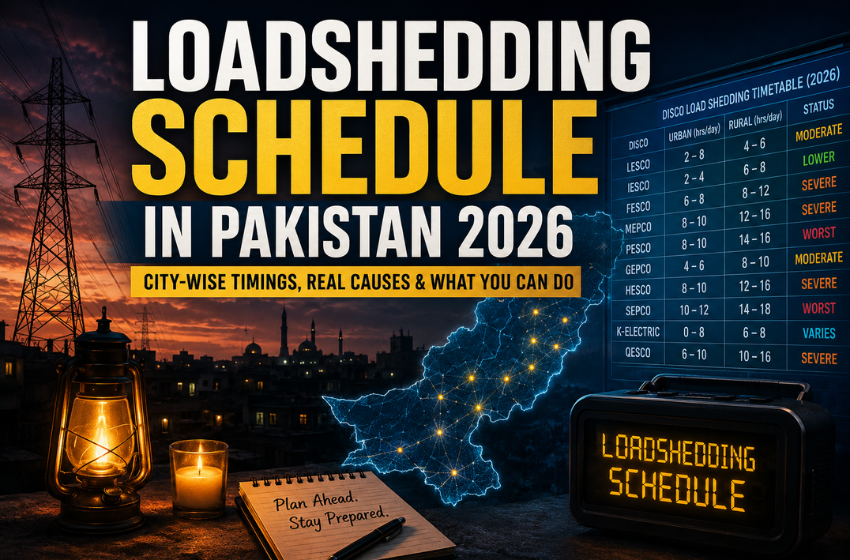
What is Loadshedding Schedule in Pakistan 2026: Full Breakdown
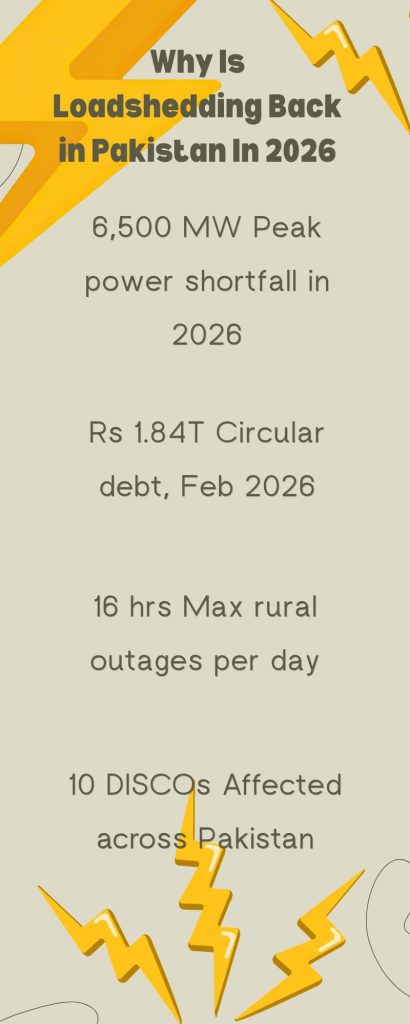
A loadshedding schedule is a pre-planned timetable that tells consumers when their area will have electricity cut off to manage national power supply shortfalls. Urban areas face 4–10 hours of daily outages. Rural areas endure 10–20 hours. The national power shortfall reached as high as 6,500 MW during peak demand. KPK remains the worst-hit region, with some rural feeders seeing 14–16 hours of cuts per day.
Check the latest loadshedding schedule in Pakistan 2026. Millions of households are waking up in the dark again. Power cuts have returned with force in 2026. We tracked loadshedding reports from readers across 12 Pakistani cities through the first quarter of this year, and the pattern is consistent: urban families are losing 6–8 hours daily, while rural households in South Punjab and KPK are routinely losing 14 hours or more.
If you are trying to plan your day around the darkness, this breakdown covers every major DISCO, the real causes behind the 2026 surge, and what actually helps.
Why Loadshedding Came Back in 2026?
Many Pakistanis believed the worst was over after the government slashed circular debt in 2025. It was not. By January 2026, loadshedding returned with 8–10 hour urban outages and 12–18 hour rural cut levels not seen in nearly a decade.
Three forces hit at once in early 2026: reduced hydropower output, a Qatar LNG force majeure triggered by the Iran-US conflict, and rising circular debt that limited fuel procurement. The result was a system shortfall of 2,000–4,000 MW, spiking to 6,500 MW on the worst days.
1. The LNG Supply Shock Nobody Saw Coming
Qatar is Pakistan’s main LNG supplier. When the Iran-US conflict shut the Strait of Hormuz, Qatar declared a force majeure. Pakistan’s gas supply dropped sharply. The system needs 1,100 MMCFD of RLNG to keep gas-based power plants running at full capacity, but supply fell to nearly half that. Gas-based plants that collectively produce over 5,000 MW went offline or ran at minimal output.
2. Lower Water in Dams
Hydropower covers roughly 33% of Pakistan’s total installed capacity. When water released from Tarbela and Mangla dams fell in winter and early spring 2026, the gap between supply and demand widened fast. WAPDA data showed inflows at Tarbela around 20,200 cusecs against outflows of just 8,000 cusecs, well below levels needed to sustain full generation.
3. Circular Debt Still Strangling the System
Pakistan’s power sector circular debt rose to Rs 1.84 trillion in February 2026, up from Rs 1.76 trillion in January, according to data compiled by Arif Habib Limited, citing the Ministry of Energy (Power Division). On a fiscal year-to-date basis, circular debt increased by Rs 225 billion, significantly higher than the Rs 138 billion rise in the same period last year, signalling that despite government injections in 2025, accumulation pressure has returned.
What this means for you: Every time circular debt rises, the chances of unscheduled power cuts increase, even in areas that normally have a clean loadshedding schedule.
DISCO-Wise Loadshedding Schedule: Pakistan Load Shedding Hours (2026)
Every distribution company (DISCO) manages its own loadshedding schedule based on its supply allocation from the national grid, feeder losses, and bill recovery rates. Below is the DISCO load shedding timetable for 2026, based on NEPRA’s April 2026 load management framework.
| DISCO | Region | Urban (hrs/day) | Rural (hrs/day) | Status |
|---|---|---|---|---|
| LESCO | Lahore + 5 districts | 2 – 8 hrs | 4 – 6 hrs | Moderate |
| IESCO | Islamabad + Rawalpindi | 2 – 4 hrs | 6 – 8 hrs | Lower |
| FESCO | Faisalabad | 6 – 8 hrs | 8 – 12 hrs | Severe |
| MEPCO | Multan + South Punjab | 8 – 10 hrs | 12 – 16 hrs | Severe |
| PESCO | Peshawar + KPK | 8 – 10 hrs | 14 – 16 hrs | Worst |
| GEPCO | Gujranwala Division | 4 – 6 hrs | 8 – 10 hrs | Moderate |
| HESCO | Hyderabad + Interior Sindh | 8 – 10 hrs | 12 – 16 hrs | Severe |
| SEPCO | Sukkur + Upper Sindh | 10 – 12 hrs | 14 – 18 hrs | Worst |
| K-Electric | Karachi | 0 – 8 hrs | 6 – 8 hrs | Varies by zone |
| QESCO | Quetta + Balochistan | 6 – 10 hrs | 10 – 16 hrs | Severe |
Note: These figures reflect the April–May 2026 average electricity unit price in Pakistan 2026. Actual power outage timings in Pakistan vary daily based on generation availability and feeder status. Always check your DISCO’s official site for real-time schedules.
K-Electric Karachi Load Shedding Schedule (Zone-by-Zone)
K-Electric divides Karachi into three categories based on bill recovery and technical losses. The loadshedding schedule in Karachi is directly tied to how well an area pays its bills.
| Category | Recovery Rate | Daily Outage | Example Areas |
|---|---|---|---|
| Category A (Exempt) | 95 – 100% | 0 hours | DHA, Clifton, Saddar, SITE Industrial |
| Category B (Low-Loss) | 70 – 94% | 2 – 4 hours | PECHS, North Nazimabad, Federal B Area |
| Category C (High-Loss) | Below 70% | 6 – 8 hours | Orangi, Lyari, Malir, Landhi, Baldia |
Communities can move out of high-loss categories. Several Karachi neighbourhoods, like North Nazimabad Block L, reduced their outage time from 6 hours to 2 hours after raising area bill recovery to 85%.
How to Check Your Loadshedding Schedule in Pakistan (2 Ways)
Finding your WAPDA bijli schedule is easier than ever. Every major DISCO publishes feeder-level schedules online. Use the method that works fastest for you.
1. Official DISCO Websites
- LESCO: lesco.gov.pk → Shutdown Schedule section
- IESCO: iesco.com.pk → Customer Services → Load Shedding Schedule
- FESCO: fesco.com.pk → Load Management
- MEPCO: mepco.com.pk → Load Shedding Schedule
- K-Electric: ke.com.pk → Power Status
- GEPCO: gepco.com.pk → Electric Load tab
- PITC Portal: ccms.pitc.com.pk → Search by Grid Station, Feeder, or City
2. K-Electric App & SMS
Download the KE Live app for real-time outage alerts by area. Or SMS your area name to 8119 and get the current schedule in minutes. Call helpline 118 for unscheduled outage updates.
NEPRA’s April 2026 rule change: Under a revised load management framework, DISCOs must now publish feeder-level schedules at least 24 hours in advance. If your DISCO is not doing this, you can file a complaint directly with NEPRA.
The Solar Paradox: Why More Panels Are Making Night Cuts Worse
More Pakistanis installed solar panels in 2024 and 2025. This actually reduced daytime demand on the grid, which sounds like good news. But it created a new problem: evening demand now spikes sharply as the sun sets and solar systems stop generating.
LESCO CEO Ramzan Butt confirmed this in April 2026, stating that solar adoption has lowered daytime load but is pushing evening demand beyond manageable levels. “The lack of solar power generation during fog and nighttime hours has created new peak pressure we did not face three years ago,” Butt said, citing the growing gap between sunset demand and grid availability. The government’s response time-of-use (TOU) tariffs push industrial consumers to shift heavy usage away from that evening window.
What it means for you: If you have solar, consider shifting high-consumption appliances (washing machines, water heaters) to daytime hours. This lowers your net metering bill and reduces your dependence on a grid that is most strained after sunset.
How Fuel Cost Adjustment Drives the Loadshedding Decision?
The government does not just shed load because of a supply shortage. In 2026, load management is also a cost-control strategy. Running expensive furnace oil and RLNG-based plants increases the Fuel Cost Adjustment (FCA) on your monthly electricity bill. To keep bills from rising further, authorities choose controlled loadshedding over expensive generation.
The Central Power Purchasing Agency (CPPA) filed a petition with NEPRA in April 2026 seeking a 26-paisa-per-unit increase for the fuel cost adjustment for March 2026. The energy mix that month included 30% coal, 23% hydel, 22% nuclear, 10% gas, and 5% RLNG. The trade-off is painful: less loadshedding costs more per unit. More loadshedding keeps the FCA lower, but your day still goes dark.
Scheduled vs Unscheduled Loadshedding: Know the Difference
How can I check if my area is on scheduled or unscheduled loadshedding? If the outage occurs during your feeder’s regular published slot, it is scheduled. If power goes out outside that window, it is an unscheduled or forced outage. Call your DISCO helpline (118 for KE, or your DISCO’s number) to confirm the reason and get an estimated restoration time.
| Type | Notice | Cause | Duration | What to Do |
|---|---|---|---|---|
| Scheduled | 24 hrs in advance | NEPRA load management plan | Fixed daily windows | Check DISCO site; plan your day around it |
| Unscheduled (Forced) | None | Shortfall, tripping, fog, storm | 1–12 hrs (unpredictable) | Call 118 / DISCO helpline for ETA |
| High-Loss Feeder | None | Policy: electricity theft areas | 12–16 hrs daily | Report theft; push for community recovery rate improvement |
| Maintenance | 3–7 days | Infrastructure upgrade | 4–12 hrs (one-time) | SMS/app notification from DISCO |
Seasonal Load Shedding Pattern: Summer 2026 Warning
| Season | Peak Demand | Expected Outage Impact |
|---|---|---|
| Winter (Nov – Feb) | 2,200 – 2,500 MW shortfall | 8–18 hours rural; fog disrupts solar |
| Spring (Mar – Apr) | 2,000 – 2,500 MW shortfall | Improving with dam inflows |
| Summer (May – Aug) | Projected 3,000 – 5,000 MW | Could be the worst period of 2026 |
| Monsoon (Jul – Sep) | Variable | Hydro improves; storms cause tripping |
Summer 2026 alert: Pakistan’s energy analysts, including those cited in NEPRA’s revised April 2026 load management framework, project peak shortfalls of 3,000–5,000 MW between May and August as air conditioning demand drives afternoon load beyond current generation capacity. Power Minister Sardar Awais Ahmad Khan Leghari acknowledged this risk in April 2026, stating that loadshedding remains a “compulsion” tied to gas supply disruptions — and that the situation is under review by a committee led by Finance Minister Muhammad Aurangzeb. Start preparing your backup power solution before peak heat arrives.
5 Practical Steps to Survive and Fight Back
- Know your feeder name. Your electricity bill shows your feeder number. Search it on ccms.pitc.com.pk for daily on/off status and advanced schedules.
- Shift your heaviest appliances to daytime. Washing machines, irons, and water heaters draw high current. Running them before noon reduces your evening bill and eases grid strain.
- Install a UPS or solar battery backup for essentials. Even a small system can power lights, fans, and phone charging through a 4-hour cut without breaking the bank.
- Pay your bill on time and push your neighbours to do the same. Your area’s bill recovery rate directly controls how many hours of loadshedding NEPRA assigns to your feeder. A 5% improvement in community recovery can reduce outages by 2 hours daily.
- Report electricity theft. Illegal connections, kundas force paying consumers to absorb the losses. Call 118 or use your DISCO’s app to report anonymously.
Final Thoughts: Know Your Loadshedding Schedule, Then Go Beyond It
The loadshedding schedule in Pakistan in 2026 is not random. It is the product of circular debt, geopolitical shocks, ageing infrastructure, and institutional failures that go back decades. Understanding your DISCO’s power outage timings in Pakistan is the first step. But the deeper solution, paying bills, reporting theft, and investing in solar, depends on all of us.
Check your feeder schedule today. Shift heavy appliances to daytime. Push your community’s recovery rate up. Every 5% improvement in your area’s payment record could shave 2 hours off your daily darkness.
Written by Saira Imran and reviewed by our team, which monitors NEPRA circulars, DISCO load management notices, and daily power sector filings to keep this data current.
Last verified: May 2026 | Sources: NEPRA Load Management Framework (April 2026), CPPA-G petition data, Arif Habib Ltd. power sector report, Profit by Pakistan Today field reports.
FAQs
Urban areas face 4–10 hours of daily outages, and rural areas face 10–20 hours, depending on your DISCO and feeder type. KPK and South Punjab are the worst-affected regions.
Rural feeders typically have lower bill recovery rates and higher technical losses. NEPRA policy allows DISCOs to cut supply to high-loss feeders for longer durations as a recovery measure. High theft and poor infrastructure compound the problem.
Circular debt fell to Rs 1.61 trillion in June 2025 after government injections, but rose again to Rs 1.84 trillion by February 2026. Alongside that, the Qatar LNG force majeure and low dam water levels cut generation capacity sharply, triggering the return of widespread outages.
Energy analysts project it could. As temperatures rise and air conditioner use spikes, demand could push the national shortfall to 3,000–5,000 MW during peak afternoon hours.
When generation from expensive fuels like furnace oil or imported RLNG rises, it increases the FCA charged to consumers. To avoid this, authorities sometimes choose controlled loadshedding over running costly generation. The April 2026 FCA petition sought a 26-paisa-per-unit increase for March 2026 alone.