Saira Imran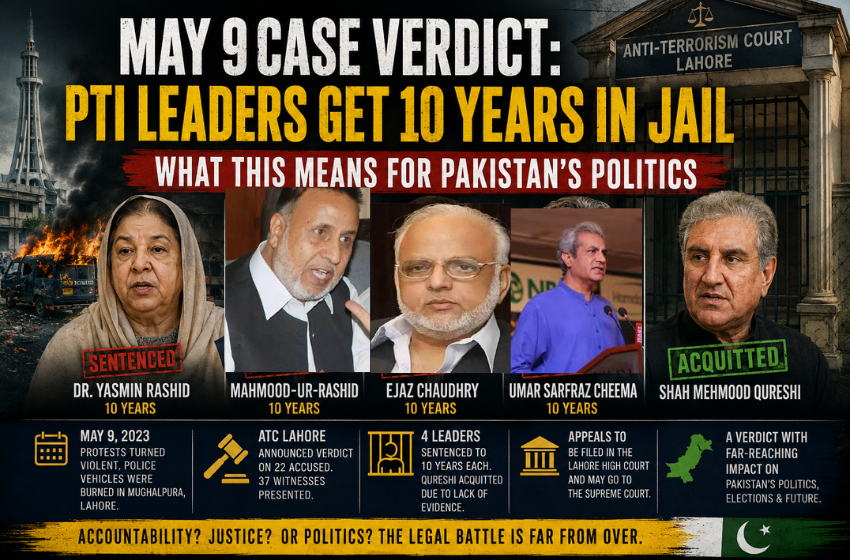
May 9 Case Verdict: PTI Leaders Sentenced to 10 Years
A Lahore court has handed 10-year prison sentences to senior PTI leaders in the latest May 9 case verdict. This is not just a court decision. It changes the political future of one of Pakistan’s biggest parties.
Here is what happened, why it matters, and what comes next.
What Happened in Court Today?
An Anti-Terrorism Court (ATC) in Lahore announced its verdict in the Mughalpura police vehicle arson case. The case is linked to the May 9, 2023, violence.
ATC Judge Manzar Ali Gul delivered the verdict inside Kot Lakhpat Jail. The court had reserved the decision on June 18, 2025, after both sides finished their arguments.
The case involved 22 accused. Prosecutors presented 37 witnesses during the trial.
Who Was Sentenced And Who Was Set Free?
The court sentenced four senior PTI leaders to 10 years in prison each:
- Dr. Yasmin Rashid: former Punjab Health Minister
- Mahmood-ur-Rashid: former Punjab Chief Minister candidate
- Ejaz Chaudhry: PTI Senator
- Umar Sarfraz Cheema: former Governor of Punjab
Former Foreign Minister Shah Mehmood Qureshi was acquitted. The court found insufficient evidence against him in this specific case.
Two other accused, Arbaz Zaman and Ilahi Bakhsh, were declared absconders. Legal proceedings against them will continue separately.
In total, the court reached a verdict on 15 of the 22 accused.
What Was the Mughalpura Arson Case?
On May 9, 2023, PTI founder Imran Khan was arrested. His supporters took to the streets across Pakistan. In Lahore’s Mughalpura area, a mob burned police vehicles. That incident became this criminal case.
Prosecutors claimed that senior PTI leaders made speeches that pushed workers toward violence. The court agreed — but only for some of the accused.
This is not the first conviction for these leaders. For Dr. Yasmin Rashid, Ejaz Chaudhry, Omar Sarfraz Cheema, and Mahmood-ur-Rashid, this is actually their fifth conviction in May 9 related cases.
Why This Verdict Matters for Ordinary Pakistanis?
You may be thinking: this is politics, not my problem.
But think again.
When senior elected leaders go to jail, their voters lose representation. Laws that affect your electricity bills, your taxes, your children’s education those are made by elected people. When those people face legal battles, governance suffers.
PTI still has millions of voters across Punjab. With its top leaders in jail, the party struggles to function normally. That affects the political balance in Pakistan. And political instability affects the economy, investment, and daily life.
How Big Is PTI’s Legal Crisis Right Now?
The numbers tell the story clearly.
Multiple ATCs across Pakistan have sentenced PTI leaders in May 9 cases. Before this verdict, courts in Lahore and Sargodha had already sentenced dozens of PTI workers and leaders. The Sargodha ATC sentenced over 34 people, including Punjab Assembly Opposition Leader Ahmad Khan Bachar.
PTI founder Imran Khan himself remains in jail in connection with several ongoing cases.
The party’s top leadership is now either in jail or fighting court cases. This is the biggest legal crisis any major Pakistani political party has faced in recent memory.
What Shah Mehmood Qureshi’s Acquittal Tells Us?
Qureshi’s acquittal is worth noting. The court said there was not enough evidence against him in this particular case.
This matters for two reasons.
- First, it shows courts are examining evidence case by case, not giving blanket convictions.
- Second, Qureshi has now been acquitted in multiple May 9 cases. His legal situation differs from that of his party colleagues who have received multiple sentences.
PTI’s Response
PTI has consistently called May 9 cases politically motivated. The party argues that the government and military are using courts to silence opposition.
After the verdict, PTI Chairman Barrister Gohar Ali Khan said the sentences were given without full due process. The party has filed multiple appeals in the Lahore High Court.
Some leaders have already challenged their earlier sentences in higher courts. Those legal battles are ongoing.
What Happens to Convicted Leaders Now?
In the May 9 case verdict, the four sentenced leaders of PTI are already in custody. They were arrested in connection with earlier May 9 cases.
Under Pakistani law, they can appeal to the Lahore High Court. If the High Court rejects the appeal, they can go to the Supreme Court.
But appeals take time. Months, sometimes years. Meanwhile, they remain behind bars.
Their political futures depend on what the higher courts decide. If convictions are upheld, they cannot contest elections while serving sentences.
What to Watch Next?
A few things will shape what comes after this verdict.
PTI’s lawyers will file appeals in the Lahore High Court. The court may or may not suspend the sentences while appeals are heard. That decision will tell us whether these leaders can be more active politically while their cases continue.
More May 9 verdicts are expected from other ATCs. Each new conviction adds pressure on PTI. Each acquittal gives the party room to argue selective accountability.
Imran Khan’s own cases are separate. His legal situation is being watched closely both inside and outside Pakistan.
The Bigger Picture
Pakistan has seen political leaders go to jail before. What makes the May 9 cases different is the scale. Hundreds of workers. Dozens of leaders. Multiple courts. Years of trials.
Whether you support PTI or oppose it, this legal process will shape Pakistani politics for years.
For ordinary Pakistanis, the key question is simple: will accountability apply equally to everyone? Or will political affiliation decide who faces justice and who does not?
That question does not yet have a final answer.