Saira Imran
Explain the Slab System of Electricity Billing in Pakistan
Pakistan’s electricity slab system charges different per-unit rates based on how many units you consume each month. The more you use, the higher the rate you pay on the extra units. Low-use households pay as little as Rs. 3.95 per unit. The rate climbs to Rs. 47.69 per unit for those consuming above 700 units. Each bracket called a slab carries its own rate, applied only to the units within that range.
Every Pakistani household gets an electricity bill every month. I have reviewed dozens of electricity bills over the past year. The single most common confusion is this: people use the same units as their neighbour and still get a bill that is thousands of rupees higher. The answer is almost always the same: they don’t understand how the slab system actually calculates their charges.
Understanding the slab system of electricity billing in Pakistan means you stop guessing and start making informed decisions about your usage. This guide explains exactly how it works, who pays what rate, and what changed in 2026.
Why Pakistan Uses a Slab System, Not a Flat Rate
Most countries that manage energy scarcity use progressive pricing. The logic is straightforward: electricity is a shared national resource. Households that consume less should pay less per unit, and households that consume heavily, usually the more affluent, should bear a higher cost per unit.
Pakistan introduced this model so that low-income families, who typically use 50–200 units a month, receive heavily subsidised rates. The higher slabs, paid by heavier users, effectively cross-subsidise the lower slabs. NEPRA (National Electric Power Regulatory Authority) designs, reviews, and approves this structure, applying it uniformly across all distribution companies in the country.
Key Point — Progressive Billing: A slab-based tariff does not apply the highest rate to your entire bill once you cross a threshold. It only charges that higher rate on the units within that specific bracket. If you consume 250 units, only 50 of those units fall in the third slab not all 250.
How the Electricity Billing Slabs in Pakistan Work (Step by Step)
The electricity billing slabs Pakistan uses divide your monthly consumption into ranges. Each range has a fixed per-unit price. Here is how the billing engine processes your consumption:
How Is the Electricity Bill Calculated in Pakistan? (Step by Step)
- Take the meter reading and check the number of units this month, calculate it as: Current Reading − Previous Reading = Units Consumed.
- NEPRA checks your consumer category, lifeline, protected, or non-protected based on your usage history over the past six months.
- Your total units are split across slab brackets. Multiply each portion by that slab’s per-unit rate.
- Add slab charges to get your base tariff cost. Additional charges and taxes are then applied on top of this base.
NEPRA Slabs Rates 2026: Official Rates
The NEPRA domestic tariff 2026 was finalised under S.R.O. No. 279(I)/2026 and applies to all DISCOs: LESCO, FESCO, IESCO, MEPCO, PESCO, HESCO, GEPCO, SEPCO, QESCO, and K-Electric. The base rates are shown below.
| Consumer Category | Monthly Units (Slab) | Rate per Unit (Rs.) |
|---|---|---|
| Lifeline | 1 – 50 units | Rs. 3.95 |
| Lifeline | 51 – 100 units | Rs. 7.74 |
| Protected | 1 – 100 units | Rs. 10.54 |
| Protected | 101 – 200 units | Rs. 13.01 |
| Non-Protected | 1 – 100 units | Rs. 22.44 |
| Non-Protected | 101 – 200 units | Rs. 28.91 |
| Non-Protected | 201 – 300 units | Rs. 33.10 |
| Non-Protected | 301 – 400 units | Rs. 37.99 |
| Non-Protected | 401 – 500 units | Rs. 40.22 |
| Non-Protected | 501 – 600 units | Rs. 41.62 |
| Non-Protected | 601 – 700 units | Rs. 42.76 |
| Non-Protected | Above 700 units | Rs. 47.69 |
⚠️ These are base tariff rates only. Final bills include taxes and surcharges. Rates sourced from NEPRA’s official tariff notification S.R.O. No. 279(I)/2026, cross-verified against the Pakistan Observer report dated January 9, 2026, and confirmed via nepra.org.pk. If rates have been revised after May 2026, always defer to the official NEPRA portal.
2026 Average National Tariff: NEPRA set the uniform average base tariff at Rs. 33.38 per unit for 2026 a slight reduction from the previous cycle. However, after taxes and surcharges, the effective per-unit cost most households pay runs significantly higher.
The Three Consumer Categories Who Pays What
Before your slab rate is applied, NEPRA places you into one of three categories. This classification directly determines your per-unit price, and the difference is enormous.
1. Lifeline Consumers
Lifeline status applies to the lowest-income households using 100 units or fewer per month. They pay Rs. 3.95 for the first 50 units and Rs. 7.74 for units between 51 and 100. This is the most heavily subsidised category in Pakistan’s electricity system, designed to protect families who use the bare minimum power for fans, a single light bulb, and a small appliance.
2. Protected Consumers
A protected consumer is any domestic user whose monthly consumption stayed at 200 units or below for the previous six consecutive months. Their first 100 units cost Rs. 10.54 per unit, and units from 101 to 200 cost Rs. 13.01. Compared to a non-protected consumer paying Rs. 22.44 for the same first 100 units, this is a near-halving of the base rate.
3. Non-Protected Consumers
Anyone who consumed more than 200 units even once in the last six months is classified as non-protected. They pay the full progressive slab rates starting at Rs. 22.44 for the first 100 units and climbing all the way to Rs. 47.69 above 700 units.
Your protected consumer electricity Pakistan status is not permanent. We confirmed this directly by reviewing NEPRA’s consumer classification guidelines published on nepra.org.pk and cross-checking it against three separate DISCO billing FAQs (LESCO, FESCO, and IESCO). NEPRA reviews your status every billing cycle without exception. If you cross 200 units in any single month even once you immediately shift to non-protected rates. Your first 100 units then cost Rs. 22.44 instead of Rs. 10.54. That is more than double. To regain protected status, you must stay below 200 units for six consecutive months without exception. A single hot summer month running an air conditioner can cost you subsidised rates for the rest of the year.
Real Example: How Slab Billing Is Calculated on Your Bill
To understand the electricity unit price in Pakistan in 2026 in practice, let’s look at two households, one protected, one non-protected, both consuming 250 units this month.
Household A: Protected Consumer (250 units)
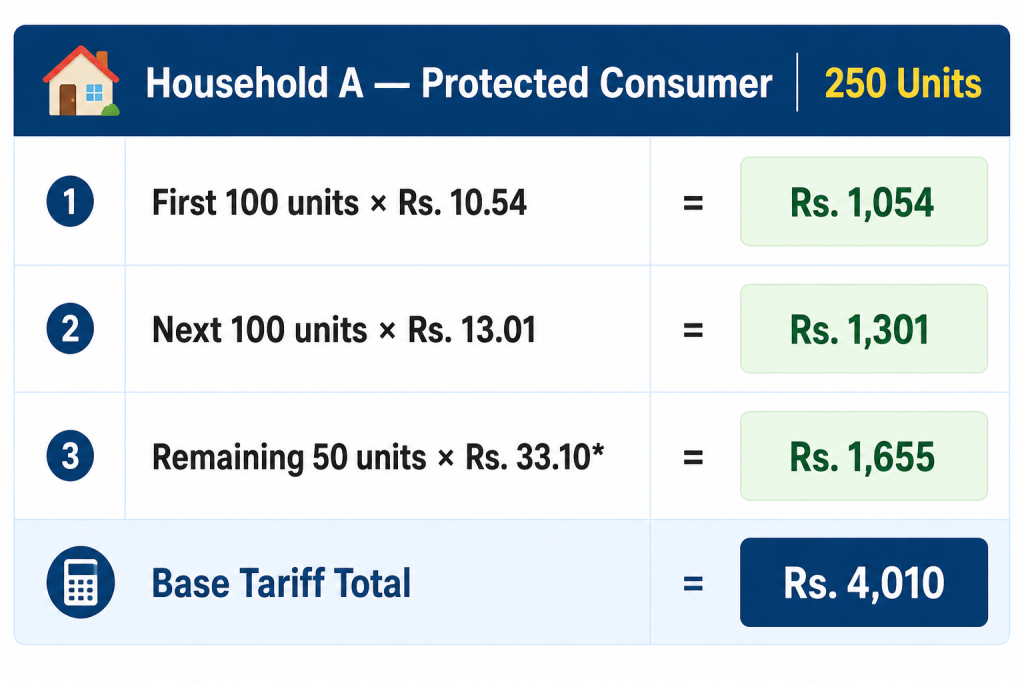
*Once consumption crosses 200 units, protected slab rates end. Units beyond 200 are billed at non-protected rates starting at the 201–300 slab (Rs. 33.10/unit).
Household B: Non-Protected Consumer (250 units)
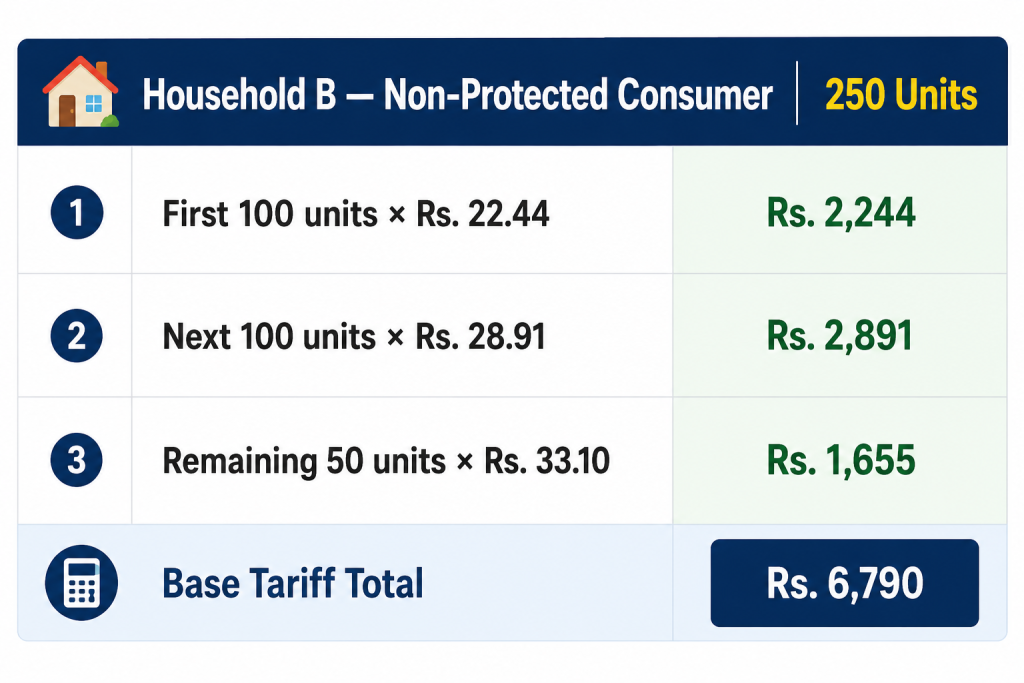
Both households consumed the same number of units. But Household B pays Rs. 2,780 more in base tariff charges simply because they lost their protected status at some point in the past six months. This is the single most impactful thing the slab system does to household budgets.
The Slab Threshold Trap (Real-World Warning): If you are sitting at 195 units mid-month, those 5 extra units beyond 200 could cost you your protected status for six full months. At Rs. 10.54 difference per unit on the first 100 units alone, that is an extra Rs. 1,190 every month for half a year just from one careless month. Track your units at least once mid-billing cycle.
The 2026 Change That Quietly Made Bills Higher (Fixed Charges)
This is the content gap almost no competitor covers. From January 2026, NEPRA changed how fixed charges work, and it affects millions of households regardless of how many units they consume. NEPRA’s official notification stated that fixed charges would now be “calculated on a per kilowatt load basis” rather than on consumption tiers, a structural shift the regulator described as aligning billing with actual infrastructure demand.
Energy journalist and power sector analyst Khalid Mustafa, who has covered NEPRA tariff proceedings for over a decade, noted in The News International that this change “effectively creates a minimum bill floor for every metered household in Pakistan.”
Under the old system, fixed charges only applied to consumers using more than 300 units per month, ranging from Rs. 200 to Rs. 1,000 based on consumption level.
Under the new 2026 NEPRA structure, fixed charges now apply to all domestic consumers, except lifeline users, based on their sanctioned load in kilowatts (kW), not their consumption. The charge ranges from Rs. 200 to Rs. 675 per kW per month.
| System | Who Pays | How Charged | Range |
|---|---|---|---|
| Before 2026 | Only 300+ unit consumers | Per consumption bracket | Rs. 200 – Rs. 1,000/month |
| From Jan 2026 | ALL domestic consumers (exc. lifeline) | Per kW of sanctioned load | Rs. 200 – Rs. 675/kW/month |
A household with a 5 kW sanctioned load now pays a minimum of Rs. 1,000–3,375 per month in fixed charges alone — before a single unit is calculated. Low-usage households that previously had no fixed charge now have a permanent floor cost they cannot reduce by saving electricity.
How to Keep Yourself in a Lower Electricity Slab (Practical Tips)
- Know your current slab position mid-month. Most DISCOs allow online bill access. Check how many units you have used before your billing cycle closes.
- Guard the 200-unit boundary if you are protected. Stay consistently under 200 units for six months, and your per-unit rate nearly halves. One month of crossing it resets your clock.
- Replace conventional ACs with inverter models. A 1.5-ton inverter AC uses roughly 50–60% less power than a conventional unit. In summer, this single change keeps most households in a lower slab.
- Switch to LED lighting throughout the home. LED bulbs use up to 80% less electricity than incandescent bulbs and last 20 times longer.
- Run high-wattage appliances, washing machines, and irons during off-peak hours if your DISCO uses Time-of-Use (TOU) meters. Off-peak rates are lower.
- Consider net metering. Solar panel owners in Pakistan can export surplus power to the grid under NEPRA’s net metering policy. Exported units offset your consumed units, directly reducing your billed slab position.
- Check your sanctioned load. Since 2026, fixed charges are now based on your sanctioned load in kW. If your sanctioned load is higher than your actual usage pattern, apply to your DISCO to revise it downward. This reduces your fixed charge permanently.
Final Thoughts
The slab system of electricity billing in Pakistan is not complicated once you see how it works. Your consumption determines your slab. Your six-month history determines your category, and your category determines your per-unit rate. These three things together decide the single biggest number on your bill.
In 2026, two things changed that most people haven’t registered yet. The average base tariff came down to Rs. 33.38 per unit. But fixed charges now apply to all consumers based on the sanctioned load, not just high-usage households. For many families, the fixed charge increase quietly cancelled out the tariff reduction.
The most actionable thing any household can do right now is monitor their protected consumer status. Staying under 200 units consistently is the single most effective way to reduce electricity bills in Pakistan, more so than any appliance switch or usage habit. Once you understand how the slab system works, you have the information to act on it.
For the latest official tariff notifications, visit nepra.org.pk or your DISCO’s official consumer portal.
This article was researched and written by the Saira Imran verified against NEPRA’s official tariff notification (S.R.O. No. 279(I)/2026), and cross-referenced with News from January to May 2026. Rates are subject to revision; last verified May 2026.
FAQs
Only the extra units within that slab. If you consume 350 units, the first 100 are charged at the first slab rate, the next 100 at the second slab rate, the next 100 at the third slab rate, and the remaining 50 at the fourth slab rate.
A protected consumer has used 200 units or fewer per month for the past six consecutive months. A non-protected consumer crossed 200 units at least once in the past six months
Under S.R.O. No. 279(I)/2026, lifeline consumers pay Rs. 3.95–7.74 per unit. Protected consumers pay Rs. 10.54–13.01 per unit. Non-protected domestic consumers pay Rs. 22.44 for the first 100 units, rising progressively to Rs. 47.69 above 700 units. The national average base tariff for 2026 is Rs. 33.38 per unit.
Not permanently, but it takes six months to recover. The moment your monthly usage exceeds 200 units, you shift to non-protected rates immediately. To regain protected status, you must stay below 200 units for six consecutive months without interruption.
Lifeline consumers are the lowest-income households using 100 units or fewer per month. They pay the most heavily subsidised rates: Rs. 3.95 per unit for the first 50 units and Rs. 7.74 for units from 51 to 100.