Saira Imran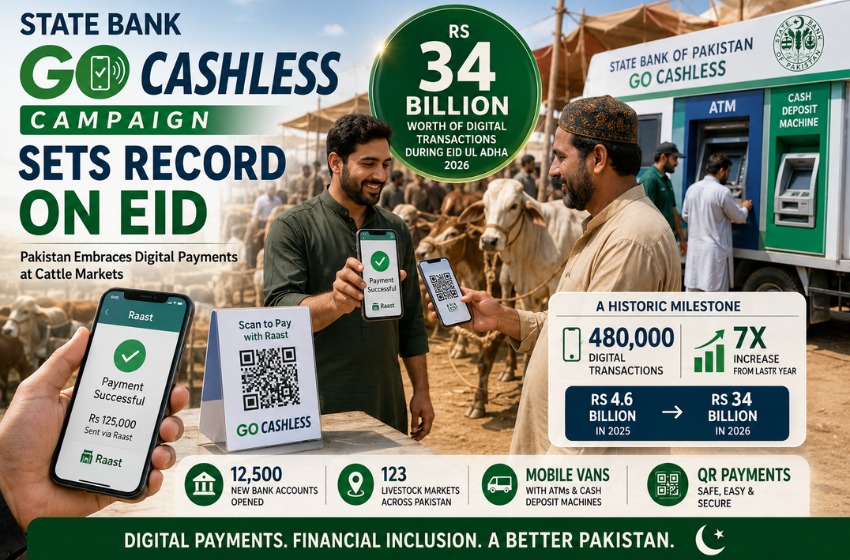
State Bank Go Cashless Campaign Sets Record on Eid
How State Bank’s Go Cashless Campaign Changed the Way Pakistan Bought Qurbani Animals This Eid
Pakistan just crossed a major milestone in digital payments. And it happened at the cattle market.
The State Bank of Pakistan announced that its Go Cashless campaign during Eid ul Adha 2026 recorded Rs 34 billion worth of digital transactions. That is not a small number. That is a signal that Pakistan’s financial habits are changing fast.
What is the State Bank Go Cashless campaign?
It is a digital payment promotion run by the State Bank of Pakistan. It encourages people to use mobile banking, QR codes, and digital transfers instead of cash. The campaign runs at major public events and markets across Pakistan. Rs 34 billion across 480,000 transactions occurred digitally during the Eid ul Adha period. Last year recorded Rs 4.6 billion in digital transactions. This year that figure grew 7x to Rs 34 billion.
What Happened This Eid?
The State Bank ran its Go Cashless campaign across 123 livestock markets in Pakistan during Eid ul Adha 2026.
People bought and sold animals using digital payments instead of carrying large amounts of cash. QR codes were available at markets. Mobile vans with ATMs and cash deposit machines were parked at locations across the country.
The result? 480,000 digital transactions worth Rs 34 billion in just a few days.
Last year, the same campaign recorded Rs 4.6 billion in transactions. This year that number jumped to Rs 34 billion. That is a 7x increase in one year.
Why This Matters for Pakistanis?
Carrying large amounts of cash to a cattle market is risky. Theft is a real concern. Counting money manually leaves room for error. And disputes over payments can turn into problems.
Digital payments remove all of that friction.
You scan a QR code. You pay from your phone. The transaction is recorded. No counting. No carrying bundles of notes through a crowded market.
This is exactly the kind of change that makes daily life easier for ordinary Pakistanis.
12,500 New Bank Accounts Opened
One of the most important numbers from the campaign is not the transaction value. It is this: 12,500 new bank accounts were opened during the campaign period.
That means thousands of Pakistanis who were previously unbanked decided to enter the formal financial system. They signed up for accounts. They made digital payments. And they will likely continue using those accounts long after Eid is over.
This is what financial inclusion looks like in practice. It is not just about mobile apps. It is about reaching people at a place they already go.
The cattle market is one of the most cash-heavy environments in Pakistan. If digital payments can work there, they can work anywhere.
Mobile Vans Made It Possible
The State Bank did not just launch a campaign and hope people would figure it out. They sent mobile vans to 123 livestock markets across the country.
Those vans carried ATMs and cash deposit machines. Bank staff was available on site to help people open accounts and make transactions.
QR code support was set up across the markets. Buyers could pay sellers directly using mobile banking apps without touching cash.
This kind of on-ground support is what separates a successful campaign from an announcement that goes nowhere.
Pakistan Is Moving Toward a Digital Economy
This campaign is part of a larger picture. Pakistan has been working to increase digital payment adoption for several years.
The SBP has pushed for QR-based payments. Raast, Pakistan’s instant payment system, has made transfers faster and cheaper. Mobile banking apps have improved significantly.
The Go Cashless campaign shows that this work is producing results. A 7x jump in one year is not an accident. It reflects real infrastructure being built and real trust being earned.
What This Means for You
If you still rely on cash for everyday transactions, now is a good time to explore your options.
Most major banks in Pakistan offer mobile banking apps. You can open an account online or at a branch. Raast transfers are free. QR payments work at thousands of locations.
You do not need to change everything at once. Start with one or two digital transactions. See how it works. Build the habit gradually.
The shift is already happening around you. Getting on board early means fewer hassles later.