Saira Imran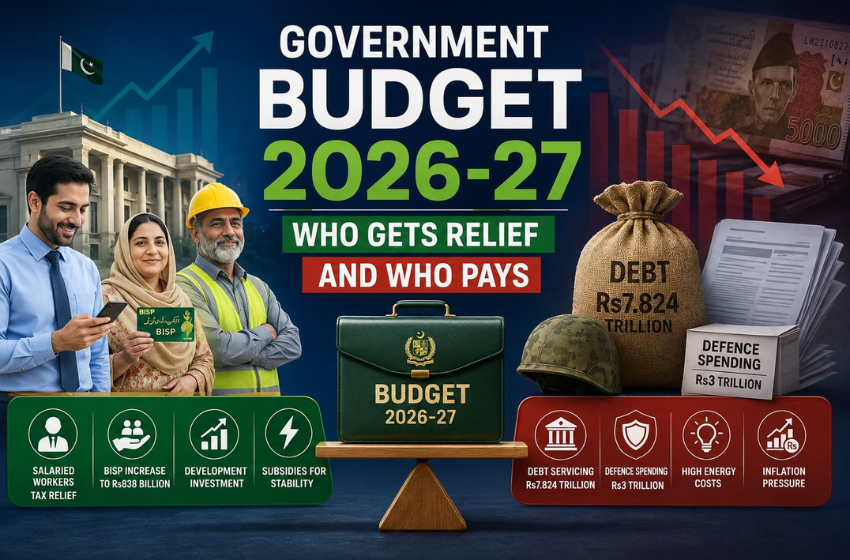
Government Budget 2026-27: Who Gets Relief and Who Pays
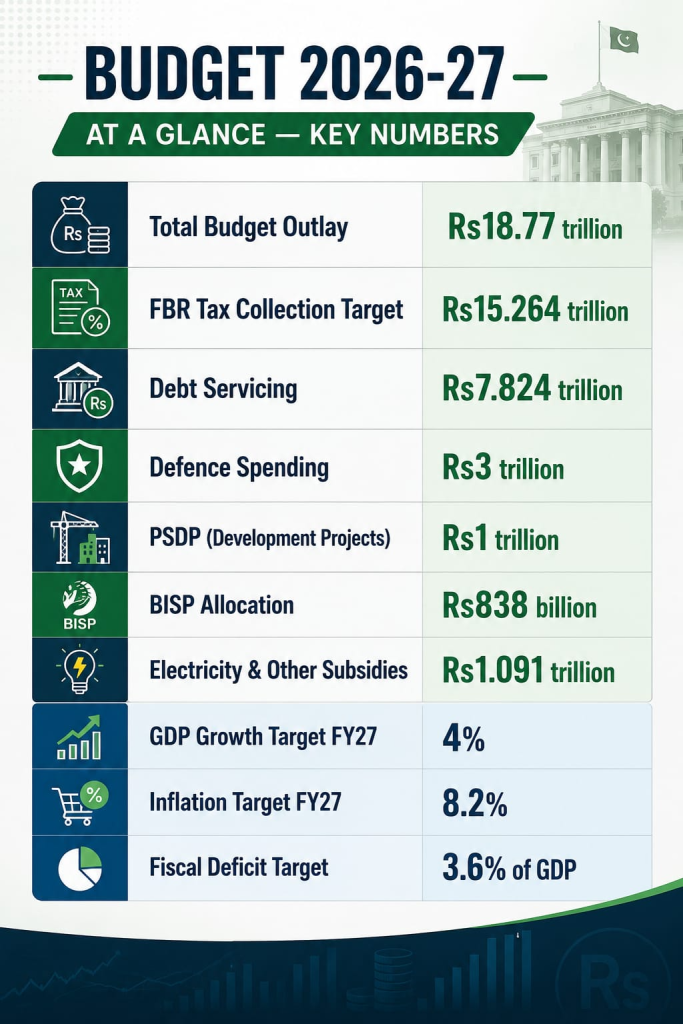
The federal government budget for FY2026-27 was presented on June 12, 2026, by Finance Minister Muhammad Aurangzeb- total outlay: Rs18.77 trillion. Salaried workers get a 7% pay raise and tax cuts across four income slabs. BISP gets Rs838 billion. Defence spending crosses Rs3 trillion. FBR must collect Rs15.26 trillion in taxes.
If you earn a salary, pay electricity bills, or depend on BISP support, this budget touches your life directly. Here is exactly what changed, what stayed the same, and what it means for your pocket.
What Is Budget 2026-27 and Why Does It Matter?
Every June, the government decides how it will earn money and spend it over the next 12 months. That document is the federal budget.
This year’s budget for fiscal year 2026-27 covers July 2026 to June 2027. Finance Minister Muhammad Aurangzeb presented the Government Budget 2026-27 in the National Assembly on June 12, 2026.
Why it matters to you: The budget decides your tax rate, whether your salary goes up, how much BISP pays out each quarter, how much the government spends on roads and electricity, and whether your grocery prices rise or fall.
Pakistan’s economy has grown. GDP reached $452 billion. Per capita income rose from $1,751 to $1,901. Foreign exchange reserves now sit above $17 billion, compared to just $4 billion three years ago. These are real improvements. The budget tries to build on them.
Budget 2026-27 Key Numbers
Good News for Salaried Workers: Income Tax Cuts
This is the part most working Pakistanis care about most. The government reduced income tax slabs in 2026 across four income brackets. It also abolished the 10% surcharge on annual salaries above Rs10 million. Both changes take effect from July 1, 2026.
What this means in real numbers:
- A government employee earning Rs200,000 per month saves roughly Rs500 per month
- Someone earning Rs400,000 per month saves around Rs5,667 per month before the surcharge removal benefit
The surcharge removal matters more for higher-income earners. For middle-bracket earners, the savings are real but not dramatic given two years of inflation.
Why salaried people carry a heavy tax burden: In FY2024-25, salaried individuals paid over Rs605 billion in income tax, a 55% jump year-on-year. Employers deduct tax before the salary even reaches the account. Retailers and wholesalers don’t face the same scrutiny. The government acknowledged this imbalance and the FY27 cuts are the most direct response in three budget cycles.
Salary increase: Government employees get a 7% raise. Pensioners also get a 7% increase. The minimum wage rises by 10%. These apply to federal employees. Provincial salary increases come through separate provincial budgets.
Income Tax Slabs 2026-27: New vs Old (Salaried Class)
The number of income tax slabs expanded from six to eight categories. This gives more precision and reduces the cliff-edge jumps between brackets.
| Annual Income | Direction of Change |
|---|---|
| Up to Rs1.2 million | No change (zero tax) |
| Rs1.2M to Rs2.2M | Rates reduced |
| Rs2.2M to Rs3.6M | Rates reduced |
| Rs3.6M and above | Rates reduced |
| Above Rs10M (surcharge) | Surcharge abolished |
Note: These are the confirmed changes from the Finance Bill 2026-27. Your actual monthly deduction depends on your exact salary. Ask your HR department for the revised withholding amount from July 2026.
BISP Gets Rs838 Billion
The Benazir Income Support Programme receives Rs838 billion in this budget. That is a 17% increase from last year’s Rs716 billion. Coverage expands to 12 million families across Pakistan.
The quarterly stipend rises from Rs13,000 to Rs14,500. That is an extra Rs1,500 per quarter, or Rs6,000 annually per household.
BISP continues to serve as the main safety net for low-income families who face rising electricity tariffs and fuel costs. The government raised BISP by 21% the previous year. This year’s 17% is slightly lower, but the programme keeps growing.
Defence Budget Crosses Rs3 Trillion
Defence spending now stands at Rs3 trillion for FY27. Finance Minister Aurangzeb linked this directly to regional security developments, citing Operation Bunyan Marsus and the geopolitical situation with India.
This is a major chunk of the total budget. Together, debt servicing (Rs7.824 trillion) and defence (Rs3 trillion) absorb roughly Rs10.8 trillion. That leaves about Rs8 trillion for everything else: BISP, salaries, development, subsidies, health, education, and regional allocations.
What it means: The government has very little room to give broad-based relief. That is why the salary increase is 7%, not 15%. That is why the income tax cuts target specific slabs rather than cutting rates across the board.
What Budget 2026-27 Says about Electricity Subsidy
The government set electricity and other sector subsidies at Rs1.091 trillion. Energy sector allocations under the development Government Budget 2026-27 include:
- Rs50.2 billion for WAPDA solar and wind projects
- Rs13.1 billion for eight hydropower projects in AJK and Gilgit-Baltistan
- Rs158 billion in additional investment from WAPDA and power sector entities
If you are on a LESCO, MEPCO, or HESCO connection, do not expect electricity bills to fall significantly in FY27. The subsidy goes to stabilise the system, not cut your unit rate.
Related: Pakistan’s federal budget deficit Pakistan is projected at Rs7.02 trillion, which equals 3.6% of GDP. The government also targets a primary surplus of 2% of GDP, meaning it wants to run a surplus before debt interest payments, a requirement under its IMF programme.
Development Budget for Roads, Water, Digital Pakistan
The Public Sector Development Programme gets Rs1 trillion under the federal budget. Provincial Annual Development Plans add another Rs2.218 trillion, though these were cut from original proposals.
Key PSDP breakdowns:
- Infrastructure: Rs602.5 billion (roads, transport, connectivity)
- Energy projects: Rs116 billion
- Water infrastructure: Rs76 billion
- Physical planning and housing: Rs55 billion
Apna Ghar Housing Scheme gets Rs71 billion in this Government Budget 2026-27. This scheme offers mortgage financing at 5% markup — well below normal market rates of 18-22%.
National AI Programme: The government launched a $1 billion Artificial Intelligence Ecosystem Development Programme. This is a flagship initiative aimed at digital transformation and technology-led growth.
What Got More Expensive in Budget 2026-27?
Electric vehicles and hybrids: Despite earlier signals, imported EVs and plug-in hybrids will cost more under proposed budget measures. The IMF opposed duty exemptions on imported EVs, and the government complied.
Luxury vehicles: A new Environmental Levy applies:
- 10% levy on petrol/diesel vehicles between 2001cc and 3000cc
- 19.5% levy on vehicles above 3000cc
- Expected revenue from this: Rs25.8 billion
Petroleum Development Levy: The PDL collection target rises to Rs1.727 trillion — Rs259 billion higher than the current year’s target of Rs1.468 trillion. This levy is built into fuel prices, so petrol and diesel costs remain under pressure.
What Got Cheaper or Tax-Free?
- Medicines: Customs duty removed on over 100 raw materials for cancer and other serious disease medicines
- Cosmetics and soap: Prices may fall due to proposed tax adjustments on consumer goods
- Contraceptives: Tax removed under the family planning programme
- Industrial raw materials: Import duty on raw materials drops to 1%. Duties on parts for local manufacturing cut from 10% to 5%
Regional Allocations AJK, GB, KP
- Rs146 billion for Azad Jammu and Kashmir
- Rs88 billion for Gilgit-Baltistan
- Rs95 billion for merged districts of Khyber Pakhtunkhwa
- Rs88 billion under the Export Finance Scheme for exporters
The IMF Factor: What You Were Not Told
Pakistan is under an IMF Extended Fund Facility. The IMF requires Pakistan to:
- Keep the fiscal deficit within targets (3.6% of GDP this year)
- Hit FBR tax collection numbers
- Restructure energy subsidies (not expand them)
- Maintain the primary surplus
What this means practically: The government cannot give you large tax cuts or big electricity bill reductions without IMF approval. The reason the tax exemption data was not released publicly is likely tied to ongoing IMF negotiations about which exemptions survive and which get removed.
The budget is not just a domestic document. It is a negotiated outcome between Islamabad and Washington.
Pakistan Economy: Where Things Stand in 2026
Before judging the Government Budget 2026-27, look at where Pakistan started:
- Foreign exchange reserves: now $17 billion (was $4 billion in 2022)
- Full-year remittances: expected to exceed $41 billion
- GDP: $452 billion
- Per capita income: $1,901 (up from $1,751)
- FBR tax collection: grew from Rs7.2 trillion to Rs13 trillion over three years
- GDP growth FY26: 3.7% (highest in recent years)
- Target for FY27: 4%
- Inflation target: 8.2%
These numbers of Pakistan’s economy show real recovery. The challenge is that recovery is not felt equally. Salaried workers and fixed-income earners feel the costs more than they feel GDP growth.
Final Thoughts
Pakistan’s Government Budget 2026-27 gives the most relief to people who earn more; that is the honest reading of the income tax cuts. Someone earning Rs400,000 monthly saves five times more than someone earning Rs200,000. The BISP increase helps the poorest households, but Rs1,500 extra per quarter does not cover two years of inflation.
Electricity bills will not fall meaningfully. The subsidy is being restructured, not increased. The PDL target went up, which means fuel price pressure continues.
The positive side: the economy is genuinely more stable than it was in 2022. Reserves are up. Growth is positive. Inflation is coming down from peaks above 30%. The budget builds on that stability rather than trying to reverse course.
For the average Pakistani household, this budget offers small, targeted improvements, not broad relief. Understanding exactly what changed in your income tax slab, your BISP payment, and your electricity cost is what will actually make a difference to your monthly budget.
FAQs
The total federal budget outlay for FY2026-27 is Rs18.77 trillion, presented in the National Assembly on June 12, 2026.
Federal government employees get a 7% salary increase and a 7% increase in pensions. The minimum wage rises by 10%. These apply from July 2026 for federal employees only.
Income tax rates have been reduced across four slabs. The 10% surcharge on annual salaries above Rs10 million has been abolished. The number of income tax slabs expanded from six to eight categories.
Not significantly. The government allocated Rs1.091 trillion for electricity and other subsidies, but this is being “restructured” to target specific distribution companies and regions, not to cut unit rates across the board.
FBR must collect Rs15.264 trillion — a record target, up from roughly Rs13 trillion collected in FY26.
According to Geo News, ongoing IMF negotiations about finalising budget measures are the stated reason. The IMF has a say in which tax exemptions stay and which get removed, so the data cannot be confirmed until those talks conclude.
The fiscal deficit is projected at Rs7.02 trillion, or 3.6% of GDP. The government also targets a primary surplus of 2% of GDP.