Saira Imran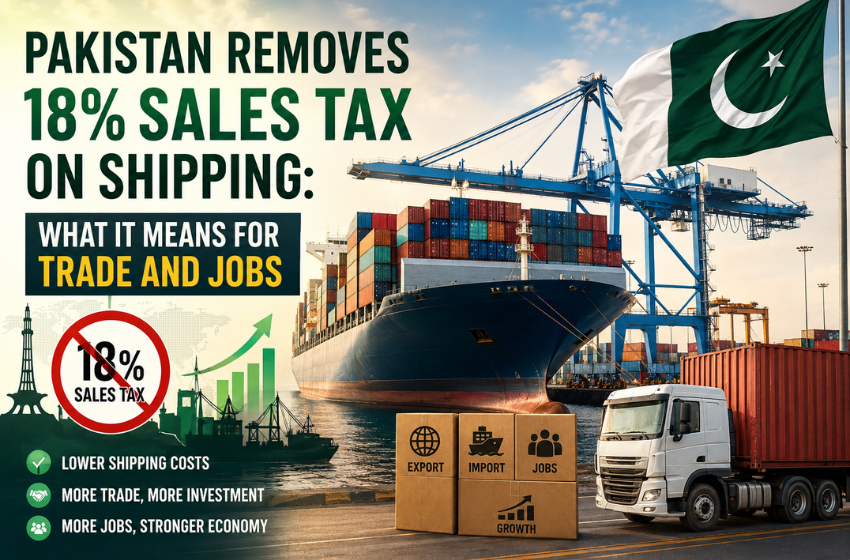
Pakistan Removes 18% Sales Tax on Shipping: What It Means for Trade and Jobs
The government of Pakistan has removed the 18% sales tax on the shipping industry. This tax was a direct cost burden on shipping companies, freight operators, and logistics businesses. With it gone, the cost of moving goods in and out of Pakistan gets cheaper.
Federal Minister for Maritime Affairs Muhammad Junaid Anwar Chaudhry announced this on June 13, 2026. He called it a historic relief for the maritime and logistics sector.
This is not a small change. The shipping sector drives imports and exports. When shipping costs fall, the price of goods can fall too.
Why This 18% Sales Tax Removal on Shipping in Pakistan Matters to You?
You may not think about shipping costs in your daily life. But they affect the price of almost everything you buy.
Imported medicines, electronics, food items, and raw materials all travel through Pakistan’s ports. When the tax on shipping goes up, those prices go up. When it comes down to it, businesses can pass the savings on to consumers.
This change is part of Budget 2026-27. It targets the maritime sector directly. That includes shipping companies, cargo operators, port service providers, and freight forwarders.
What Did the Minister Say about the Removal of 18% Tax?
Federal Minister Muhammad Junaid Anwar Chaudhry said the removal of this tax will create new investment opportunities in shipping. He said it will reduce both import and export costs.
He also said that growing the local shipping industry will create more jobs and benefit the national economy. The federal minister congratulated the business community on what he described as a historic tax relief.
The announcement came through News on June 13, 2026.
How Will This Affect Shipping Companies?
Shipping companies in Pakistan were paying 18% sales tax on their services. That is a high operating cost. When you add 18% to every transaction in a business built on thin margins, it pushes costs higher at every step.
Now that this tax is gone, shipping firms can:
- Reduce their service charges. With lower operating costs, companies can price their services more competitively.
- Attract more business. Lower costs make Pakistani shipping firms more attractive to international clients.
- Reinvest in growth. Money that was going to tax can now go toward fleet expansion, technology, and staff.
What About Import and Export Costs?
This is the part that matters for businesses across Pakistan.
When you export a product, you pay for packaging, production, and shipping. If shipping costs drop, your exported goods become more competitive in global markets. That is good for Pakistani exporters of textiles, food, and manufactured goods.
When you import raw materials or finished goods, lower shipping costs reduce your total landed cost. That means cheaper inputs for factories and, potentially, cheaper products for end consumers.
The government says this change directly reduces both import and export costs. That could encourage more trade volume through Pakistani ports.
Pakistan’s Maritime Sector: The Bigger Picture
Pakistan has two main ports: Karachi Port and Port Qasim. Most of the country’s trade moves through these two points.
The maritime sector has long been seen as an underdeveloped area of Pakistan’s economy. The country has a coastline of 1,046 kilometers. But it has not fully benefited from that geographic advantage.
High tax burdens have been one reason why investment in local shipping has been limited. Foreign shipping lines have dominated Pakistan’s import-export trade. Local operators have struggled to compete.
Removing the 18% sales tax is one step toward fixing that. It gives local shipping companies a fairer chance to compete.
Will This Create Jobs?
Yes. When an industry’s costs fall, it can grow faster. A growing shipping sector needs more workers: dock workers, logistics managers, truck drivers, freight agents, customs officials, and maritime engineers.
Pakistan’s youth unemployment is a serious challenge. Any policy that expands a capital-intensive sector like maritime logistics can create formal employment at scale.
The minister of maritime specifically mentioned that growth in the local shipping industry will increase employment opportunities. This was not a passing comment. It was a policy goal.
What Does This Mean for Budget 2026-27?
The government has given up a tax revenue stream. That is a trade-off.
But the bet is that a growing shipping sector will generate more economic activity, more corporate taxes, more employment income taxes, and more trade-related revenues than the 18% sales tax was bringing in.
This is called a supply-side tax cut. The idea is that by removing a barrier, you unlock more growth. That growth then generates more tax revenue through other channels.
Whether this bet pays off depends on how the industry responds. If shipping companies lower their prices and attract more business, the growth case holds. If costs stay high and profits just increase, the consumer benefit will be limited.