Saira Imran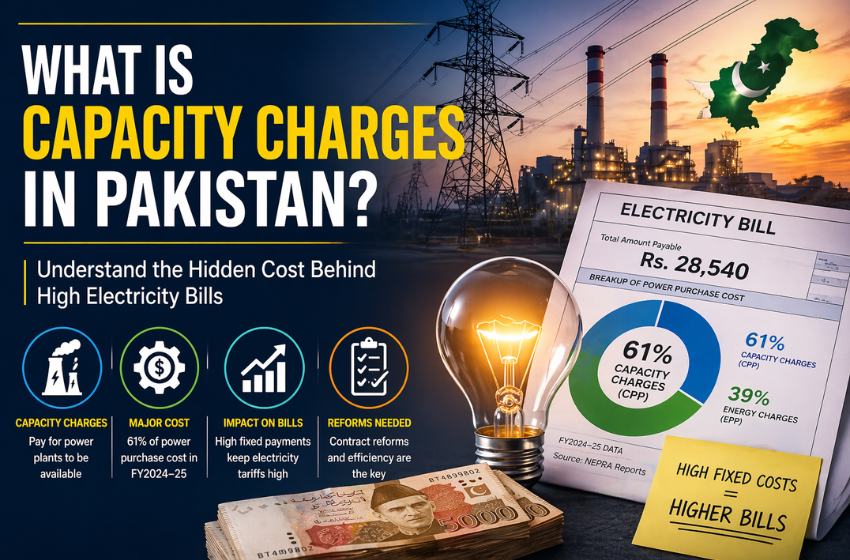
What are Capacity Charges in Pakistan? Full Simple Guide
What are capacity charges in Pakistan is a question many people ask when they look at rising electricity bills. Capacity charges are fixed payments to power producers simply for keeping generation capacity available, not just for actual electricity output.
In Pakistan, these “take-or-pay” contracts with Independent Power Producers (IPPs) have driven up consumers’ bills and ballooned circular debt. For FY2024–25, NEPRA reports total capacity payments of about Rs1.806 trillion (around Rs14.3/kWh), roughly 61% of the total power purchase cost.
Over 2019–2024, capacity payments exceeded Rs6 trillion (vs. ~Rs5 trillion in energy costs). Thermal plants ran at only ~42–46% of capacity (renewables at ~36–39%), meaning consumers paid for large amounts of unused capacity. The burden fell on tariffs, helping push Pakistan’s circular debt into the trillions. Tackling this issue involves contract renegotiation, boosting demand, and grid reforms.
This article explains what capacity charges are in Pakistan, outlines causes and impacts with recent data, and discusses reform options and outcomes.
What does a Capacity Charge Actually Mean?
What are Capacity Charges in Pakistan? In Pakistan’s power sector, capacity charges are payments made to keep power plants on standby, a kind of “availability fee” even if the plants don’t actually generate electricity. These fixed payments arise from long-term IPP contracts, many of which date back to the 1994 Power Policy, and include “take-or-pay” clauses.
Under such contracts, the government (through CPPA-G and K-Electric) must pay for a fixed fraction of a plant’s capacity every month. In effect, Pakistan pays for unused generation capacity. This system was meant to guarantee supply during shortages, but today it means consumers pay high fixed costs for underutilized plants.
Read Also: How to Reduce Electricity Bill in Pakistan
For example, in FY2024–25, Pakistan’s total power purchase cost (excluding Iran imports) was Rs2.943 trillion, of which 61% was capacity charges. The average Capacity Purchase Price (CPP) was Rs14.3 per kWh, versus Rs9.0/kWh for energy (fuel) costs. In absolute terms, capacity payments reached around Rs1.806 trillion that year. These figures are far higher than in past years. From FY2019–20 to FY2023–24, capacity payments jumped from Rs856 billion to Rs2,112 billion. This dramatic rise in capacity payments has made them one of the biggest drivers of Pakistan’s expensive power tariffs.
How Capacity Charges Work in Pakistan?
Under Pakistan’s standard power purchase agreements, particularly those signed during the 1990s and 2000s, power producers are paid in two ways:
- Capacity Purchase Price (CPP): A fixed payment for a portion of a plant’s installed capacity, regardless of output. It covers fixed costs and debt servicing.
- Energy Purchase Price (EPP): A variable payment based on actual electricity generated (covering fuel and variable operating costs).
Learn more from our guide on How Electricity Bills Work in Pakistan
Capacity charges act like a rental fee on a generator. Even if demand is low and a plant sits idle, Pakistan still pays a hefty capacity bill. These take-or-pay contracts were originally introduced to incentivize private investment (IPPs) and curb load shedding. But over time, growth in demand fell short of added capacity.
FPCCI documented: a 5% demand shortfall raises capacity charges by Rs1.40–1.80/unit; a 10% gap adds Rs3+/unit.
The result: Pakistan ended up with surplus generation capacity and low utilization. For instance, NEPRA’s latest report notes thermal plants ran at only about 42.5% of reference capacity in FY2024–25. Renewable plants (hydro, wind, solar) ran at roughly 36.6%. In FY2021–22, the situation was similar, with thermal utilization only 46% and hydel 39%. This means over half the capacity was unused, yet capacity payments were made on it. In turn, these fixed payments are baked into electricity tariffs.
Capacity Charges vs Energy Charges
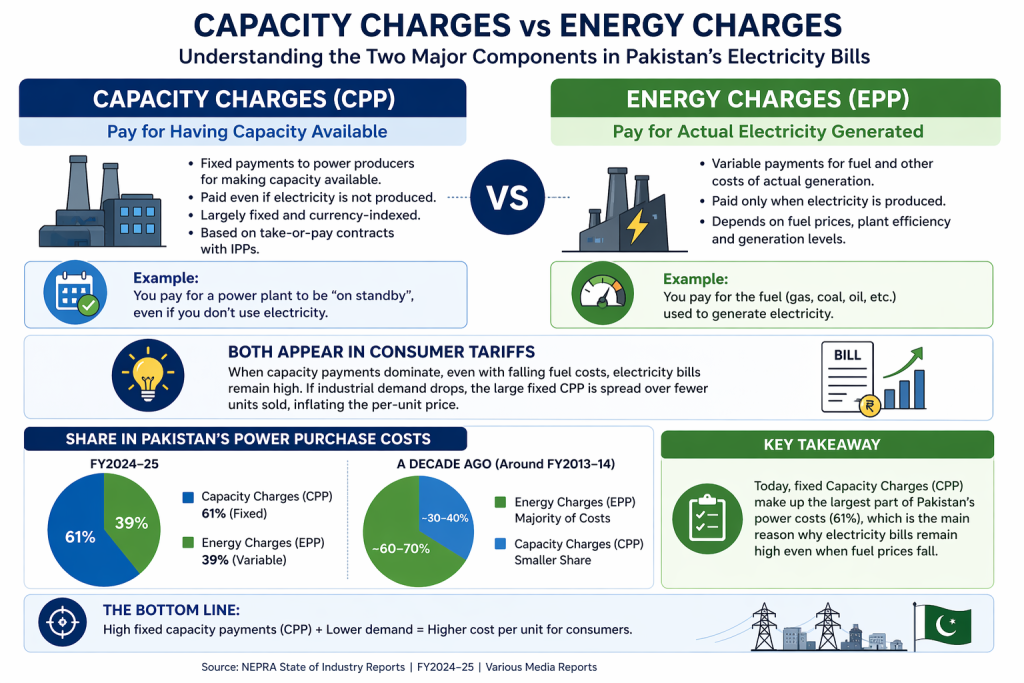
It’s important to distinguish capacity charges from energy (fuel) charges.
- Capacity charges (CPP) pay for having capacity available. They are fixed and largely currency-indexed.
- Energy charges (EPP) pay for the fuel and variable costs of actual generation.
Both appear in consumer tariffs. When capacity payments dominate (as now), even with falling fuel costs, bills stay high. For example, if industrial demand drops, the large fixed CPP is spread over fewer units sold, inflating the per-unit price. In FY2024–25, 61% of Pakistan’s purchase costs were fixed CPP versus 39% EPP. In contrast, a decade ago, EPP typically made up a majority of costs. (A study notes that in FY2022, energy was ~60% of tariff and CPP ~40%, shifting to ~50:50 by FY2023 and now roughly 2:1 in favor of CPP).
Why Capacity Charges Have Grown?
Several factors drove capacity payments higher:
- Expanding Capacity: Pakistan added many large power plants (coal, LNG, nuclear) since the 2000s. But demand growth was weak, so much capacity remains idle. New projects often came with high fixed charges. For example, “projects in FY23 with high debt repayment costs caused a 46% jump in capacity payments in FY24”.
- Take-or-Pay Clauses: Contracts guarantee payment for capacity. Even efficient plants (e.g., Thar coal, nuclear, local gas) are being underutilized but still paid for. Underutilization also causes loadshedding.
- Currency Depreciation: Capacity tariffs are usually US-dollar-linked. As the rupee fell, these payments swelled in rupee terms. NEPRA notes that indexed returns cause any PKR devaluation to raise IPP payouts.
- Fixed Rate of Return: Earlier policies offered IPPs 18–30% ROE in USD (down to 12% only in 2002). These high returns, protected by contracts, mean capacity charges include hefty profits.
- Inefficient Dispatch & Losses: Transmission constraints and distribution losses mean surplus plants sit idle. Costs of idle capacity still accumulate as CPP.
- Lack of Demand Growth: Industrial shift to captive solar and other inefficiencies means lower grid demand. Less power sold means fixed CPPs burden fewer units.
The net effect has been rising tariffs. The Dawn newspaper reported that two-thirds of consumer tariffs now come from capacity payments.
Capacity Charges, Tariffs, and Circular Debt
NEPRA introduced fixed per-connection charges for 28.5 million residential consumers, explicitly to recover stable funding for capacity payments. High-capacity payments directly hurt consumers’ bills and Pakistan’s finances:
- Tariff Pressure: With most costs fixed, tariffs can’t easily fall with fuel prices. Instead, monthly fuel adjustments still soared because cheaper domestic plants (nuclear, Thar coal) were idle while expensive RLNG, RFO, and imported coal ran. Households and businesses face high rates largely to cover fixed capacity costs for slab consumers.
- Circular Debt: Capacity payments are a major component of Pakistan’s circular debt. When tariffs are insufficient (due to subsidies or inefficiencies), payments to generators pile up unpaid. NEPRA and news sources link growing capacity costs to record circular debt levels (over Rs2.6 trillion by 2024). In fact, one analysis estimates Pakistan paid Rs6 trillion in capacity payments over FY2020–FY2024, versus Rs5 trillion in energy costs. Any unpaid balance adds to circular debt.
- Economic Competitiveness: High power costs weaken industry. As Business Recorder notes, excessive capacity charges (and cross-subsidies) contribute to “premature deindustrialization” and lower electricity demand.
Key Statistics
Capacity Payments (Last 5 FY): The table below summarizes capacity payments and related metrics.
| Period | Capacity payments | % of PPP | CPP per unit | Source |
|---|---|---|---|---|
| FY2019–20 | Rs856 bn | ~40% | — | Profit/NEPRA |
| FY2021–22 | Rs971 bn | ~40% | — | NEPRA |
| FY2023–24 | Rs2,112 bn | ~63% | Rs16.22/kWh | Dawn, NEPRA |
| FY2024–25 | Rs1,806 bn | 61% | Rs14.3/kWh | NEPRA PER report |
| CY2026 (approved) | Rs2,163 bn | 68% | Rs17.19/kWh | NEPRA Jan 2026 |
Notes: Capacity payments include IPPs and WAPDA plants. CPP% data for FY2023–24 is approximate (Profit reported CPP/EPP at ~67/33 projected). Thermal and renewable utilization are from NEPRA reports; only FY2021–22 and FY2024–25 values are publicly cited.
These figures illustrate how CPP dwarfed energy costs in recent years. The trend has been upward: capacity payments more than doubled from FY2021–22 to FY2023–24.
Why Capacity Charges Became So High?
Several structural factors caused capacity charges to escalate:
- Surplus Capacity: Overbuilding (44,943 MW installed vs. 15,000 MW base load) means many plants are idle.
- Economic Shocks: Currency devaluation and high interest rates increased debt servicing on projects.
- Late Project Costs: Newer coal and RLNG projects (post-2015) carry high fixed costs during debt repayment.
- Take-or-Pay Contracts: The contracts themselves force payment; Pakistan’s generation mix is “heavily skewed towards take-or-pay baseload plants”. There is no drop in CPP when usage is down.
All combined, the capacity obligation overwhelmed the system, as reports note high CPP due to under-utilization.
Read Also: Why Electricity Bills Are High in Pakistan
Capacity Charges in 2026: What Has Changed?
NEPRA has approved capacity charges at Rs17.19 per unit for 2026, which is 5.33% higher than the Rs16.32/unit projected for H1 FY2025-26, and the capacity share has risen from 63% to 68% of the total power purchase price.
Electricity consumers are expected to receive relief of Rs1.75 per unit over three months (June to August), due to Rs64 billion in savings mainly on account of lower capacity charges paid during Q1 2026 (January–March). This is breaking news (NEPRA hearing May 19)
A parliamentary committee this week directed NEPRA to conduct comprehensive investigations into IPP performance, capacity payments, energy payments, and extensions granted beyond their contractual timelines, with parliamentarians expressing concerns over alleged over-invoicing.
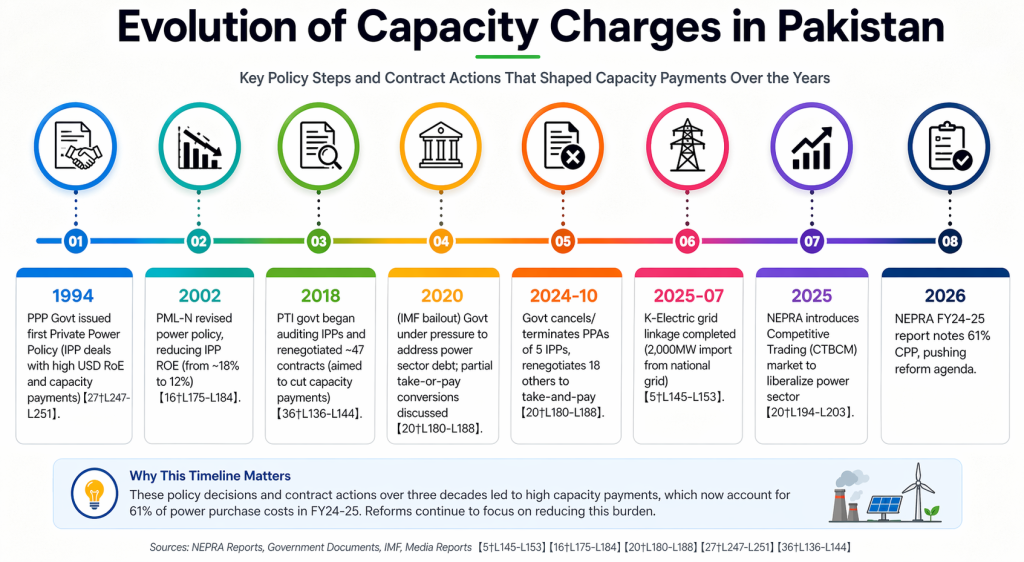
Government Action and Timeline
The image below highlights key policy steps and contract actions affecting capacity charges:
Reform Options to Reduce Capacity Costs
Experts and policymakers suggest multiple reforms:
- Renegotiating Contracts: Revising or terminating old IPP PPAs to lower fixed charges or shift to “take-and-pay” (pay only for energy). Recent moves include compensating selected IPPs to end contracts. This can trim future CPP.
- Boosting Demand: Stimulating industry and reducing cross-subsidies would increase units sold. More consumption helps spread fixed costs. (Currently, only ~28% of electricity goes to industry in Pakistan, far lower than global norms.)
- Grid & Distribution Reforms: Cutting transmission/distribution losses (currently >20%) and improving recovery ensures more revenue to cover payments. Inefficiencies in DISCOs have added hundreds of billions to the debt.
- Renewable Integration: Expanding low-cost renewable projects (solar, wind, domestic hydro) can reduce reliance on costly IPPs. However, renewables also have capacity payments unless restructured.
- Market Mechanisms: Rolling out wholesale electricity markets (CTBCM, competitive trading) could encourage competitive pricing and phase out guaranteed returns.
- Generation Mix Optimization: Prioritizing dispatch of cheap indigenous resources (nuclear, Thar coal, domestic gas) can lower EPP and free up expensive plants, indirectly easing the need for high CPP coverage.
In the short term, Pakistan faces a trade-off: running expensive plants boosts generation but raises fuel (energy) costs, whereas running cheap plants reduces EPP but does nothing to cut CPP. Long-term solutions require aligning capacity with demand and ensuring payments are tied to output.
Impacts on Industry and Debt
Rising capacity charges have hurt Pakistan’s economy:
- Circular Debt: The State Bank notes power sector liabilities soared in FY2023–25, partly from unsustainable capacity payments. Even when disbursed by budget measures, the underlying obligation remains. The COVID-era and IMF programs have pressured the govt to ultimately pass costs to consumers.
- Industrial Tariff: High CPP causes high tariffs (currently >$0.09/kWh for industry). This makes Pakistani goods less competitive. The stock of high fixed charges contributes to deindustrialization as manufacturers switch off grid power or relocate.
- Financial Strain: The government subsidizing or deferring payments crowds out other spending. It’s been noted that Pakistan repaid over Rs6 trillion of capacity payments (debt servicing) in 5 years. Debt-equity returns locked in contracts “exceed 70% in dollar terms” for some IPPs, a huge financial drain.
Without action, these pressures will continue. The NEPRA report warns that simply adding new capacity without cost evaluation will worsen the crisis.
What Happens Next?
Rapid rooftop solar growth is reducing grid demand, which shrinks units sold over which fixed capacity costs are spread — directly increasing per-unit charges. Prosumer Regulations 2026 (abolishing net metering) emerged partly from this dynamic.
Final Thoughts
What Capacity Charges in Pakistan are not just a technical question. It affects every electricity consumer. These charges are fixed payments for available power, even when that power is not fully used. That is why they have become a major reason behind expensive electricity, pressure on tariffs, and power sector debt.
With capacity payments reaching around Rs1.8 trillion and taking 61% of power purchase costs, the issue is too large to ignore. By analyzing “What are Capacity Charges in Pakistan,” we see it is more than just a billing term; it embodies decades of policy choices. Addressing it is crucial for cheaper, sustainable electricity and a healthier economy.
This guide was researched and written by the Saira Imran a Pakistan-based content writer contributing to AjjKiBaat. She specializes in creating clear, engaging, and research-driven articles that simplify complex topics for everyday readers. Our team cross-references every guide with official sources. Last Verified: May 2026
FAQs
Capacity charges are fixed payments made to power plants for staying available, even if they do not generate electricity.
Pakistani’s pay these indirectly through tariffs because Pakistan’s power purchase contracts include fixed capacity payments. Every unit billed includes a portion to cover these charges.
Fuel (energy) charges pay for the actual electricity produced (fuel costs). Capacity charges pay for holding capacity ready. So fuel charges vary with generation, but capacity charges are fixed under contract.
Yes. They raise the fixed portion of tariffs. When plants run under capacity, the cost per kWh goes up because consumers still pay for unused capacity. In Pakistan, capacity costs now form the majority of tariffs
Pakistan may reduce them through reforms, but removing them fully is difficult because of long-term contracts.