Saira Imran
Apophis Asteroid 2029 to Pass Close to Earth Safely
Apophis Asteroid 2029 is drawing global attention as scientists prepare for one of the rarest space events in modern history. A giant asteroid once linked with impact fears is expected to pass safely near Earth in April 2029. Experts say there is no immediate danger, but the event carries major scientific importance and has sparked both excitement and speculation worldwide.
Named after the ancient Egyptian god of chaos, Apophis has long captured public imagination. Early observations raised concerns years ago, but improved tracking has ruled out a collision. Now, researchers see this flyby as a historic opportunity rather than a threat.
What Is Apophis and Why Is It Important?
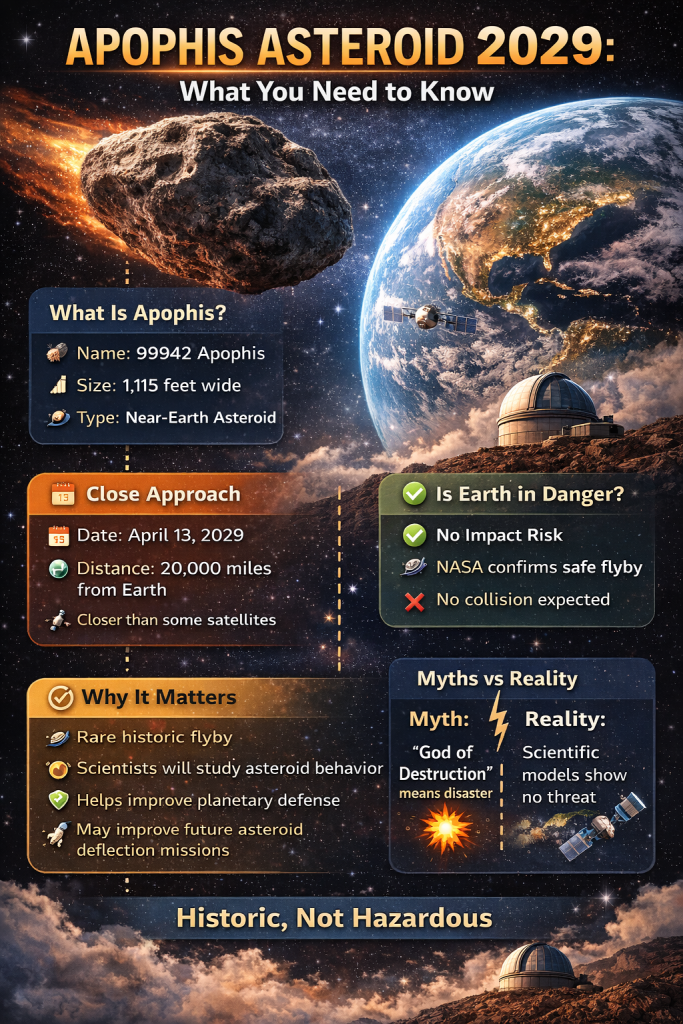
Apophis, also known as 99942 Apophis, is a near-Earth asteroid measuring about 1,115 feet across. That makes it large enough to attract serious scientific interest. Its size and unusual close approach make it different from many other asteroids that pass unnoticed.
Read Also: NavIC Satellite System Failure Hits India’s Space Program Hard
NASA says Apophis will come within nearly 20,000 miles of Earth. That distance is closer than some satellites orbiting in geosynchronous space. This makes the event extremely rare in recorded astronomical history.
Why Scientists Are Watching Closely?
Astronomers are not focused on impact risk. They are focused on science.
This close approach gives experts a rare chance to study how Earth’s gravity may affect an asteroid’s shape, surface, speed, and orbit. Such observations can improve future planetary defense strategies.
Scientists believe Earth’s gravitational pull may slightly alter Apophis during the flyby. That makes the event even more valuable for research.
NASA Says There Is No Impact Threat
Some social media posts have used dramatic terms like “God of Destruction” to create fear. However, experts have rejected those concerns.
The NASA asteroid flyby is expected to happen safely. Current tracking shows no collision with Earth in 2029.
This matters because Apophis was once considered a potential threat when first discovered in 2004. As observation technology improved, scientists refined its orbit and removed major impact concerns.
Why Earlier Concerns Changed?
Early calculations had uncertainty that is normal in astronomy when data is limited.
As telescopes collected more precise data, researchers gained a clearer picture of Apophis’ path. New calculations confirmed the asteroid would miss Earth safely.
This is a strong example of how science corrects early fears through evidence.
Why the 2029 Flyby Is Historic?
This is not just another asteroid passing by. It may become one of the most observed asteroid events in human history.
In many regions, people may even see Apophis without telescopes, depending on local visibility conditions. That alone makes it remarkable.
A Rare Opportunity for Global Science
Space agencies are preparing missions, observations, and studies linked to the event.
Researchers want to examine:
Surface composition: Scientists want to study what materials make up Apophis.
Orbital changes: They want to see whether Earth’s gravity shifts its path.
Planetary defense lessons: The event may improve future asteroid risk planning.
This is why many experts see the flyby as a scientific milestone.
Social Media Hype vs Scientific Reality
Apophis has sparked both fascination and superstition across social media, where speculation often spreads faster than scientific facts. Some users have linked Friday, April 13, 2029, to myths, doomsday theories, and dramatic predictions, while others have exaggerated the asteroid’s approach as a threat to Earth. However, science does not support these claims.
According to astronomers, the reality is far simpler and far less alarming. Apophis is a large asteroid that will pass unusually close to Earth, but it is not expected to strike the planet. Instead of posing danger, this rare flyby will provide valuable scientific data and give researchers a unique chance to study a near-Earth object up close. That is the real story behind the headlines.
Could Apophis Become a Future Risk?
.This question often comes up after every major asteroid report, especially when a large space object passes close to Earth. It is a reasonable concern, but current scientific models show no known impact threat from Apophis in 2029. Based on present calculations, the asteroid is expected to pass Earth safely.
Scientists are still tracking its future path beyond 2029, and that is standard practice for all major near-Earth objects. Researchers do not stop monitoring an asteroid simply because one flyby is considered safe. They continue studying its orbit to maintain accurate predictions over time.
Ongoing monitoring also helps experts detect even small orbital changes that could happen due to gravity or other space forces. This constant observation is an important part of planetary defense and helps scientists stay prepared for any long-term risks. That is how planetary defense works.
What This Means for Earth and Space Research?
This event highlights how much asteroid science has advanced over the years. In the past, such a close asteroid pass might have created major uncertainty and concern because tracking systems were far less precise.
Today, researchers can predict asteroid orbits with much greater accuracy, which improves global preparedness and reduces unnecessary fear. This progress also strengthens confidence in asteroid detection and monitoring systems used to track near-Earth objects.
Beyond observation, the Apophis flyby may also help improve future space missions designed to deflect hazardous asteroids if needed. In this way, the event is not just a rare astronomical moment, but also an important step forward for Earth’s planetary defense and space research efforts.
Public Interest in Asteroids Is Growing
Asteroid stories often attract attention because they combine science with the possibility of risk. People naturally want to know whether Earth faces any danger, especially when news about a large asteroid makes headlines.
At the same time, many people are curious about what exists in near-Earth space and how scientists track objects moving close to our planet. This growing interest often increases when a rare event like Apophis captures global attention.
Apophis brings both of these questions into focus. It raises public interest not only about safety, but also about astronomy, space missions, and planetary defense.
Its historic flyby may inspire more people to follow space research and understand how scientists monitor potential threats. That could become one of the lasting impacts of this event.
Final Thoughts
The 2029 passage of Apophis is shaping up to be a historic moment, not a disaster scenario. Scientists say the asteroid will pass Earth safely, while offering rare opportunities for research, observation, and public engagement.
Rather than fear the event, experts see it as a chance to learn more about near-Earth objects and improve future defense strategies. As attention grows, Apophis Asteroid 2029 remains one of the most closely watched space events of the decade.