Saira Imran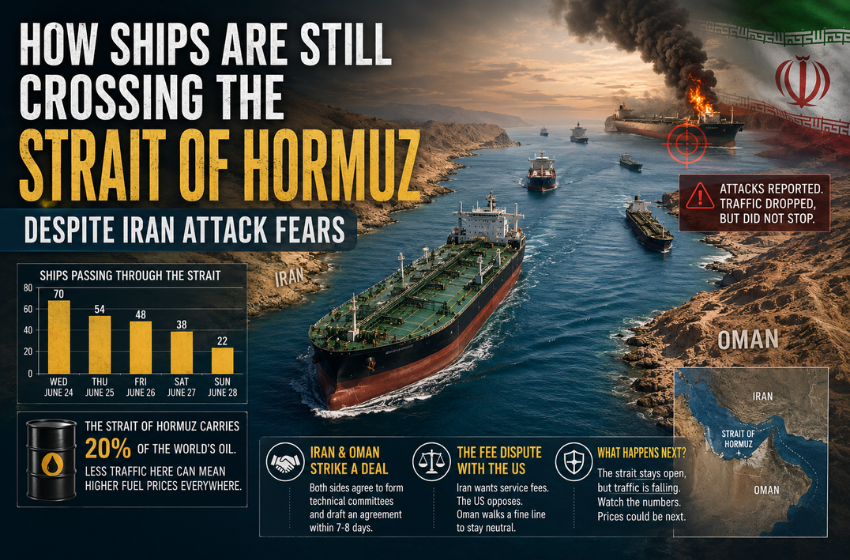
Strait of Hormuz Shipping Continues Despite Attacks
Marine Traffic, a company that tracks shipping worldwide, recorded 108 confirmed vessels passing through the Strait of Hormuz over three days. That’s despite two ships being attacked on Friday and Saturday. Iran and Oman have also agreed on a joint plan to manage the strait’s future.
Strait of Hormuz Shipping Continues Despite Attacks. Traffic dropped, but it did not stop.
That matters to you, even if you live nowhere near the Gulf. This narrow waterway carries a fifth of the world’s oil. Less traffic here can mean higher fuel prices everywhere else.
Why it matters?
The Strait of Hormuz sits between Iran and Oman. Oil tankers use it to reach the rest of the world. If ships stop moving through it, oil supplies tighten. Prices climb. Pakistan imports most of its fuel, so any slowdown here eventually hits petrol prices at home.
This is also a story about how fast normal life can shrink under pressure. Before the war between the US, Israel, and Iran began, around 130 to 140 ships passed through daily. That number has fallen by more than half.
What do the numbers show?
Marine Traffic broke down the daily count. Friday, June 26, saw 48 ships pass through, the highest of the three days. Saturday brought 38. Sunday dropped to 22.
The days before the attacks told a different story. Thursday, June 25, had 54 ships. Wednesday, June 24, had 70, the highest single-day count since the US and Israel went to war with Iran.
So traffic is falling, day by day. But it has not collapsed. Cargo is still moving. Tankers are still sailing.
Iran and Oman strike a deal
While ships keep crossing, something else happened behind the scenes. Iran and Oman held their first joint committee meeting on the strait’s future.
Iran’s deputy foreign minister, Kazem Gharibabadi, confirmed both countries reached an understanding. He told Iranian state media that Oman supports joining future arrangements for the waterway, given its own coastline along the strait. Oman, he said, also backs charging a fee for services provided in the area.
Technical committees will form soon. Experts from both sides plan to begin detailed talks within seven to eight days. Their goal is to draft an agreement and settle shipping routes.
The fee dispute with the US
This is where things get tense. Iran wants to charge new service fees on ships passing through the strait, working together with Oman. The United States opposes this plan.
Oman’s position has wobbled. Last week, Iran and Oman jointly said they were reviewing the costs of managing the strait. Oman later clarified there are no plans to charge a transit fee on ships.
Oman also announced a temporary maritime corridor near its coast, set up with United Nations support. The idea is to give ships a safer path while tensions stay high.
What happens next
Nobody knows yet how this ends. Iran wants control and compensation. The US wants free passage. Oman is caught between both, trying to stay neutral while protecting its waters.
For now, the strait stays open. Shipping in the Strait of Hormuz keeps moving, just fewer of them. Watch the daily ship count over the next week. If it keeps falling, expect oil prices to react first, and petrol prices at the pump to follow.