Muhammad Kaleem
What Is Freelancing? Your Complete 2026 Guide
If you’ve ever asked yourself what is freelancing and whether it could replace your 9-to-5, you’re not alone. I asked the same question before I landed my first client on Fiverr with nothing but a writing sample and a half-finished profile. That single project changed how I thought about work entirely. Millions of people around the world are at that same starting point right now, and this guide covers everything I wish I had known before I began.
This guide gives you everything in one place. You’ll learn how freelancing works, what the freelancer’s meaning really is, which skills pay the most in 2026, how much money you can realistically earn, and exactly how to get started.
What Is Freelancing? (The Simple Answer)
Freelancing is a type of self-employment where individuals sell their skills or services to multiple clients on a project or contract basis, without being permanently employed by any single company. Freelancers set their own rates, choose their own clients, and control their own schedule. Common freelance fields include writing, design, development, marketing, and consulting.
The word “freelance” originally described a medieval mercenary who sold his services to the highest bidder. Today, it describes over 1.57 billion workers worldwide who trade skills for income entirely on their own terms. In 2026, freelancing is no longer a fallback option — it’s a parallel economy that operates alongside traditional employment.
Freelancer Meaning: How It Differs from a Regular Job?
Understanding the freelancer’s meaning makes the whole model click. In a regular job, your employer owns your time. They set your schedule, assign your tasks, and cap your earnings with a fixed salary. They also handle your taxes, provide health benefits, and offer job security.
As a freelancer, you handle all of that yourself. You find clients, negotiate contracts, send invoices, and manage your own taxes. In exchange, you get complete control over your time, your income ceiling, and the kind of work you accept.
Freelancer vs Employee: Key Differences
| Factor | Employee | Freelancer |
|---|---|---|
| Income | Fixed salary | Variable, project-based |
| Schedule | Set by employer | Self-determined |
| Benefits | Health, pension, leave | Self-managed |
| Tax | Deducted automatically | Self-reported |
| Income ceiling | Limited | Unlimited |
| Job security | Higher | Variable |
Neither model is objectively better. The right choice depends entirely on your goals, risk tolerance, and lifestyle. As Hayden Brown, CEO of Upwork, put it in Upwork’s 2025 Future Workforce Report: ‘Independent professionals are no longer the alternative workforce; they are the workforce.’ What’s changed in 2026 is that more people have the tools, platforms, and market demand to make this model work even from zero.
How Freelance Work Actually Works?
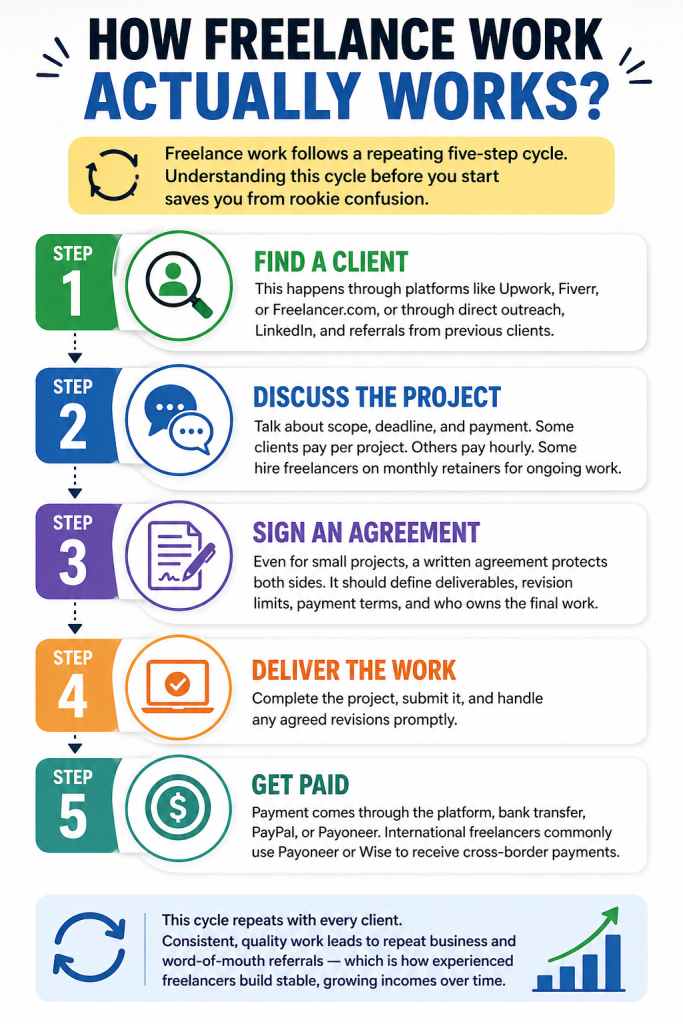
Freelance work follows a repeating five-step cycle. Understanding this cycle before you start saves you from rookie confusion.
Step 1: Find a client: This happens through platforms like Upwork, Fiverr, or Freelancer.com, or through direct outreach, LinkedIn, and referrals from previous clients.
Step 2: Discuss the project: Talk about scope, deadline, and payment. Some clients pay per project. Others pay hourly. Some hire freelancers on monthly retainers for ongoing work.
Step 3: Sign an agreement: Even for small projects, a written agreement protects both sides. It should define deliverables, revision limits, payment terms, and who owns the final work.
Step 4: Deliver the work: Complete the project, submit it, and handle any agreed revisions promptly.
Step 5: Get paid: Payment comes through the platform, bank transfer, PayPal, or Payoneer. International freelancers commonly use Payoneer or Wise to receive cross-border payments.
This cycle repeats with every client. Consistent, quality work leads to repeat business and word-of-mouth referrals — which is how experienced freelancers build stable, growing incomes over time.
The Real Numbers Behind Freelancing in 2026
Freelancing isn’t a side-hustle trend. The data proves a structural shift in how the global economy works, and the 2026 numbers are sharper than ever.
Global workforce data:
- 1.57 billion people worldwide now work as self-employed or freelance professionals, according to the International Labour Organization’s 2024 World Employment and Social Outlook report.
- 28% of skilled knowledge workers now operate as full freelancers or independent professionals, per Upwork’s Future Workforce Index (April 2026).
- 36% of full-time knowledge workers are actively considering switching to freelancing, from the same Upwork Future Workforce Index (April 2026).
US-specific numbers:
- 76.4 million Americans freelanced in 2024–2025, making up roughly 38% of the total workforce
- US freelancers contribute $1.27 trillion to the national economy, more than the GDP of many countries
- By 2027, Statista projects 86.5 million Americans will be freelancing, crossing the 50% mark
Income and earnings data:
Here is freelancers’ income and earnings data:
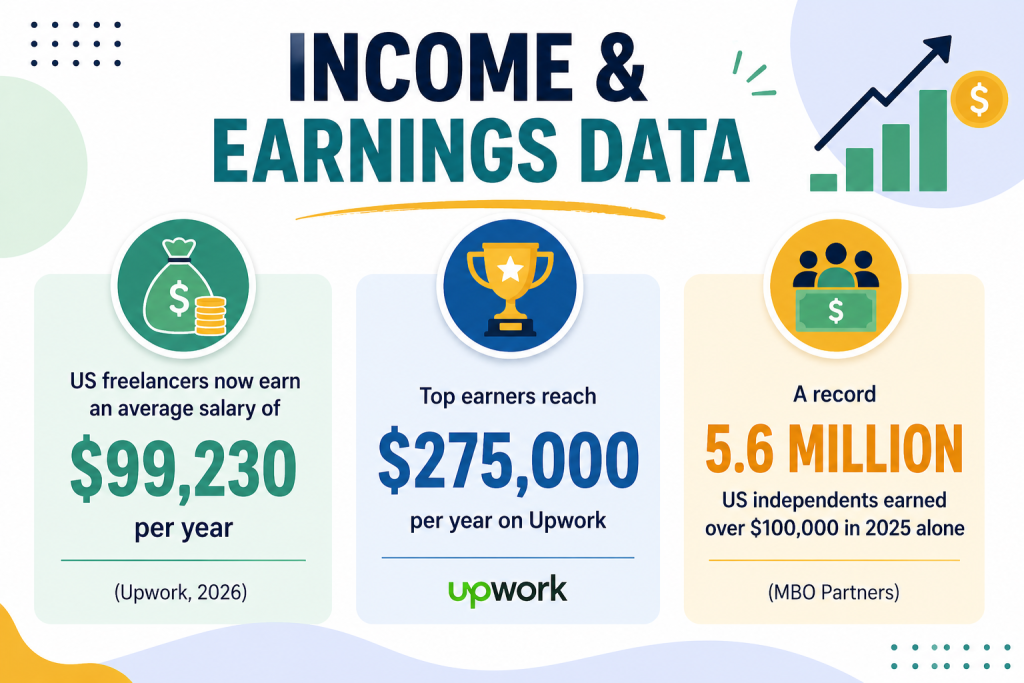
- US freelancers now earn an average salary of $99,230 per year (Upwork, 2026)
- Top earners reach $275,000 per year on Upwork
- A record 5.6 million US independents earned over $100,000 in 2025 alone (MBO Partners)
Hiring demand:
- 69% of employers hired freelancers after the 2023–2024 layoff wave
- Over 99% of employers plan to continue hiring freelancers in 2026 (Fiverr)
- 68% of companies globally now hire freelancers regularly, up from just 48% in 2020
These numbers show that companies actively choose freelancers over full-time hires. The demand is real, structural, and growing every year.
Top In-Demand Freelancing Skills in 2026
Not every skill earns equally. The market rewards specialization. Here are the skills with the strongest demand and earning potential right now.
High-Earning Technical Skills
AI and prompt engineering lead everything. Demand for AI-related freelance skills on Upwork grew 109% year-over-year in 2026. AI video work alone surged 329%, becoming the fastest-growing category on the entire platform. Expert AI freelancers now earn up to $220 per hour, according to Upwork’s Q1 2026 Skill Index.
Machine learning engineers earn between $50–$200 per hour on freelancing platforms. They build models, train algorithms, and solve data problems companies can’t solve in-house.
Cybersecurity consulting pays $40–$90 per hour. As more businesses move operations online, the demand for freelance security experts accelerates fast.
Web and software development leads Upwork with 34% of all platform activity. React, Python, and Node.js developers consistently attract the highest-paying long-term clients.
Data analysis and data science remain a premium category. Data analysis accounts for 14.2% of the most valued technical skills among freelance clients globally.
Creative and Communication Skills
Copywriting and SEO content writing account for 18% of Upwork activity. Writers who understand search intent, conversion, and audience psychology earn significantly more than generalists.
Graphic design brand identities, logos, and social media graphics maintain steady, consistent demand across every industry.
Video editing continues to grow as brands compete for attention on YouTube Shorts, Instagram Reels, and TikTok. Short-form content specialists are especially sought-after.
Digital marketing, covering SEO, paid ads, email sequences, and social media strategy, ranks among the top services clients search for month after month.
Entry-Level Skills for Beginners
Virtual assistance gives new freelancers a fast, low-barrier entry point. Managing emails, calendars, and data entry requires no specialized technical training.
Bookkeeping stays in constant demand because small businesses always need help tracking their money. Even basic skills here command reliable rates.
If you’re just starting, pick one skill and go deep on it before expanding. Depth beats breadth every single time.
How Much Can Freelancers Actually Earn in 2026?
Earnings vary based on your skill, experience, niche, and the quality of clients you attract. Here’s what the latest data shows.
- US freelancers now earn an average of $99,230 per year (Upwork, 2026)
- Top earners on Upwork reach up to $275,000 per year
- Machine learning engineers earn $50–$200 per hour
- Business consultants earn $28–$98 per hour
- Cybersecurity developers earn $40–$90 per hour
- Freelancers who use AI tools earn approximately 40% more per hour than those who don’t (Upwork)
- 60% of people who switched from full-time employment to freelancing report higher earnings afterward
Your income grows as your reputation builds and you raise your rates strategically. Most experienced freelancers don’t accept whatever clients offer — they set their price, communicate their value, and attract clients willing to pay it.
Benefits of Freelancing
Here are some benefits of freelancing:
You Control Your Time
You work when you’re most productive. Prefer late nights? Work then. Have children at home? Structure your day around them. Nobody else decides your calendar.
You Can Work from Anywhere
A laptop and a reliable internet connection are all you need. Freelancers work from home offices, co-working spaces, coffee shops, and countries they once only dreamed of visiting.
Your Income Has No Ceiling
A salaried employee waits for annual reviews and modest raises. A freelancer raises rates, attracts better clients, and scales income on their own timeline.
You Reduce Dependence on One Employer
With multiple clients, losing one doesn’t mean losing everything. Your income doesn’t collapse when one client moves on.
You Learn Faster
Working across different industries, projects, and client types sharpens your skills far faster than staying inside a single company ever could. In 2026, that cross-industry exposure also makes you more resilient against automation.
Challenges of Freelancing and How to Handle Them?
Freelancing has real downsides. Knowing them in advance means you can prepare before they hit.
Income inconsistency hits hardest in the beginning, and it hits harder than most guides admit. According to MBO Partners’ 2025 State of Independence report, 63% of first-year freelancers describe irregular income as their number one stressor. Some months overflow with work; others go completely quiet. I kept a separate savings account from my very first freelance payment specifically because of this. Save three to six months of living expenses before going full-time freelance, and keep marketing yourself even when your calendar looks full.
No automatic benefits means health insurance, retirement savings, and paid time off come entirely out of your own pocket. Factor those costs into your rates from day one, or you’ll consistently underprice yourself.
Client acquisition takes real effort, especially early on. Most beginners underestimate how long it takes to land consistent, well-paying work. Patience, combined with persistent daily outreach, solves this over time.
Self-discipline becomes non-negotiable. Without a manager setting expectations, procrastination creeps in easily. Treat your freelancing like a business because that is exactly what it is.
Isolation is real. Around 74% of freelancers report occasional burnout, but those who regularly connect with peers and communities experience it far less (Millo, 2026). Join freelancer communities online or local co-working spaces to stay connected.
How to Start Freelancing: Step by Step
How to start freelancing is the question most beginners overcomplicate. I have gone through this process myself and watched dozens of new freelancers make the same early mistakes, most of which cost them months they didn’t need to lose. The honest answer, after all of that experience, is this: start before you feel perfectly ready.
Here is how to start freelancing step by step:
Step 1: Choose One Skill
Pick something you already know or can learn quickly. Don’t offer five services. One focused, specific skill wins more clients than five vague ones.
Step 2: Build a Portfolio Without Client Work
You don’t need paying clients to show your abilities. Create three to five sample projects. Writers publish articles on Medium or their own blog. Designers create mock brand identities for imaginary companies. Developers build small apps and put them on GitHub. Three solid samples beat zero every time.
Step 3: Set Your Rates Strategically
Research what freelancers in your niche charge on Upwork and Fiverr. Start slightly below the market average while you collect your first reviews, then raise rates after five to ten successful projects.
Step 4: Create Complete Platform Profiles
Open accounts on Upwork, Fiverr, or both. Fill every section of your profile. Use keywords that your target clients actually search for. Your profile is your storefront — treat it that way.
Step 5: Send Personalized Proposals Every Day
Don’t wait for clients to find you. Apply to projects consistently. Personalize every single proposal. Show the client you understand their specific problem, not just that you can do work in general. In 2026, clients can spot a copy-paste proposal instantly.
Step 6: Deliver Well, Earn Reviews, Repeat
Every completed project earns you a chance to ask for a review. Reviews build trust. Trust attracts better clients. Better clients pay higher rates and come back again.
Freelancing for Beginners: 5 Mistakes That Kill Early Careers
Freelancing for beginners looks straightforward from the outside. Most new freelancers, however, make the same avoidable mistakes that cost them months of progress.
- Underpricing to win work: Charging too little attracts difficult clients and breeds resentment. Know your minimum acceptable rate and hold to it from day one.
- Working without a contract: A simple one-page agreement protects you from scope creep, unlimited revisions, and non-payment. Never skip it, even for small projects.
- Ignoring taxes: You now pay your own taxes. Set aside 20–30% of every payment and speak with a local tax advisor early in your freelance journey.
- Joining every platform at once: Spreading yourself thin, earns less than committing fully to one. Master Upwork or Fiverr before joining five others.
- Stopping outreach when busy: When work floods in, new freelancers stop sending proposals. Then work dries up, and they start over. Maintain steady daily outreach regardless of your current workload.
AI and the Future of Freelancing in 2026
AI has not killed freelancing. It has raised the stakes for skilled, specialized talent and opened entirely new income categories.
Demand for AI-related freelance skills on Upwork grew 109% year-over-year. AI video work surged 329%. Expert AI freelancers, those who build workflows, train prompts, and automate business processes, now earn up to $220 per hour. Freelancers who use AI tools of any kind earn approximately 40% more per hour than those who don’t.
At the same time, basic and repetitive work faces real pressure. Simple data entry, generic translation, and commodity writing have declined significantly on major platforms as AI handles more of that volume.
The freelancers winning in 2026 combine human judgment, creativity, and strong client relationships with AI speed and efficiency. If you start freelancing today, building basic AI literacy alongside your core skill gives you a measurable, immediate competitive advantage.
Final Thoughts
What is freelancing at its most essential? It’s a decision to take ownership of your work, your income, and your time.
The 2026 numbers validate that decision more clearly than ever. Over 1.57 billion people already work this way. US freelancers average nearly $100,000 per year. AI-enabled specialists earn up to $220 per hour. Employer demand keeps rising, with 99% of companies planning to hire freelancers this year.
But statistics don’t build a freelancing career. Your first proposal, your first delivered project, and your first five-star review do.
Pick your skill. Build your portfolio. Send your first proposal today. The only bad time to start is later.
“This article was written by Muhammad Kaleem, an experienced SEO content writer and digital marketing specialist with strong expertise in freelancing. He specializes in SEO content writing, keyword research, content strategy, and helping individuals and businesses grow through effective freelance and online income strategies. Last updated on April, 2026.”
FAQs
These are the top questions people search for alongside “what is freelancing.”
The major difference is that in a regular job, one employer pays you a fixed salary, controls your schedule, and provides benefits like health insurance. In freelancing, you work for multiple clients on your own terms, set your own rates, and manage your own taxes and benefits. Freelancing gives more freedom but requires more self-discipline and financial responsibility.
Yes, freelancing is a strong career choice in 2026. The US freelance market now averages $99,230 per year in earnings, and 99% of employers actively plan to hire freelancers. Specialized skills in AI, development, and marketing command premium rates. It suits people who value autonomy, can handle income variability, and commit to consistent skill growth.
Freelancers receive payment through platform escrow systems (Upwork, Fiverr), direct bank transfers, PayPal, or international tools like Payoneer and Wise. Payment structures include hourly rates, fixed prices per project, and milestone-based payments released as work progresses. Always confirm payment terms in writing before starting any project to avoid disputes.
Yes. Beginners start by building a portfolio of sample projects — not client work — to demonstrate their skill. Three strong samples are enough to compete on major platforms. Most beginners who send personalized daily proposals consistently land their first client within two to four weeks, even with zero prior paid experience.
Most freelancers work between four and eight hours per day, depending on their workload and goals. Full-time freelancers average around 43 hours per week — similar to traditional employees — but with full control over when those hours happen. Part-time freelancers work 10 to 20 hours per week alongside other commitments.