Saira Imran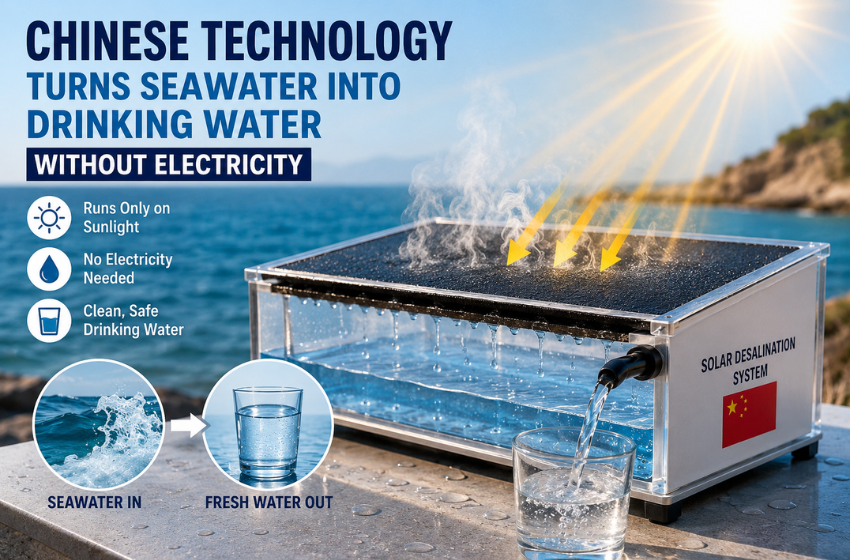
Chinese Seawater Desalination Technology
Fresh water is becoming one of the world’s biggest challenges. Many countries struggle with water shortages while seawater covers most of the planet. Researchers in China have developed a Chinese seawater desalination technology that converts salty seawater into fresh drinking water without using electricity. Instead, the system runs only on sunlight.
The breakthrough has attracted worldwide attention because it could provide clean water at a much lower cost. Researchers even believe that, after long-term use, the cost of producing drinking water could become lower than bottled water.
What is Chinese Seawater Desalination Technology?
Chinese scientists have created a solar-powered desalination system that turns seawater into fresh drinking water without electricity.
The system uses a new material that captures sunlight and converts it into heat. That heat evaporates seawater and removes the salt naturally. Tests showed the system worked continuously for one year using only sunlight.
If the technology is expanded, it could provide affordable clean water in many parts of the world.
Why This Technology Matters
Around the world, millions of people still do not have reliable access to safe drinking water.
Many dry regions receive plenty of sunlight but have limited electricity and weak energy infrastructure. Traditional desalination plants are expensive because they need large amounts of electricity.
This new Chinese seawater desalination technology could solve both problems.
Instead of depending on power plants, it uses natural sunlight. That makes it cheaper, cleaner, and easier to use in remote areas.
If commercial production becomes successful, it may help communities that struggle with water shortages every year.
What Chinese Scientists Developed?
According to reports, Chinese researchers designed a new solar-powered desalination system that works entirely without electricity.
The system was developed using an advanced photothermal material.
This material captures sunlight very efficiently and converts it into heat. The heat then evaporates seawater. As the water turns into vapor, the salt remains behind. The vapor later becomes clean fresh water through condensation.
Unlike traditional desalination systems, this method does not require external electricity, fuel, or connection to the national power grid.
That makes the technology both energy efficient and environmentally friendly.
How the New System Works
The process is surprisingly simple.
- First, sunlight falls onto the specially designed material.
- The material absorbs solar energy and converts it into heat.
- The heat causes seawater to evaporate.
- During evaporation, salt and other impurities stay behind.
- Finally, the clean water vapor cools and turns into fresh drinking water.
Since the entire process depends only on sunlight, operating costs remain very low.
Researchers say this approach could become especially useful in sunny coastal regions.
The Secret Behind the Breakthrough
The biggest innovation is the newly developed photothermal material. Scientists created it by weaving nanoparticles into a three-dimensional structure. This design greatly improves the material’s ability to capture sunlight.
During testing, the material achieved a 90.2 percent sunlight absorption rate.
Researchers also found that it required 45.7 percent less energy to evaporate the same amount of seawater compared with conventional methods.
Higher efficiency means more fresh water can be produced using the same amount of sunlight. That could significantly lower production costs in the future.
One Year of Successful Testing
Laboratory results are important, but real-world testing matters even more. Researchers built a working prototype and placed it outdoors.
The system continued operating for an entire year. Throughout the testing period, it did not require electricity, fuel, or any outside energy source.
Instead, it relied completely on natural sunlight.
This long-term performance suggests that the technology may be practical outside laboratory conditions.
More testing will still be needed before large-scale commercial deployment.
It Also Helped Grow Crops
Scientists also tested the system in agriculture. Fresh water produced by the desalination unit was used to irrigate farmland. The system successfully supplied water to nearly five square meters of agricultural land during an entire growing season.
This result shows that the technology may support farming in dry coastal regions where fresh water is limited. Agriculture consumes a large share of the world’s fresh water supply. Affordable desalination could help farmers reduce water shortages while improving crop production.
Could Drinking Water Become Cheaper Than Bottled Water?
One of the most interesting claims from the research team involves production costs.
Scientists estimate that if the system operates continuously for around two years, the cost of producing clean drinking water could become lower than bottled water.
As production increases and more systems are built, costs could fall even further.
While these estimates still need confirmation through commercial deployment, the possibility has generated significant interest. Lower water costs could benefit both households and governments.
What Makes This Technology Different?
Many desalination plants already exist around the world. However, they usually require expensive equipment and consume large amounts of electricity.
This new system offers several advantages, such as:
- works without electricity.
- runs only on sunlight.
- reduces energy consumption
- lowers operating costs.
- can work in remote areas.
- produces clean drinking water.
- supports farming with fresh water.
- reduces environmental impact.
These features could make it attractive for developing countries facing water shortages.
Could Pakistan Benefit From This Technology?
Pakistan faces increasing water challenges.
Many regions experience water shortages during the summer months. Population growth and climate change continue to increase pressure on existing water resources.
Pakistan also has a long coastline that provides access to seawater.
If solar-powered desalination technology becomes commercially available and affordable, coastal communities could benefit from it in the future.
Large-scale adoption would still require investment, infrastructure, and local testing.
At this stage, the Chinese project remains a research breakthrough rather than a widely available commercial solution.
What Happens Next?
The research has shown promising results, but commercialization will take time. Scientists will likely continue improving efficiency and reducing manufacturing costs.
Governments and private companies may also explore partnerships to scale the technology. If successful, solar-powered desalination could become an important part of future water security strategies around the world.
For countries with abundant sunshine and limited fresh water, this technology offers real promise.
Final Thoughts
Chinese seawater desalination technology has shown that clean drinking water can be produced using only sunlight without electricity.
The successful one-year outdoor test and improved energy efficiency make this development one of the most interesting clean water innovations in recent years.
Although more work is needed before widespread adoption, the technology has the potential to lower water production costs, support agriculture, and improve access to safe drinking water for millions of people.
If future large-scale projects deliver similar results, solar-powered desalination could become an important solution for countries facing growing water shortages.