Saira Imran
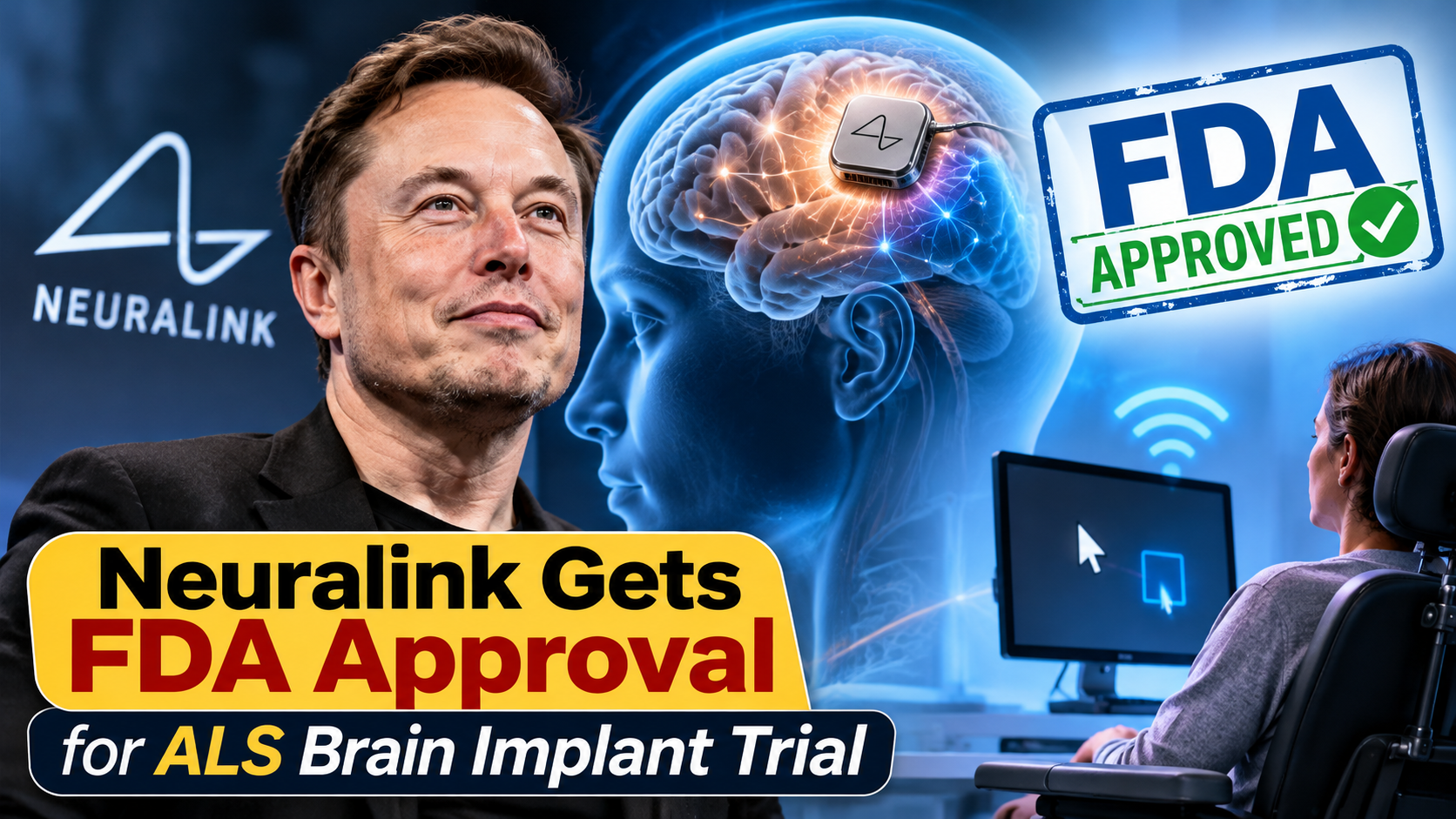
Neuralink FDA Approval for ALS Brain Implant Trial
Elon Musk’s brain technology company, Neuralink, has received approval from the US Food and Drug Administration (FDA) to begin an important clinical trial of its brain implant in people with severe paralysis caused by ALS.
The study will test whether the company’s brain-computer technology can help people control computers and other digital devices using their thoughts. It will also examine the safety and long-term performance of the implant.
Neuralink announced the approval on November 25, 2026. The company has named the research programme the LINK Pivotal Study. It is the first pivotal clinical trial in the United States for an implantable brain-computer interface, according to Neuralink.
How Neuralink’s Brain Implant Works
Neuralink has developed a brain-computer interface (BCI) that reads signals from the brain and converts them into commands for digital devices.
The system uses a small implant called the N1. Doctors place it inside the skull, while thin electrode threads extend into the brain. These threads collect brain signals linked to a person’s intended movements.
Special software then reads these signals and converts them into instructions. This allows a person with paralysis to control a computer without using their hands.
For example, a participant may be able to move a computer cursor or select items on a screen by thinking about the movement.
The technology focuses on the brain area responsible for planning body movements. It aims to give people with severe physical disabilities another way to communicate and use digital devices.
New Trial Will Focus on ALS Patients
The LINK Pivotal Study will focus on people with severe paralysis caused by amyotrophic lateral sclerosis (ALS).
ALS is a progressive disease that damages nerve cells responsible for controlling voluntary muscles. As the disease advances, patients may lose the ability to walk, move their arms, speak, or perform everyday activities.
Neuralink wants to find out whether its brain implant can help these patients regain some control over digital devices.
Researchers will also examine how safely the implant works over a longer period. The study will take place at multiple clinical centres to collect information about its safety and reliability.
The main goal is to understand whether patients can use the technology to perform everyday digital tasks more independently.
More Than 30 People Have Already Received the Implant
Neuralink says its new trial builds on earlier studies in the United States, Canada and the United Kingdom.
According to the company, more than 30 people have received its brain implant through these early research programmes. Participants have collectively used the technology for thousands of hours.
The company says some participants have used the implant to communicate with family members, continue their education and play video games.
These early studies have helped Neuralink collect information about how people use the technology in everyday situations.
The LINK Pivotal Study will now examine its performance in a larger clinical research programme focused on people with ALS.
Registration Opens for the New Study
Neuralink has opened registration for the LINK Pivotal Study. People with ALS may be eligible to take part in the research.
However, the company has not yet shared the total number of participants it plans to enrol. It has also not announced the expected study duration or the names of all participating medical centres.
The FDA approval allows Neuralink to conduct this clinical trial. It does not mean the brain implant has received approval for general medical use or commercial sale.
The company will need to collect and present clinical evidence about the device’s safety and effectiveness before it can move towards wider medical use.
Neuralink Is Working on Other Brain Technologies
The company is also researching other ways to connect the human brain with computers and physical devices.
Earlier this week, Neuralink received a patent from the US Patent and Trademark Office for a brain-computer interface that uses living neurons to transfer signals between the brain and an electronic device.
The patent describes a possible alternative to the company’s current electrode-based system. However, the early experiments related to this technology were conducted on mice, not humans.
Neuralink is also conducting several other clinical studies.
Its PRIME study examines the safety of the N1 implant and the R1 surgical robot used to place it inside the brain. Another programme, called CONVOY, looks at whether people can use their implants to control physical assistive devices, including robotic arms.
The company is also working on the VOICE study in collaboration with UT Southwestern Medical Center in Dallas, Texas. This research aims to find out whether brain signals can help people with severe speech difficulties communicate through written messages or computer-generated speech.
In addition, Neuralink is developing Blindsight, a technology designed to help people with vision loss. The device received the FDA’s Breakthrough Device Designation in September 2024.
The new FDA approval gives Neuralink permission to move ahead with its important ALS trial. The results will help determine whether its brain-computer interface can provide a safe and reliable way for people with severe paralysis to control digital devices.