Saira Imran
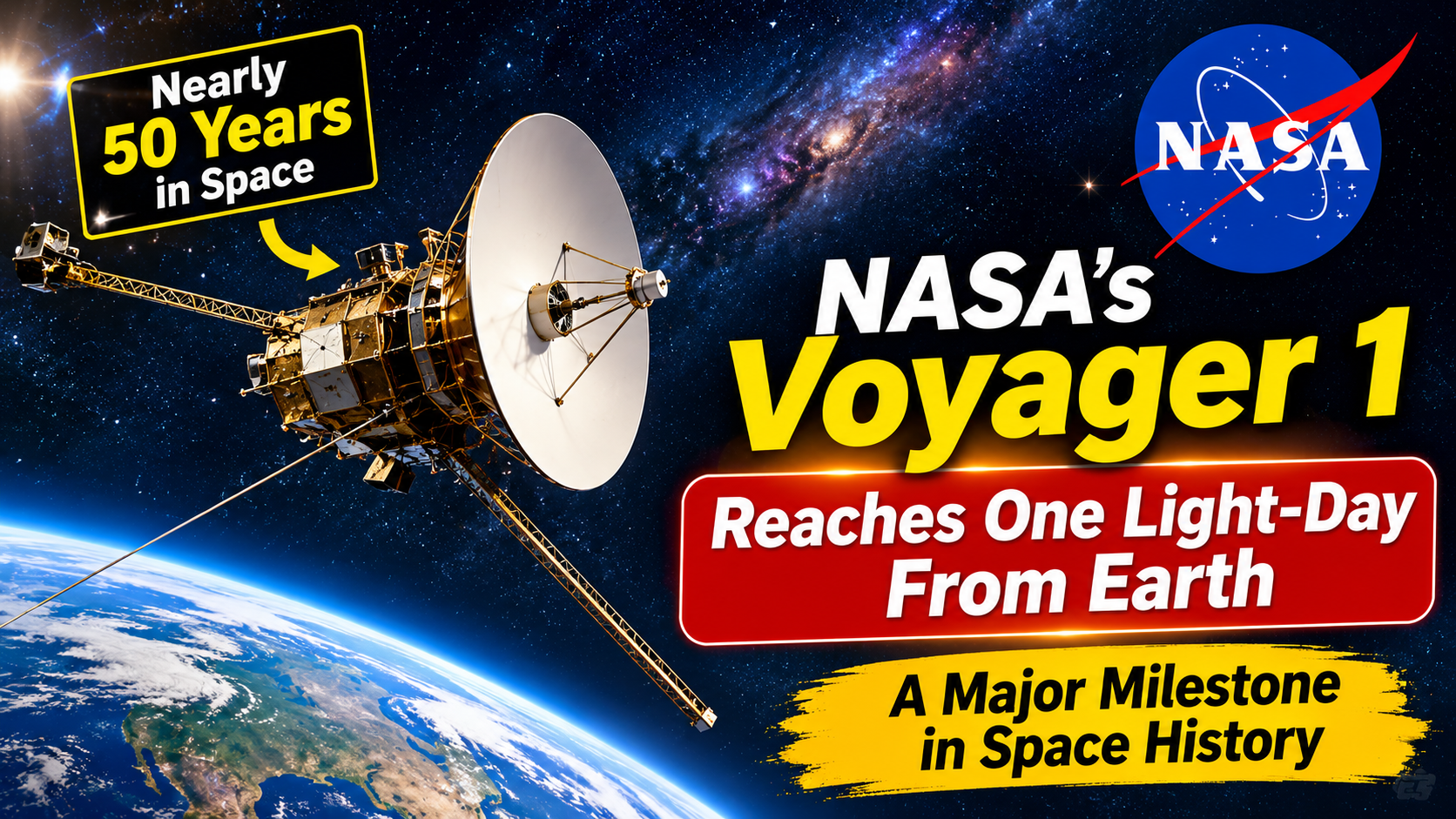
NASA’s Voyager 1 Reaches One Light-Day From Earth
NASA’s Voyager 1 has reached a distance of one light-day from Earth, setting a new record for human space exploration. The spacecraft crossed this milestone on November 18, 2026, after travelling through space for nearly 50 years.
Voyager 1 is now about 16.1 billion miles (25.9 billion kilometres) away from Earth. No other human-made object has ever travelled this far.
A light-day is the distance light travels in 24 hours. Since light moves at around 186,000 miles per second, this distance equals more than 16 billion miles.
The milestone also means that radio signals now take about 24 hours to reach Voyager 1. Any response from the spacecraft needs another 24 hours to return to Earth. This creates a two-day communication cycle between NASA and the distant probe.
Voyager 1 Reaches a Historic Distance
NASA launched Voyager 1 on September 5, 1977. Its original mission focused on studying the outer planets of our solar system, including Jupiter and Saturn.
The spacecraft used the planets’ gravity to travel farther into space. During its journey, it sent back detailed images and scientific information about these distant worlds.
Voyager 1 later continued towards the edge of the solar system. In 2012, it crossed the heliosphere, the region influenced by the Sun’s solar wind and magnetic field. It then entered interstellar space, the area between stars.
Voyager 1 remains the most distant human-made object from Earth. It travels at around 38,000 miles per hour and continues to move farther away.
Source: Science.nasa.gov
NASA Faces a Communication Problem
The spacecraft reached the one-light-day distance, but NASA is also dealing with a technical problem.
On November 14, the mission team noticed that Voyager 1 had stopped sending scientific and engineering data. A Deep Space Network antenna in Canberra, Australia, received a carrier signal from the spacecraft but no usable data.
NASA said the carrier signal shows that Voyager 1 can still point its antenna towards Earth and transmit a signal. This suggests that its communication equipment and attitude control system remain operational.
However, engineers suspect a problem with the onboard computer that collects information from the spacecraft’s systems and prepares it for transmission.
NASA plans to confirm the one-light-day milestone using the carrier signal and the spacecraft’s known flight path. The agency scheduled this confirmation for November 19, after allowing time for the signal to reach Earth.
Engineers are still investigating the data problem. The distance between Earth and Voyager 1 makes repairs and troubleshooting difficult. Every command takes about a day to reach the spacecraft, and its response takes another day to return.
Why Is Voyager 1 Still Working After Nearly 50 Years?
Voyager 1 was originally designed for a much shorter mission. Yet, it has continued working for almost five decades.
The spacecraft gets electricity from radioisotope thermoelectric generators. These systems convert heat from the natural decay of plutonium-238 into electrical power.
The power supply loses strength over time. NASA has therefore switched off several instruments and other systems to save energy.
The spacecraft no longer uses its cameras for regular observations. Its remaining scientific instruments help researchers study magnetic fields and plasma waves in interstellar space.
Despite its age, Voyager 1 continues to provide information that scientists cannot easily collect from Earth.
What Is the Difference Between Voyager 1 and Voyager 2?
NASA launched two Voyager spacecraft in 1977. Voyager 1 and Voyager 2 followed different paths through the outer solar system.
Voyager 1 studied Jupiter and Saturn before heading towards interstellar space. Voyager 2 visited Jupiter, Saturn, Uranus and Neptune. It remains the only spacecraft to have visited Uranus and Neptune.
Both probes have now entered interstellar space. They continue to send information about the region beyond the Sun’s protective bubble.
Voyager 2 is closer to Earth than its twin. NASA estimates that it will reach the one-light-day distance in 2035, although its remaining power will limit how long it can continue sending data.
What Does This Achievement Mean for Space Research?
Voyager 1’s latest milestone gives scientists another chance to study the vast distances between objects in space.
The spacecraft has travelled for nearly 50 years to reach a distance that light covers in just one day. This comparison shows how slowly even fast-moving spacecraft travel across the enormous distances of space.
Its instruments also help researchers study gas, dust, magnetic fields, and other material between stars. These measurements give scientists information about interstellar space that they cannot collect through observations from Earth alone.
Voyager 1 and Voyager 2 also carry golden records. These gold-plated discs contain sounds and images that represent life and culture on Earth. NASA designed them as messages for any possible extraterrestrial life that might find the spacecraft.
Voyager 1’s one-light-day milestone marks another chapter in a mission that has lasted far beyond its original plan. Engineers will continue working to keep the spacecraft operational and receive its data for as long as possible.