Saira Imran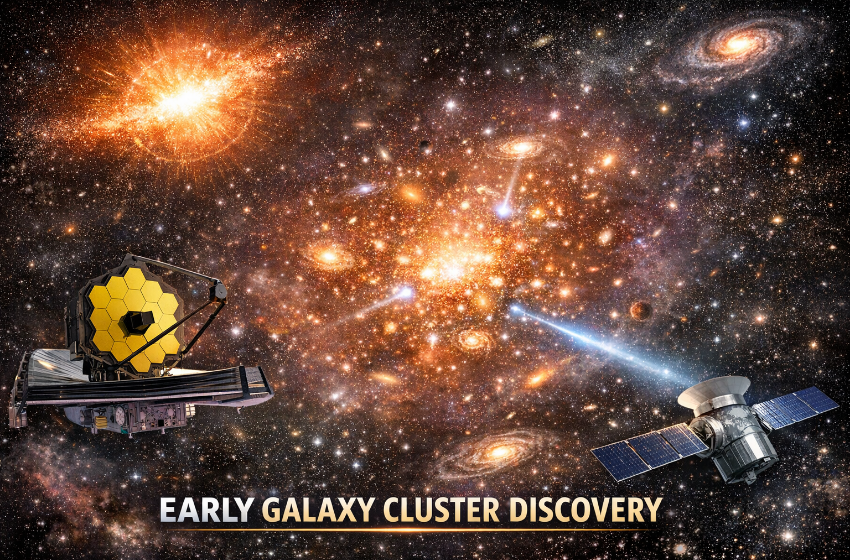
Early Galaxy Cluster Discovery Challenges Big Bang Theory
Early galaxy cluster discovery has surprised scientists and changed how they understand the early universe. NASA’s James Webb Space Telescope and Chandra X-ray Observatory made the observations. These findings force experts to rethink long-held ideas about how the universe formed.
Researchers say the universe grew much faster after the Big Bang than earlier estimates suggested. Galaxies and massive cosmic structures appeared earlier than expected. This discovery may reshape scientific understanding of cosmic evolution and the birth of the universe.
Scientists found that a group of galaxies formed much sooner after the Big Bang than previously believed. Evidence shows that this cluster existed about one billion years after the Big Bang. The universe began around 13.8 billion years ago.
The research team observed an emerging galaxy cluster with at least 66 possible galaxies. The total mass equals nearly 20 trillion suns. Scientists consider galaxy clusters the largest structures in the universe. Experts believed such clusters needed much more time to form in the early universe. Our Milky Way also belongs to a galaxy cluster.
Read Also: NASA Black Hole Image Shows Clearest View Ever Captured
Astrophysicist Akos Bogdan from the Harvard & Smithsonian Center for Astrophysics led the study published in Nature. He explained that a galaxy cluster contains hundreds to thousands of galaxies. These galaxies sit inside an extremely hot gas halo. The temperature reaches millions of degrees.
Dark matter holds this system together. Dark matter does not emit or reflect light. It makes up about 85% of all matter in the universe. Normal matter, such as stars and planets, forms the remaining portion. Scientists detect dark matter through its strong gravitational effects.
The team noted that this cluster showed signs of maturity when the universe had only 7% of its current age. This finding surprised scientists. Researchers named it an “early cluster.” It showed key features of mature clusters, including a hot gas halo and strong X-ray emissions.
Most scientific models did not predict such advanced development at this early stage. Earlier, scientists believed the oldest known structures of this type formed about three billion years after the Big Bang. This early galaxy cluster discovery now challenges those models and opens new debates about how fast the universe evolved.